

FHWA 1608 at a glance
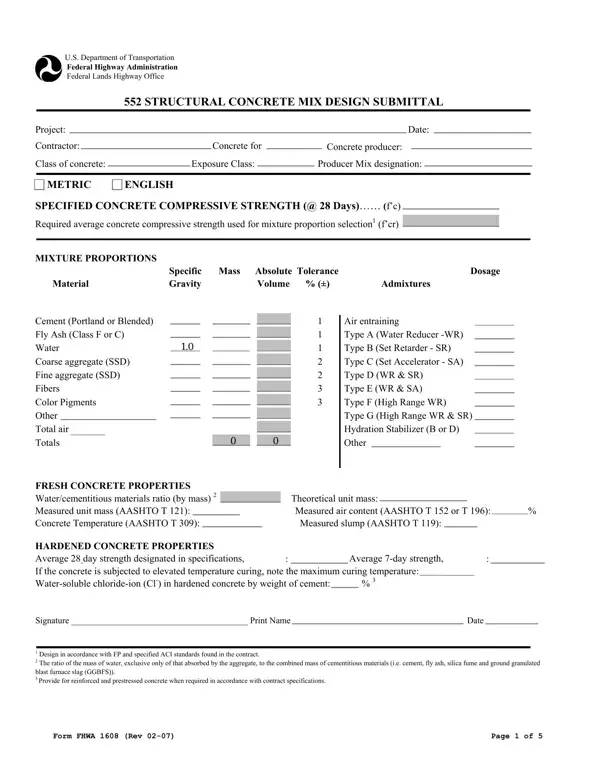
What it is: Form FHWA 1608 is the 552 STRUCTURAL CONCRETE MIX DESIGN SUBMITTAL of the U.S. Department of Transportation, Federal Highway Administration Federal Lands Highway Office.
Who signs: SIGN with the Signature, the Print Name and the Date.
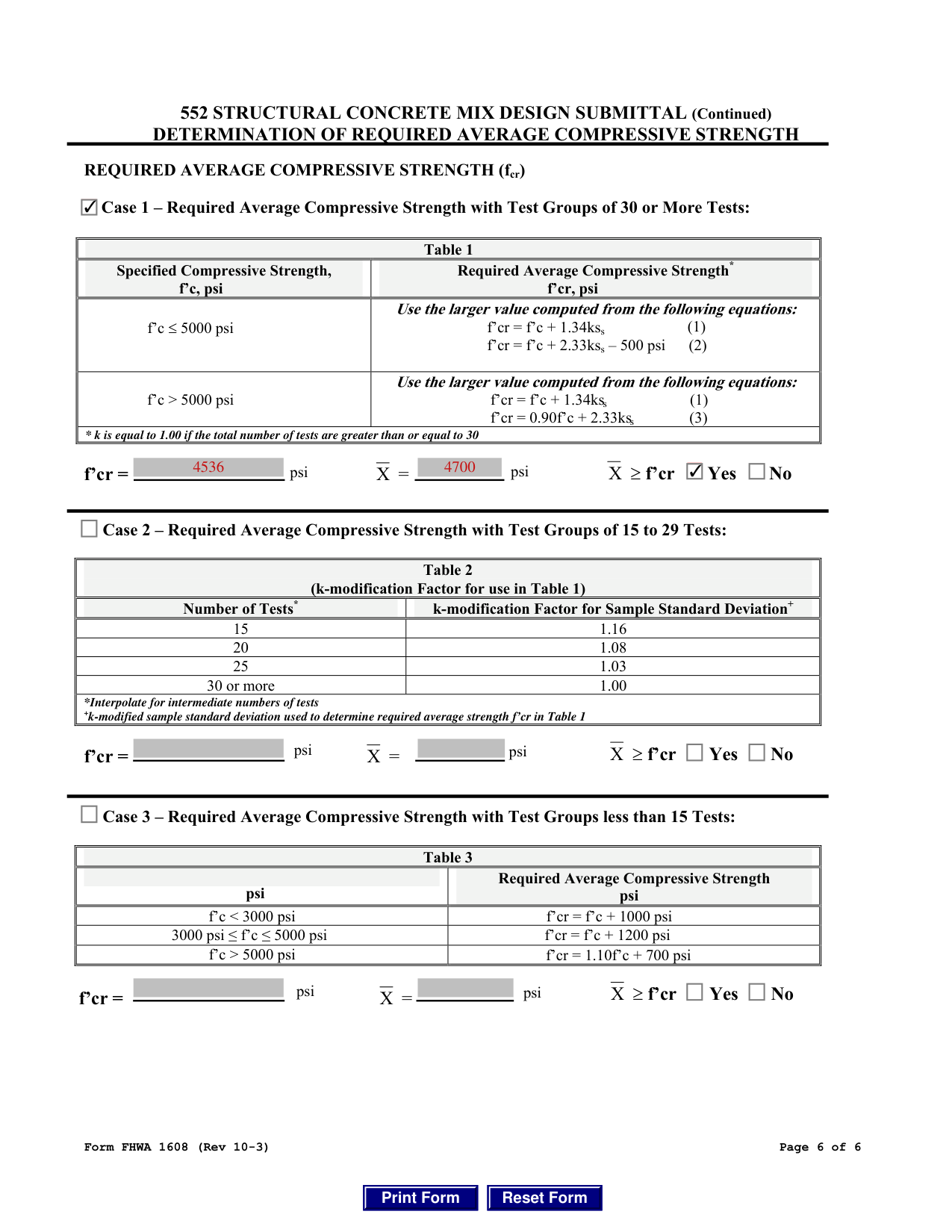
A filled-in FHWA 1608 example: an engineer finds the required average strength for 30 tests
How to fill out FHWA 1608, box by box
Specified compressive strength and required average compressive strength
Enter the SPECIFIED CONCRETE COMPRESSIVE STRENGTH (@ 28 Days) (f'c) in psi.
Enter the required average concrete compressive strength used for mixture proportion selection1 (f'cr) in psi. 1 Design in accordance with FP and specified ACI standards found in the contract.
MIXTURE PROPORTIONS
In MIXTURE PROPORTIONS, enter for each Material its Specific Gravity, its Mass in lb/yd3, its Absolute Volume in ft3 and its Tolerance % (±).
Materials listed: Cement (Portland or Blended), Water, Coarse aggregate 1 (SSD), Fine aggregate (SSD), Total air and the Theoretical unit mass.
For Admixtures, enter the Dosage in fl oz/yd3. Do not enter oz/cwt. Admixtures listed: Air entraining and Hydration Stabilizer (B or D).
FRESH CONCRETE PROPERTIES
Enter the Water/cementitious materials ratio (by mass) 2: 2 The ratio of the mass of water, exclusive only of that absorbed by the aggregate, to the combined mass of cementitious materials (i.e. cement, fly ash, silica fume and ground granulated blast furnace slag (GGBFS)).
Enter the Measured unit mass (AASHTO T 121) in lb/ft3, the Measured air content (AASHTO T 152 or T 196) in % and the Measured slump (AASHTO T 119) in in.
HARDENED CONCRETE PROPERTIES
If the concrete is subjected to elevated temperature curing, note the maximum curing temperature in °F.
Enter the Water-soluble chloride-ion (Cl-) in hardened concrete by weight of cement in %. Provide for prestressed concrete.
Signature, Print Name and Date
SIGN with the Signature, the Print Name and the Date.
Certification attached
Mark Certification attached Yes or No for CEMENT (AASHTO M 85 OR AASHTO M 240), FLY ASH (AASHTO M 295 - CLASS C, For N), SILICA FUME (AASHTO M 307 - RAW, SLURRIED OR DENSIFIED), GROUND GRANULATED BLAST FURNACE SLAG (GGBFS) (AASHTO M 302 - GRADE 100 or 120), HIGH REACTIVITY POZZOLANS (AASHTO M 321) and OTHER.
4 Certifications documentation is required prior to approval of a mix design.
WATER (AASHTO M 157 AND AASHTO T 26)
For WATER (AASHTO M 157 AND AASHTO T 26), mark Yes or No for Reclaimed water or water of questionable quality will be used?
Mark Yes or No for Will water be added at the discharge site? and for Will water be withheld at the batch plant? If yes, enter how much in lbs/yd3.
CHEMICAL, COLOR PIGMENTS, FIBERS AND OTHER ADMIXTURES
In Chemical, color pigments, fibers and other admixtures, mark Yes or No for each Admixture Type under Certification Attached. 6 Each point where admixture is added must be noted (i.e. concrete batching facilities, project site, etc) as well as the corresponding dosage.
For Type B - Hydration Stabilizing (AASHTO M 194) and Type D - Hydration Stabilizing (AASHTO M 194), enter the hours, marked Yes or No.
5 Admixtures must be compatible and of the same type as those used in the mixtures from which strength data were obtained.
Do not use chloride accelerators. Do not use set accelerating admixtures with Class P (Prestressed Concrete).
COARSE AGGREGATE
For COARSE AGGREGATE (FP SECTION 703.02 AND AASHTO M 80, CLASS A), enter the Name and phone number of coarse aggregate supplier/producer, the Grading number (AASHTO M43), the Location of material source and the Material type.
Under Sieve Analysis: (AASHTO T 27), enter each Sieve Size and its Percent Passing with the AASHTO M 43 Specification.
Enter a Value for each Property with its Specification: (1) Clay lumps and friable particles AASHTO T 112 2.0% max; (2) Deleterious chert AASHTO T 113 3.0% max; (3) ∑ (1) + (2) AASHTO T 112 & T 113 3.0% max; (4) Minus No. 200 AASHTO T 11 1.0 or 1.5% max; (5) Coal and lignite AASHTO T 113 0.5% max; (6) LA abrasion AASHTO T 96 40% max; (7) Sodium sulfate soundness, 5 cycles AASHTO T 104 12% max; (8) Mass of insoluble residue (bridge decks or surface courses) ASTM D 3042 25% min; (9) Bulk specific gravity AASHTO T 85.
FINE AGGREGATE
For FINE AGGREGATE (FP SECTION 703.01 AND AASHTO M 6, CLASS B), enter the Name and phone number of fine aggregate supplier/producer and the Location of material source.
Enter a Value for each Property with its Specification: (1) Clay lumps and friable particles AASHTO T 112 3.0% max; (2) Coal and lignite AASHTO T 113 1.0% max; (3) Minus No. 200 AASHTO T 11 3.0% max. Also enter: (4) Organic Impurities AASHTO T 21 Color not darker than standard, Yes or No; (5) Sodium sulfate soundness, 5 cycles AASHTO T 104 10% max; (6) Sand Equivalent AASHTO T 176 75% min; (7) Bulk specific gravity AASHTO T 84.
DATA FOR COMPUTING THE STANDARD DEVIATION
Under data for computing the standard deviation, based on Section 4 of ACI 301, mark the Cylinder Size, 6 by 12-Inch or 4 by 8-Inch.
For 1 Test Group or 2 Test Groups, enter for each Consecutive Strength Test the Date Batched and the Compressive Strength at 28 days in psi for Cylinder 1 and Cylinder 2.
9 The test results must be less than 12 months old from date of submittal.
A test result consists of a minimum of three 4x8 cylinders tested or a minimum of two 6x12 cylinders tested from a load of concrete sampled according to ASTM C172. All test results must also represent materials, quality control procedures, and conditions similar to those expected for the proposed work.
A group of test results must be from a single project without a break in production of more than 3 months and groups shall not consist of fewer than 10 tests. Changes in materials and proportions within the test records must not be more restricted than those for proposed work. In addition, they must represent concrete produced to meet a specified strength f'c.
10 When an acceptable record of field tests is not available, concrete proportions shall be established from trial mixtures according ACI 301 4.2.3.4 (c). Submit documentation of test results, trial mixtures and determination of compressive strength that meets f'cr. Pending 28-day strength results, a mix design may be approved on the basis that 7-day compressive strength results are at least 85 percent of the required average strength (f'cr) at 28 days.
Case 1 - Required Average Compressive Strength with Test Groups of 30 or More Tests
For Case 1, with f'c ≤ 5000 psi, use the larger value computed from the following equations: (1) f'cr = f'c + 1.34kss and (2) f'cr = f'c + 2.33kss - 500 psi.
For Case 1, with f'c > 5000 psi, use the larger value computed from the following equations: (1) f'cr = f'c + 1.34kss and (3) f'cr = 0.90f'c + 2.33kss. k is equal to 1.00 if the total number of tests are greater than or equal to 30.
For Case 1, mark Yes or No for X ≥ f'cr and enter f'cr and X in psi.
Case 2 - Required Average Compressive Strength with Test Groups of 15 to 29 Tests
For Case 2, use Table 2 (k-modification Factor for use in Table 1): Number of Tests 15 is 1.16, 20 is 1.08, 25 is 1.03 and 30 or more is 1.00. Interpolate for intermediate numbers of tests. The k-modified sample standard deviation is used to determine required average strength f'cr in Table 1.
For Case 2, mark Yes or No for X ≥ f'cr and enter f'cr and X in psi.
Case 3 - Required Average Compressive Strength with Test Groups less than 15 Tests
For Case 3, Table 3, Required Average Compressive Strength: f'c < 3000 psi f'cr = f'c + 1000 psi; 3000 psi ≤ f'c ≤ 5000 psi f'cr = f'c + 1200 psi; f'c > 5000 psi f'cr = 1.10f'c + 700 psi.
For Case 3, mark Yes or No for X ≥ f'cr and enter f'cr and X in psi.
Sources
[1] Form FHWA 1608 (95-100), 552 Structural Concrete Mix Design Submittal, U.S. Department of Transportation, Federal Highway Administration (the Official source link on this page).