
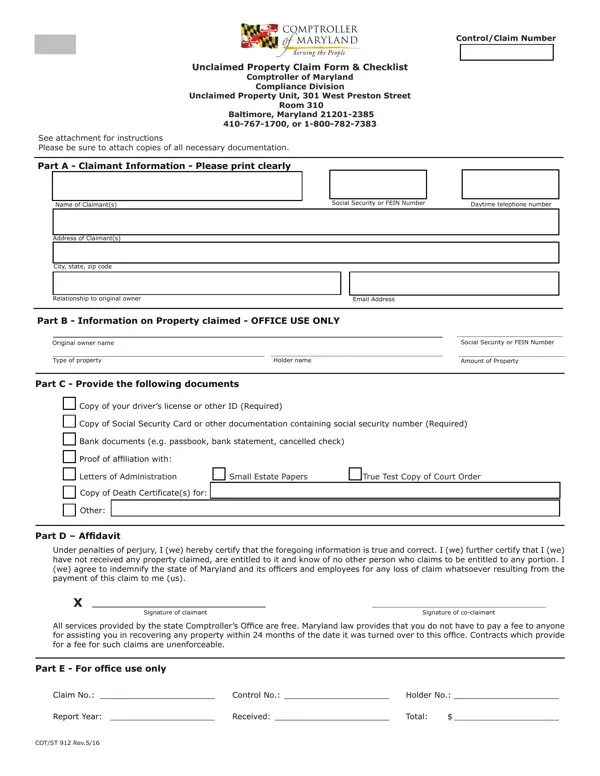

Unclaimed Property Claim Form & Checklist at a glance
What it is: Unclaimed Property Claim Form & Checklist, from Comptroller Brooke E. Lierman.
Where and when to file: Claims should be submitted online via www.claimitmd.gov.
All claimants must establish entitlement to the property sought by providing proof of ownership to the funds.
What to bring and attach to Unclaimed Property Claim Form & Checklist
Please provide legible copies of all documentation unless originals are specifically requested by the Unclaimed Property Division.
A filled-in Unclaimed Property Claim Form & Checklist example: an individual claims unclaimed property
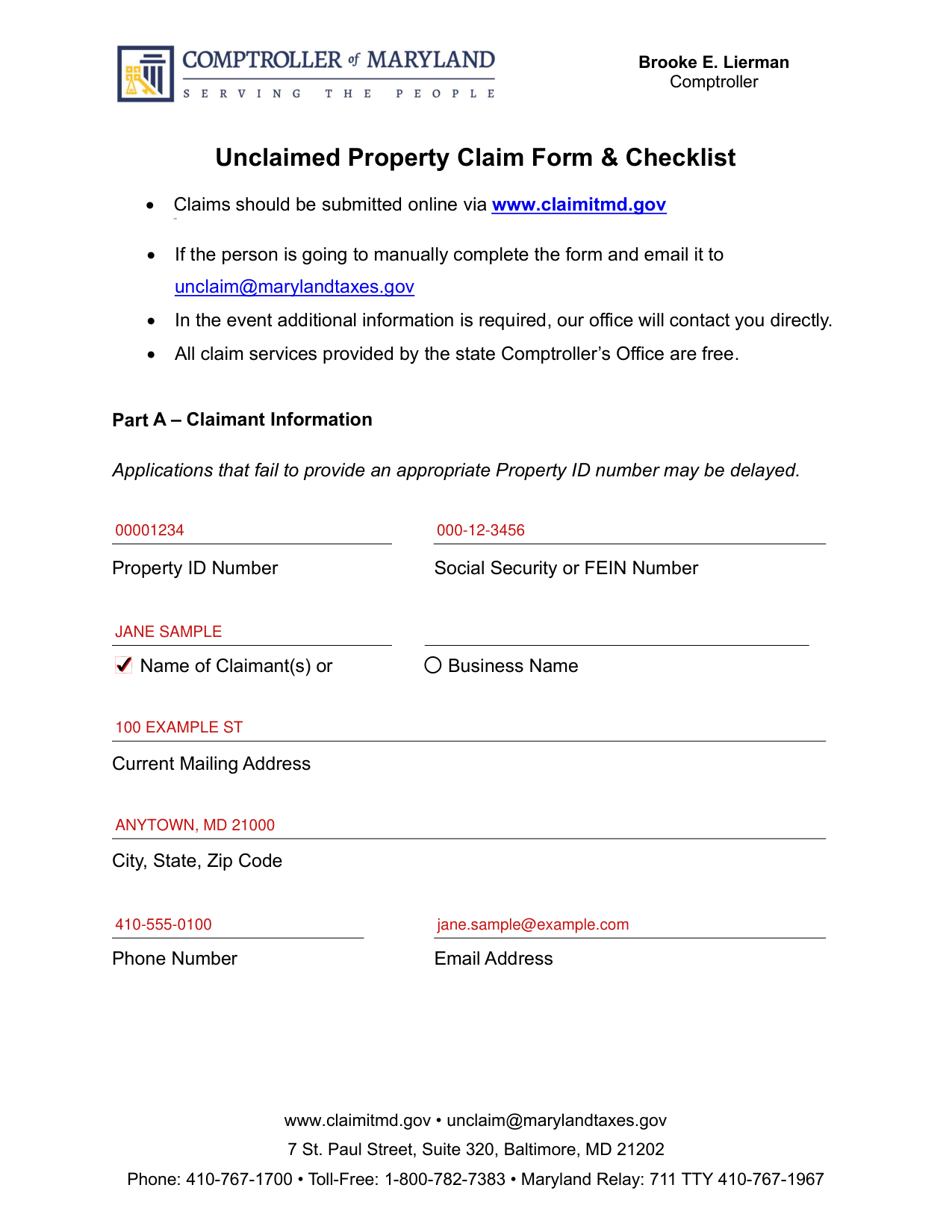
How to fill out Unclaimed Property Claim Form & Checklist, box by box
Part A - Claimant Information
In Part A - Claimant Information, enter the Property ID Number, Social Security or FEIN Number, Name of Claimant(s) or Business Name, Current Mailing Address, City, State, Zip Code, Phone Number and Email Address.
Applications that fail to provide an appropriate Property ID number may be delayed.
Part B - Documentation Checklist
Part B - Documentation Checklist: verification of ownership typically involves either address or social security confirmation, though certain situations may require additional verification methods.
Additional Documentation to Support the Request: provide information such as proof of address, ownership, or proof of authorization to claim the funds.
Government-issued ID Copy
Government-issued ID: copy of your driver's license, copy of your state-issued ID card, copy of your passport, copy of your military ID or Other. Please ensure the name on the document matches the name provided in Part A.
SSN or FEIN Documentation
SSN or FEIN Documentation: copy of your social security card, copy of your W2, 1099, tax return, copy of SS4 Letter for estates or Other. Please ensure the documentation contains the entire SSN or FEIN.
Copy of updated W-9 for a business or organization
For business or organization: copy of updated W-9. Claims for businesses or organizations require a W-9 attachment.
Individual
Individual: provide documents confirming you as owner to the property (i.e. bank statement, cancelled check, insurance policy, stock certificate, uncashed wages).
If it is a cashier's check, money order, or check provide the original or true test copy.
Joint accounts or multiple owners
Joint accounts or multiple owners: if it is a joint account, both owners must sign the claim form, as well as submit copies of photo ID and proof of SSN.
If one owner is deceased, or in the case of divorce or any other change associated with the account, please provide supporting documents (i.e. divorce documents, death certificate).
On behalf of another person
On behalf of another person: you can submit claims as a parent, custodian, conservator, trustee, guardian, power of attorney (POA), or legal representative on behalf of another person.
Provide a copy of the owner's ID (i.e. birth certificate of minor, SSN card, government issued ID) along with documents showing you have the authority to act on the original owner's behalf.
If claiming on behalf of a trust, please provide a copy of the complete trust agreement.
For deceased owner or estate
If there is a court-appointed estate representative, that person can submit a claim.
If there is not a representative or the estate is closed, claims can be filed by the surviving spouse, or non-blood relative appointed by the court (i.e. lawyer, banking institution).
Attach a copy of the owner's death certificate and relevant documents (i.e. letters of administration, small estate papers, true test copy of court order).
For business or organization
For business or organization: have the form signed by two officers of the organization, provide copies of IDs, and proof of authorization.
Provide non-redacted relevant documents (i.e. name change, affiliation, merger, acquisition, proof of organization, closed, dissolved, or sold).
Part C - Affidavit
Part C - Affidavit: under penalties of perjury, the claimant certifies that the information is true and correct.
The claimant further certifies that the claimant has not received any property claimed, is entitled to it, and knows of no other person who claims to be entitled to any portion.
The claimant agrees to indemnify the state of Maryland and its officers and employees for any loss of claim whatsoever resulting from the payment of this claim.
Sign on the Signature of claimant line; a co-claimant signs on the Signature of co-claimant line.
More rules for Unclaimed Property Claim Form & Checklist
All claim services provided by the state Comptroller's Office are free.
Common questions about Unclaimed Property Claim Form & Checklist
Where do I file it?
If the person is going to manually complete the form, email it to unclaim@marylandtaxes.gov.
Where to get help with Unclaimed Property Claim Form & Checklist
In the event additional information is required, the office will contact you directly.
www.claimitmd.gov, unclaim@marylandtaxes.gov, 7 St. Paul Street, Suite 320, Baltimore, MD 21202
Phone: 410-767-1700, Toll-Free: 1-800-782-7383, Maryland Relay: 711 TTY 410-767-1967
Sources
[1] Unclaimed Property Claim Form & Checklist, Comptroller of Maryland (the Official source link on this page).