Please rate Crime Scene Report Form

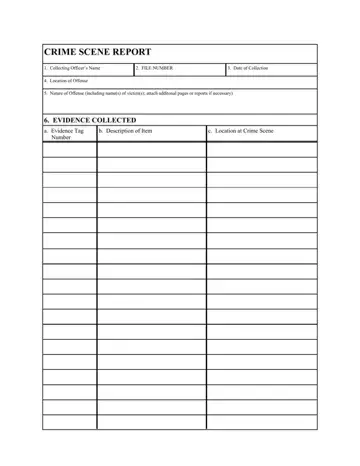
Within the intricate framework of criminal investigations, the Crime Scene Report form emerges as a pivotal document, meticulously detailing every piece of evidence gathered at the scene of a crime. At the heart of this form, one finds the name of the Collecting Officer, a testament to the personal accountability and precise involvement required in such forensic endeavors. The document is structured to include a distinct FILE NUMBER, ensuring a chain of custody and an easy reference point in the vast sea of criminal cases. The Date of Collection is equally crucial, providing a temporal snapshot that could prove vital in constructing timelines during investigations. The Location of Offense is captured with precision, grounding the investigation in a physical locale that often holds the keys to unraveling the events that transpired. Within the form, the Nature of Offense is carefully noted, including the names of victims, which adds a human dimension to the factual data, reminding all stakeholders of the real-world impact of these incidents. Attached pages or additional reports signal the complexity and depth of investigations, underscoring the often expansive nature of gathering comprehensive evidentiary details. The section labeled EVIDENCE COLLECTED serves as the cornerstone of the form, methodically listing each item through an Evidence Tag Number, its Description, and its Location at the Crime Scene—testaments to the meticulous and systematic approach crucial to the integrity of criminal justice processes.
| Question | Answer |
|---|---|
| Form Name | Crime Scene Report Form |
| Form Length | 1 pages |
| Fillable? | No |
| Fillable fields | 0 |
| Avg. time to fill out | 15 sec |
| Other names | crime scene sketch template pdf, crime scene report worksheet, scene crime report form, crime scene report example pdf |
Crime Scene Report Form isn’t the one you’re looking for?
Please rate Crime Scene Report Form