
Dd Form 1206 PDF Details

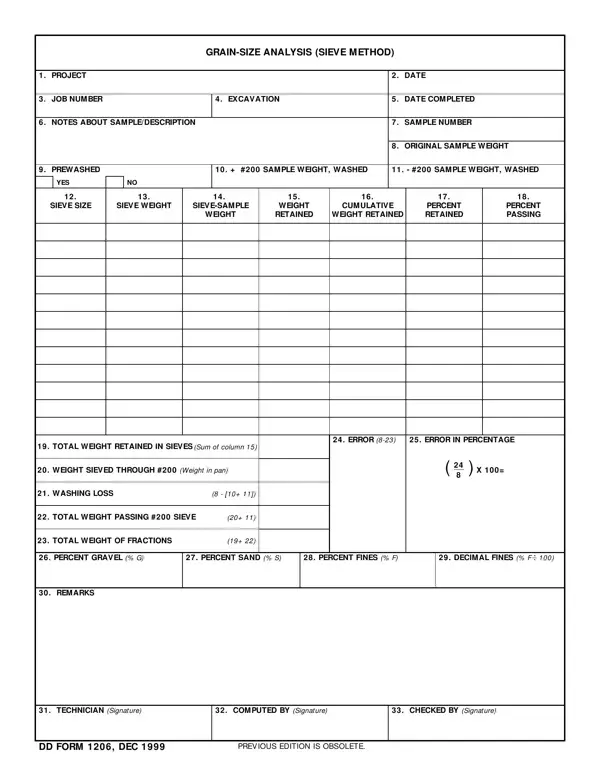
In the realm of geotechnical engineering and construction, the DD Form 1206 plays a critical role. This form, dedicated to Grain-Size Analysis through the Sieve Method, encompasses a comprehensive approach to evaluating soil samples. It begins by cataloging basic information such as the project name, date, job number, and excavation details, then delves deeper into the specifics of the sample under examination, including its number, original and post-wash weights. The form meticulously records data on the sieve process: sieve sizes, weights before and after sieving, cumulative percentages, and the weight retained or passed through each sieve. This yields an accurate depiction of the sample's grain size distribution. Such analysis is essential in assessing the suitability of soil for construction projects and in understanding its behavioral characteristics under various conditions. The form accounts for potential errors and wash losses, ensuring a thorough and precise evaluation. The involvement of multiple technicians in the filling, computing, and checking of this form underscores the importance of precision and reliability in the field's foundational data gathering efforts.

Key sections of the form

The form is divided into several distinct sections that capture both project-level and sample-level data:

When and why this form is used

Geotechnical engineers, soil testing laboratories, and construction firms rely on this form when evaluating soil for foundation design, earthwork specifications, and pavement subgrade assessment. The sieve analysis it documents is one of the most fundamental tests in soil mechanics, required by standards such as ASTM D422 and AASHTO T88. Any project involving earthwork, drainage design, or soil classification is likely to require this type of analysis. Results feed directly into soil classification reports, compaction studies, and drainage design calculations, making accurate completion of every field a non-negotiable part of the workflow.

Related Department of Defense forms

If you work regularly with DoD and military forms, these related documents are also available on FormsPal:

QuestionAnswer
Form NameDd Form 1206
Form Length1 pages
Fillable?No
Fillable fields0
Avg. time to fill out15 sec
Other namesaf form 1206 no download needed, fillable af form 1206, air force form 1206, af form 1206 pdf fillable

How to Edit Dd Form 1206 Online for Free

Dealing with PDF forms online is actually a piece of cake using our PDF editor. Anyone can fill out 1206 af form here and use several other functions we provide. Our team is aimed at giving you the ideal experience with our tool by consistently presenting new features and enhancements. With all of these updates, working with our editor becomes better than ever before! It merely requires a couple of easy steps:

Step 1: Firstly, open the tool by pressing the "Get Form Button" at the top of this site.

Step 2: This editor grants the capability to customize your PDF in various ways. Change it by adding customized text, adjust what's originally in the file, and add a signature - all at your fingertips!

If you want to finalize this PDF form, be sure you enter the right information in every single blank:

1. It is very important complete the 1206 af form properly, hence take care while filling in the sections comprising all these fields:

Part number 1 in filling in af form 1206

2. Once your current task is complete, take the next step – fill out all of these fields - TOTAL WEIGHT RETAINED IN SIEVES, Sum of column, WEIGHT SIEVED THROUGH Weight in, WASHING LOSS, TOTAL WEIGHT PASSING SIEVE, TOTAL WEIGHT OF FRACTIONS, ERROR, ERROR IN PERCENTAGE, PERCENT GRAVEL G, PERCENT SAND S, PERCENT FINES F, DECIMAL FINES F, and REMARKS with their corresponding information. Make sure to double check that everything has been entered correctly before continuing!

The way to fill in af form 1206 portion 2

It is easy to make errors when filling in your PERCENT FINES F, for that reason make sure to take a second look before you decide to finalize the form.

3. In this specific stage, take a look at TECHNICIAN Signature, COMPUTED BY Signature, CHECKED BY Signature, DD FORM DEC, and PREVIOUS EDITION IS OBSOLETE. Each of these will need to be filled out with utmost focus on detail.

DD FORM  DEC, CHECKED BY Signature, and TECHNICIAN Signature inside af form 1206

Step 3: Soon after proofreading the completed blanks, click "Done" and you're good to go! Grab the 1206 af form after you sign up for a 7-day free trial. Instantly gain access to the document from your FormsPal cabinet, together with any edits and changes all synced! FormsPal guarantees your information privacy via a protected system that never records or distributes any type of personal information involved. Be confident knowing your files are kept confidential whenever you work with our service!

Tips for accurately completing the sieve analysis form

Precision is critical when conducting grain-size analysis. Small errors in weighing or recording can invalidate results and lead to incorrect soil classifications. Keep these points in mind when filling out every section:

  • Always tare the balance before each weighing to ensure accuracy in recorded weights.
  • Record weights to at least 0.1 gram precision, or to 0.01 gram for fine-grained soils where small differences matter most.
  • Ensure all sieves are clean and undamaged before use. A bent wire or clogged opening affects every result that follows in the cumulative column.
  • Calculate and record wash loss. If washing loss exceeds 2 percent, review your procedure before continuing with the analysis.
  • Have a second technician verify all arithmetic in the cumulative percentage columns before signing. The form's three-signature requirement exists for exactly this reason.

Common mistakes to avoid

These are the most frequently seen errors when completing a sieve analysis form for the first time:

  • Skipping the wash step: The washing loss field exists for a reason. Omitting the hydro-meter wash phase underrepresents fines in the final classification and can lead to a misclassification of the soil type.
  • Incorrect cumulative totals: Each row's cumulative weight must equal the sum of all weights retained on that sieve and all coarser sieves above it. A single transposition error cascades through the entire table.
  • Wrong sieve order: Sieves must be stacked from largest opening to smallest. Reversing two adjacent sieves invalidates the entire run and requires restarting the analysis from the beginning.
  • Missing signatures: All three signature blocks, filled by, computed by, and checked by, are required for the form to be accepted. An unsigned form is typically rejected during project review.
  • Incorrect error percentage: The error percentage field is a quality control check. An error above the acceptable threshold indicates a procedural problem that should be investigated before submitting results.

Frequently asked questions

What does grain-size analysis tell engineers?

Grain-size analysis reveals the distribution of particle sizes in a soil sample. This distribution determines soil classification under the Unified Soil Classification System, which guides decisions about bearing capacity, drainage behavior, compaction requirements, and overall suitability for construction use.

Is the sieve method the only grain-size analysis option?

No. For fine-grained soils where particles pass through the No. 200 sieve, hydrometer analysis is used to determine particle-size distribution in the finer range. A combined analysis uses both methods and may document hydrometer results on a separate addendum or form.

How long does a sieve analysis typically take?

A standard sieve analysis takes 30 to 60 minutes for coarse-grained soils. When washing and oven-drying are included, total time extends to several hours depending on the drying temperature and the moisture content of the original sample.

Can this form be completed and signed digitally?

Yes. FormsPal's online editor lets you fill in all required fields digitally, add a digital signature, and download the completed PDF for your records or project file. This is the fastest way to prepare the document before obtaining physical technician signatures where required.

Other forms you may need

Working on a larger project that requires additional military or laboratory documentation? These forms are available on FormsPal: