
De 140 Form PDF Details

Navigating through the probate process in California can seem like a daunting task, especially when it involves understanding various forms and legal procedures. One crucial document in this journey is the DE-140 form, also known as the Order for Probate. This form plays a pivotal role in the official appointment of individuals responsible for administering a deceased person's estate, whether as an executor, administrator with will annexed, special administrator, or administrator. These designations depend on whether the decedent had a will, the extent of their assets, and other specific circumstances. The form details include critical elements such as the name and address of the appointed attorney or party without an attorney, the superior court's specifications, and the deceased's estate information. It further outlines the court's findings regarding the decedent's residency status, testamentary intentions, and the legal notices issued. The court's order section specifies the type of administrative authority granted—full or limited—and whether the personal representative can manage the estate independently under the Independent Administration of Estates Act. It also addresses financial matters, including bonds and blocked accounts, to safeguard the estate's assets. Understanding the DE-140 form is essential for anyone involved in the probate process, as it lays the groundwork for the estate's administration and ensures compliance with relevant California laws.

QuestionAnswer
Form NameDe 140 Form
Form Length1 pages
Fillable?No
Fillable fields0
Avg. time to fill out15 sec
Other namesca de 140, california probate form de 140, california order probate, ca order probate

How to Fill Out Form DE-140

Form DE-140 at a glance

What it is: DE-140 is the ORDER FOR PROBATE APPOINTING an Executor, Administrator with Will Annexed, Special Administrator or Administrator.

Who signs: The JUDGE OF THE SUPERIOR COURT signs under SIGN (SIGNATURE), with the Date.

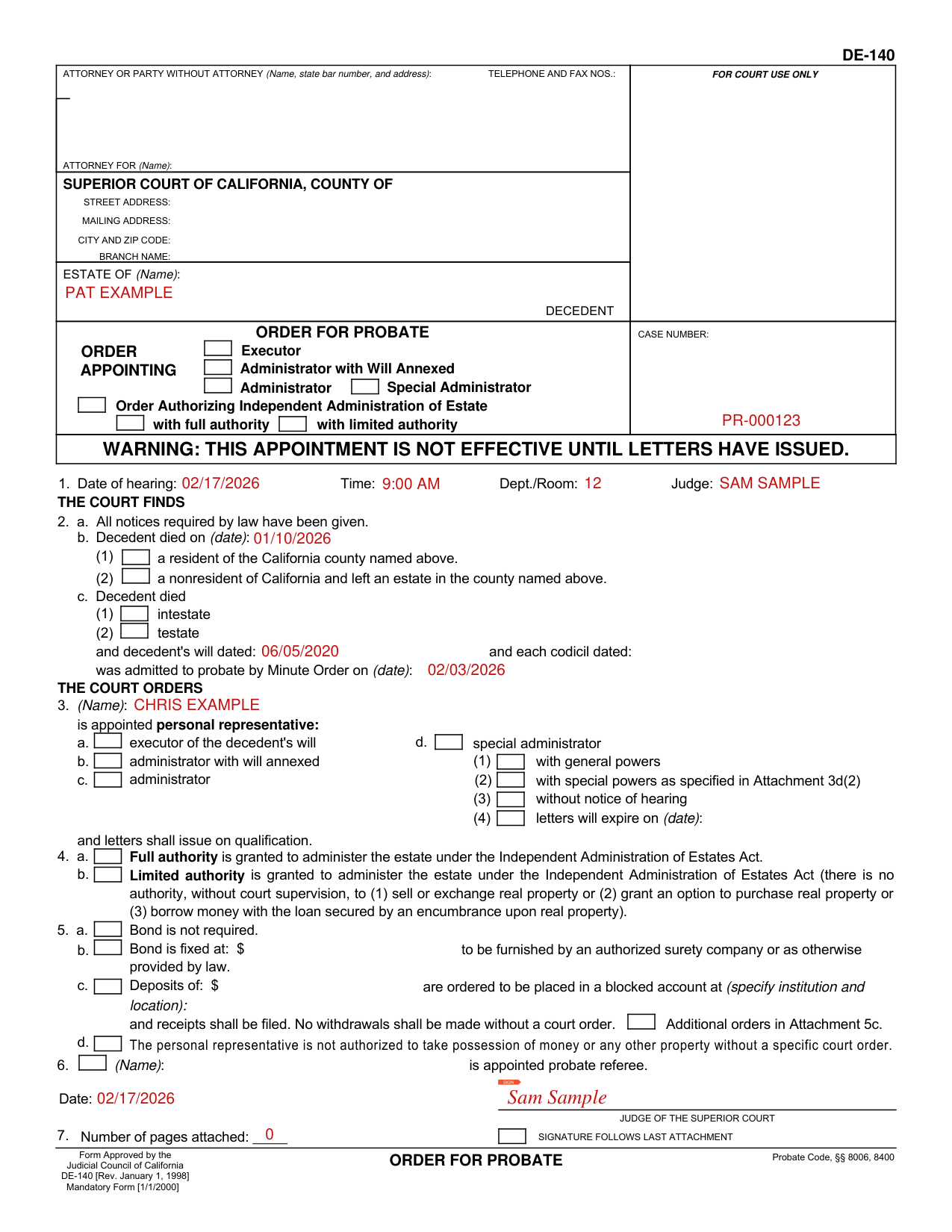
A filled-in Form DE-140 example: the court appoints an executor
Form DE-140 example filled out, example: the court appoints an executor
A superior court judge completes form DE-140 for an estate. The decedent left a will, and the court appoints an executor and requires no bond. The picture shows page 1, and all its values are invented. Bond is fixed at stays empty because no bond is required. Nothing goes in Additional orders and possession of property because the court gives no other orders. Probate referee is left blank because the court names none.

How to fill out Form DE-140, box by box

Estate of

Form DE-140 example filled out, estate of

Enter the Name under ESTATE OF (Name).

Date of hearing

Form DE-140 example filled out, date of hearing

Enter the Date of hearing, Time, Dept./Room and Judge. THE COURT FINDS 2. a. All notices required by law have been given.

Decedent died on (date)

Form DE-140 example filled out, decedent died on (date)

Enter the date on which the decedent died on (date). Mark the decedent as a resident of the California county or a nonresident of California who left an estate in the county.

Decedent died intestate or testate

Form DE-140 example filled out, decedent died intestate or testate

Mark intestate or testate for how the decedent died. If testate, enter the decedent's will dated, each codicil dated, and the Minute Order date on which the will was admitted to probate.

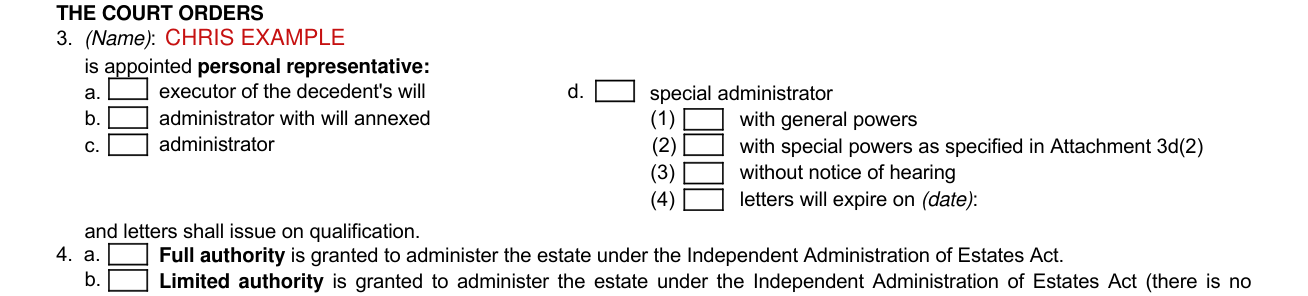
The court orders: personal representative appointed
Form DE-140 example filled out, the court orders: personal representative appointed

THE COURT ORDERS: enter the (Name) who is appointed personal representative, and mark executor of the decedent's will, administrator with will annexed or administrator.

For a special administrator, mark with general powers, with special powers as specified in Attachment 3d(2), or without notice of hearing; mark letters will expire on (date) and enter the date.

Letters shall issue on qualification.

Bond and deposits

Form DE-140 example filled out, bond and deposits

Mark either Bond is not required, or Bond is fixed at: $ to be furnished by an authorized surety company or as otherwise provided by law.

If the court orders deposits, mark Deposits of: $ and enter the blocked account at (specify institution and location), and receipts shall be filed. No withdrawals shall be made without a court order.

Additional orders and possession of property

Form DE-140 example filled out, additional orders and possession of property

Mark Additional orders in Attachment 5c.

If the court orders it, mark the box: The personal representative is not authorized to take possession of money or any other property without a specific court order.

Probate referee

Form DE-140 example filled out, probate referee

Enter the (Name) who is appointed probate referee.

Sign

Form DE-140 example filled out, sign

The JUDGE OF THE SUPERIOR COURT signs under SIGN (SIGNATURE), with the Date.

Enter the Number of pages attached.

More rules for Form DE-140

WARNING: THIS APPOINTMENT IS NOT EFFECTIVE UNTIL LETTERS HAVE ISSUED.

Mark either Full authority is granted to administer the estate under the Independent Administration of Estates Act, or Limited authority is granted to administer the estate under the Independent Administration of Estates Act.

With limited authority there is no authority, without court supervision, to (1) sell or exchange real property or (2) grant an option to purchase real property or (3) borrow money with the loan secured by an encumbrance upon real property.

Sources

[1] Form DE-140 (Rev. January 1, 1998), Order for Probate, Judicial Council of California (the Official source link on this page).

Please rate De 140 Form

1 Votes
If you believe this page is infringing on your copyright, please familiarize yourself with and follow our DMCA notice and takedown process - click here to proceed .