
A Nebraska motor vehicle power of attorney is a legal document that lets you, the principal, name another person as your agent (also called an attorney-in-fact) to handle vehicle matters for you. The Nebraska Uniform Power of Attorney Act does not apply to a power created on a form a government agency prescribes for a governmental purpose, so the Nebraska DMV’s Power of Attorney (For Vehicle/Motorboat Only) is governed by its own instructions rather than by that act.[1]
Last Updated: October 2026. This guide is reviewed and updated regularly to reflect current law. If you notice an error or outdated information, please contact us.
Build Your Document
Answer a few simple questions to make your document in minutes
Save and Print
Save progress and finish on any device, download and print anytime
Sign and Use
Your valid, lawyer-approved document is ready
A power of attorney template helps when you cannot be there in person to handle a vehicle matter. Your agent can then take care of the paperwork for you. Here are some common situations where owners use one.
Pick an agent who knows the vehicle and whom you trust. For more details and to download the necessary templates, check out all Nebraska POA forms. If you are selling the vehicle, a Nebraska bill of sale records the sale itself, while this power of attorney only lets your agent act for you. For matters beyond vehicles, take a look at the Nebraska limited power of attorney form.
The table below summarizes the essential characteristics of the Nebraska DMV form this page hands out, including its name, the state form name, an official link, the typical completion time and the download format. The form has fillable fields, so you can type into the PDF before you print it.
| Document Name | Nebraska Motor Vehicle Power of Attorney Form |
| State Form Name | Power of Attorney (For Vehicle/Motorboat Only), Revised 9/2024 |
| Relevant Link | Nebraska Department of Motor Vehicles |
| Avg. Time to Fill Out | 5 minutes |
| # of Fillable Fields | 8 |
| Available Formats | Adobe PDF |
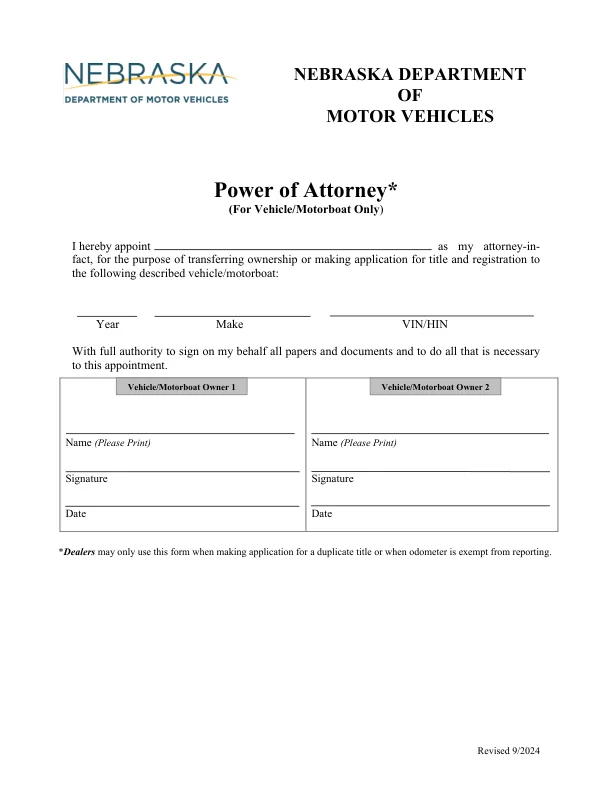
The PDF this page hands out is the Nebraska DMV’s Power of Attorney (For Vehicle/Motorboat Only, Rev. 9/2024).[2] It is a single page. Understanding the layout before you begin makes it easier to gather the information you need.
The FormsPal template behind Create My Document is a different document. It includes an acknowledgment for a notary public or other officer.
These steps follow the Nebraska DMV’s Power of Attorney (For Vehicle/Motorboat Only, Rev. 9/2024), the official form this page hands out. Open the PDF, fill in each part in the order below, and check your entries before you print. Each step names one part of the form and tells you what to enter there.
The screenshots under each step show the Nebraska DMV Power of Attorney (For Vehicle/Motorboat Only), the official Nebraska form, filled with sample entries in blue, so you can see where each answer goes. The names, dates and vehicle details are examples only.
I hereby appoint
On the line after “I hereby appoint”, print the full name of the person you choose as your attorney-in-fact. The form gives that person authority for transferring ownership or making application for title and registration for the vehicle or motorboat you describe next.

Year, Make and VIN/HIN
Enter the year and the make, then the VIN (vehicle identification number) of a vehicle or the HIN (hull identification number) of a motorboat. Copy them from your title. The sentence below these lines, which gives your attorney-in-fact full authority to sign papers for this appointment, is printed on the form, so there is nothing to enter there.

Vehicle/Motorboat Owner 1 and Owner 2
In the Vehicle/Motorboat Owner 1 box, print your name on the Name (Please Print) line, sign on the Signature line and write the date on the Date line. If the vehicle or motorboat has a second owner, that owner does the same in the Vehicle/Motorboat Owner 2 box.
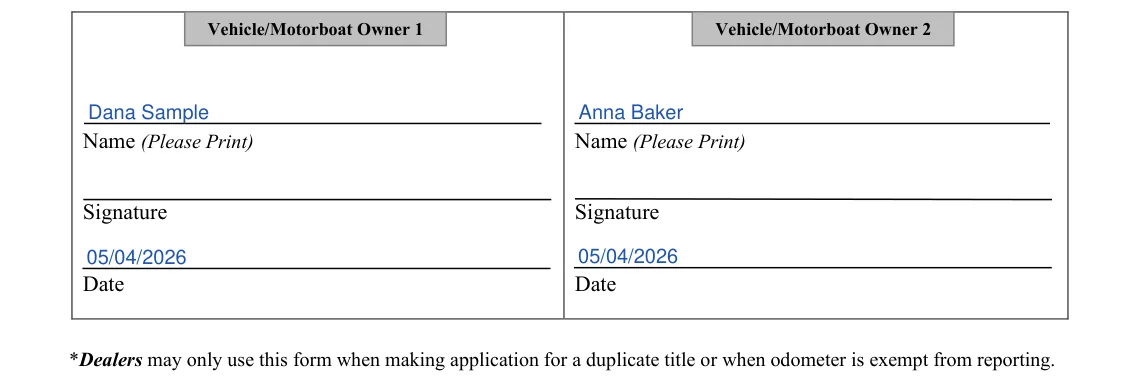
The note at the bottom of the form says dealers may only use it when making application for a duplicate title or when the odometer is exempt from reporting. Read the whole page before you sign.
Once the fields are filled in, the last part is signing. What signing takes depends on the document you use: the DMV form this page hands out, or the FormsPal template you get from Create My Document. Go through the steps in order and keep the finished form somewhere safe.
Sign the form
Sign and date the form where indicated. This signature confirms that you voluntarily grant the powers described in the document.
The DMV form has no notary section
The Nebraska DMV’s Power of Attorney (For Vehicle/Motorboat Only, Rev. 9/2024) has no notary section. On that form, each owner prints their name, signs and dates it.[2] The Nebraska Uniform Power of Attorney Act, including its notary rule, does not apply to a power created on a form a government agency prescribes for a governmental purpose, such as this DMV form.[1]
More than one owner
If the vehicle or motorboat has two owners, the second owner prints their name, signs and dates the Vehicle/Motorboat Owner 2 box of the DMV form.[2]
The FormsPal template must be notarized
The FormsPal template from Create My Document is not a form a government agency prescribes, so the Nebraska Uniform Power of Attorney Act applies to it.[1] Under the act, a power of attorney is not valid unless it is acknowledged before a notary public or another individual authorized by law to take acknowledgments.[3] The template’s acknowledgment is the part the notary or other officer completes, adding a signature and seal.
Keep a copy
Make a copy of the signed form for your records. Store it with your other vehicle papers.
Most problems with a vehicle power of attorney come from small slips in the details, particularly in numbers and spelling. Take a minute to compare each entry with your vehicle title and photo ID before you print the document. These are the slips to look for.
Gather these items before you open the PDF. The DMV form asks for the year, make and VIN of the vehicle, or the HIN of a motorboat, so the title is the best place to copy them from.
Yes. The DMV form has fillable fields for the attorney-in-fact’s name, the year, make and VIN/HIN, and each owner’s printed name and date, so you can download the PDF and type your entries before you print it. The Signature lines have no field, so sign them by hand after you print. Typed text is easier to read than handwriting. You can also create the FormsPal template online with Create My Document and print it when you are done.
The VIN is printed on your vehicle title and registration, and it is also on the vehicle itself. For a motorboat, copy the HIN from its title or registration. Copy the number exactly as you see it so it matches your paperwork.
A successor attorney-in-fact is a backup agent. The DMV form has no successor line. The FormsPal template from Create My Document has one, with lines for the name and address of an alternate agent.
Use the download buttons near the top of this page to save the PDF to your computer. Open it in any PDF viewer or in the FormsPal PDF editor, fill in the fields, and print it when you are done.
The DMV form this page hands out has no part for a notary.[2] If you use the FormsPal template from Create My Document instead, its acknowledgment is for the notary. The lines for the county, the officer and the signature and seal are completed by the notary or other officer, so leave them blank when you prepare the template.
The principal is the vehicle owner who grants the power. The agent, also called the attorney-in-fact, is the person who acts for the owner. On the DMV form, the agent’s name goes on the line after “I hereby appoint” at the top, and each owner prints their name, signs and dates an owner box at the bottom.
General information, not legal or tax advice.
