
A New Hampshire lease agreement is a written contract between a landlord and a tenant that sets the terms for renting a residential property. It covers the rent amount, the length of the tenancy, and the rules for security deposits and fees. New Hampshire Statutes Chapter 540 and Chapter 540-A govern residential tenancies in the state. Landlords and tenants use this agreement to record what each side has agreed to about the rental property before the tenant moves in, which protects both parties if a dispute comes up later.
Last Updated: September 2026. This guide is reviewed and updated regularly to reflect current New Hampshire law. If you notice an error or outdated information, please contact us.
Build Your Document
Answer a few simple questions to make your document in minutes
Save and Print
Save progress and finish on any device, download and print anytime
Sign and Use
Your valid, lawyer-approved document is ready
New Hampshire's rental laws sit in Chapter 540 and Chapter 540-A of the New Hampshire Revised Statutes. Chapter 540 covers how a landlord or tenant ends a tenancy. Chapter 540-A sets the rules for security deposits, including the dollar limit a landlord can collect and when the deposit must be returned. The sections below explain what a New Hampshire lease agreement should reflect under these two chapters.
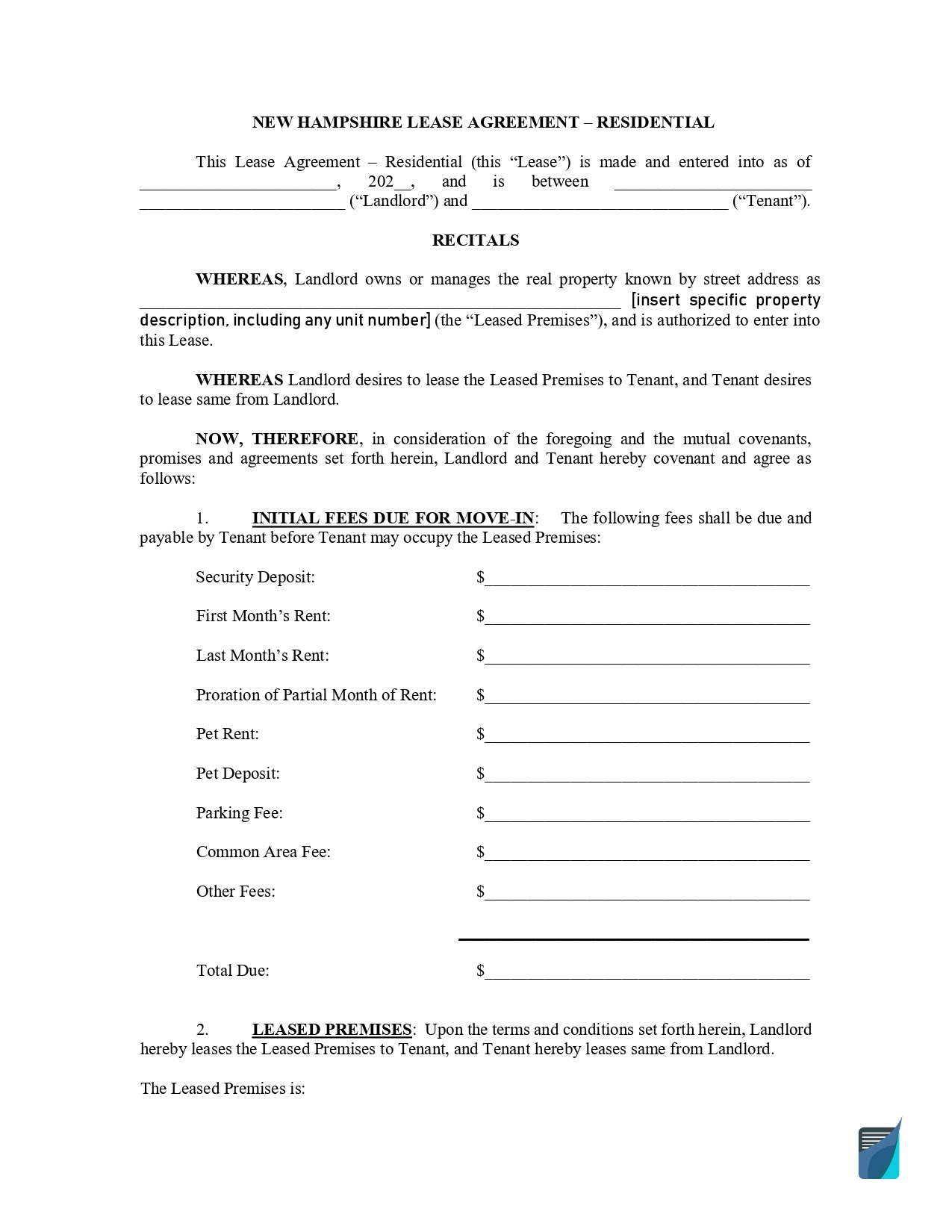
FormsPal's downloadable New Hampshire lease agreement already has fields for the security deposit amount and the receipt details this page describes. Fill in the fields and skip drafting the legal language yourself.
Under RSA 540-A:3, a landlord may not enter the rental unit without the tenant's prior consent, except to make emergency repairs or under a court order. For other entry, the landlord must give notice that is adequate under the circumstances, with no set minimum, except that 48 hours' written notice applies to an entry to inspect for bed bugs.[5]
Before a lease is signed, the landlord must also disclose in writing if, to the landlord's knowledge, methamphetamine production has occurred on the property, until the property is certified as meeting the state's remediation standards (RSA 477:4-g).[6]
Under federal law, a landlord renting housing built before 1978 must disclose known lead-based paint hazards and give the tenant the EPA lead pamphlet. The tenant signs an acknowledgment of receipt (42 U.S.C. § 4852d, 40 CFR 745.113).[7]
New Hampshire landlords and tenants both have duties around the security deposit for a rental property, from the dollar limit through the rules for returning it.
Under Section 540-A:6 of the New Hampshire Revised Statutes, a landlord cannot demand or collect a security deposit worth more than one month's rent or $100, whichever amount is greater.[2]
When a landlord receives a security deposit, New Hampshire law requires the landlord to forthwith deliver to the tenant a signed receipt. The receipt must state the deposit amount and name the place where the deposit, or a bond for it, will be held. At the same time, the landlord must give the tenant written notice that the tenant has 5 days of occupancy to report any existing damage or needed repairs in writing.[2]
Except in certain cases the statute sets out, the landlord must return the security deposit within 30 days after the tenancy ends. When the landlord deducts for damage beyond reasonable wear and tear, the landlord must give the tenant a written, itemized list of the damages, stating the repair needed, together with satisfactory evidence that the repair has been or will be completed, such as receipts, labor estimates, bills, or invoices (RSA 540-A:7, I).[1]
A security deposit remains the tenant's money. New Hampshire law requires the landlord to hold it in trust, not mingle it with the landlord's personal money, and not treat it as the landlord's asset. If a landlord holds the deposit for a year or longer, the landlord must pay the tenant interest on it. The rate must equal what regular savings accounts pay at the bank, savings and loan association, or credit union where the deposit sits.[2]
Every 3 years, 30 days before that year's tenancy ends, the tenant may request this accrued interest, and the landlord must pay it within 15 days of the request.[2]
If the landlord sells the property, assigns the lease, or a receiver takes over, the security deposit must go to the new grantee, assignee, purchaser, or receiver. This must happen at the time of delivery of the deed or instrument of assignment, or within 5 days thereafter, or within 5 days after a receiver qualifies. New Hampshire law also requires the landlord to notify the tenant of the change by registered or certified mail, giving the name and address of whoever now holds the deposit.[2]
For example, tenant Anna Baker pays landlord Ben Carter a $1,200 security deposit when she moves into a rental unit at 123 Main Street. Ben must give Anna a signed receipt for the $1,200 right away and hold it in a separate account. When Anna moves out eighteen months later with no damage beyond normal wear and tear, Ben must return the full deposit, plus any interest owed, within 30 days.
Keeping a copy of the signed receipt and the move-in notice makes it easier for either side to resolve a deposit disagreement later.
New Hampshire sets a notice period for ending a month-to-month tenancy. A landlord who is ending the tenancy generally must give 30 days' notice. Only 7 days' notice is needed when the reason for ending it is one of the specific grounds RSA 540:2, II(a) lists.[3] Use FormsPal's deadline calculator to count the notice period from the day it is sent.
A tenant who wants to end a month-to-month tenancy also gives 30 days' notice. If the termination date does not fall on the rent due date, the tenant still owes rent through the end of that month. Rent is owed up to the next due date, unless the lease says otherwise.[3]
| Document Name | New Hampshire Rental Lease Agreement Form |
| Other Names | NH Rental Lease, New Hampshire Residential Lease Agreement |
| Relevant Laws | New Hampshire Statutes, Title 55, Chapter 540A |
| Security Deposit Amount | One (1) month’s rent or $100 (whichever is greater) |
| Security Deposit Return | Within thirty (30) days |
| Avg. Time to Fill Out | 18 minutes |
| # of Fillable Fields | 119 |
| Available Formats | Adobe PDF |
Before signing the printed lease, use FormsPal's chat-with-pdf tool to ask questions about any clause you are not sure about.

Other Rental Lease Agreement Forms by State
New Hampshire's lease and security deposit rules raise a few questions landlords and tenants ask often. The answers below come from New Hampshire Revised Statutes Chapter 540 and Chapter 540-A, the same law this page explains in the Laws and Lease Requirements section above, with a citation to the exact section for each one.
New Hampshire tenants have several rights tied to their security deposit. The deposit cannot exceed one month's rent or $100, whichever is greater. The landlord must hold it in trust, give a signed receipt, and pay interest once the deposit is held for a year or longer.[2] When the tenancy ends, the tenant is entitled to get the deposit back within 30 days in most cases.[1]
New Hampshire law lets a tenant keep the tenancy in an eviction case based only on unpaid rent. The tenant must pay the full amount owed before the hearing on the merits. That payment must cover:
The payment must be in cash, certified check, money order, electronic transfer, or another guaranteed and immediately available form. Once the tenant pays that full amount, the case must be dismissed.[4]
A 30-day notice to vacate is the written notice New Hampshire law requires to end a month-to-month tenancy. A landlord or a tenant who wants to end the tenancy gives the other side 30 days' notice in most cases. A landlord only needs 7 days' notice when the reason for ending the tenancy is one of the specific grounds RSA 540:2, II(a) lists.[3]
General information, not legal or tax advice.
