Texas Rental Application Template

Updated:

A Texas rental application is a written request to rent a home. The form lists the applicant's identity, occupants, rental history, employment, income, vehicles and pets for screening. The application is needed by landlords screening applicants, especially before signing a residential lease.

Key facts

  • The application asks to rent the home; the lease comes only after the landlord approves the applicant.
  • Each co-applicant fills out a separate application, and the form asks whether there is one.
  • The applicant signs twice: on the Applicant's Signature line of the application and on the Authorization to Release Information.
  • The application fee and the application deposit are separate entries, and the Fees section names who receives the fee.
  • Under Tex. Prop. Code § 92.010, except as subsection (b) provides, the maximum number of adults a landlord may allow to occupy a dwelling is three times the number of bedrooms (a cap for the whole dwelling, not for each bedroom).
Texas rental application form preview

Create a free high quality Texas Rental Application online now!

Build Your Document

Answer a few simple questions to make your document in minutes

Save and Print

Save progress and finish on any device, download and print anytime

Sign and Use

Your valid, lawyer-approved document is ready

... or download your Texas Rental Application Template as a  PDF file

What a Texas Rental Application Includes

A Texas rental application collects the applicant's identity, household, rental history and income, so the landlord can judge whether the applicant can pay the rent and whether the home fits everyone who will live in it.

  • Property details: the address, the move-in date, the monthly rent, the security deposit and the lease term the applicant wants
  • Personal information: name, contact details, Social Security number, driver license number and date of birth
  • Occupants: the name, relationship and age of each person who will live in the home
  • Rental history: the current and previous addresses, landlords, move dates and rent
  • Employment and income: current and previous employers, supervisor, start date, gross monthly income and other income
  • Vehicles and pets: each vehicle parked at the property and each pet, with its details
  • History questions: evictions, lease breaches, bankruptcy, foreclosure, credit problems and criminal convictions

The form is also called a Texas residential lease application or a Texas lease application form. Landlords and property managers use it the same way under any of these names.

Gather your photo ID, your Social Security number and the phone numbers of your past landlords and employers before you start. With everything at hand, you can finish the form in one sitting.

Vehicles and Parking Permits

The vehicles section of the application lists each vehicle that will be parked at the property, with its type, year, make, model, license plate and monthly payment, so the landlord can plan parking. Under Tex. Prop. Code § 92.0132, a landlord who issues a parking permit to a tenant must issue it for a term coterminous with the lease term and may not terminate or suspend it until the tenant's right of possession ends.

Military Service Question

The application asks whether the applicant is in military service and, if so, whether the orders limit the stay, because a military move can end a lease early. When a lease is terminated under the military lease termination rule of Tex. Prop. Code § 92.017, the landlord shall refund, not later than the 30th day after the effective date of the termination, all rent paid in advance for any period after that date.

Texas Rental Application Form Details

Document Name Texas Rental Application Form
Other Names TX Rental Application, Texas Application to Rent, Texas Residential Lease Application
Avg. Time to Fill Out 20 minutes
# of Fillable Fields 207
Available Formats Adobe PDF
Template Preview
Create a free high quality Texas Rental Application online now!

Rental Application vs. Residential Lease Agreement

A rental application is the request that comes before the lease: the applicant fills it out to ask for the home, and the landlord reads it to screen each applicant. The rental lease agreement comes later, once the landlord has chosen a tenant, and it sets the rent, the term and the rules both sides follow.

The application mainly serves the landlord, and it works like a short written interview. A signed application does not give the applicant the home; the signed lease does.

Who Fills Out a Texas Rental Application

A Texas rental application is filled out by each applicant who will sign the lease, and each co-applicant completes a separate form, while other occupants appear by name, relationship and age on the main applicant's form.

The occupants list tells the landlord how many people will live in the home. Tex. Prop. Code § 92.010 sets the maximum number of adults a landlord may allow to occupy a dwelling at three times the number of bedrooms, except as subsection (b) of that section provides.

The emergency contact is a separate person. The form says not to name an occupant or a co-applicant as the emergency contact.

Application Fee, Application Deposit and Security Deposit

The Fees section of the application names the fee amount and the person or company it goes to, and a separate line shows whether the applicant submits an application deposit and how much it is. Check the cost before you apply. The application fee and the security deposit are separate amounts, and both are listed on the form. Ask the landlord what each one covers and get the answer in writing.

The form shows the landlord's figures for each amount, and those figures are the ones to confirm before paying.

Security Deposit Rules in Texas

The security deposit on the application is money the landlord holds during the lease and returns at the end, under the deposit rules of the Texas Property Code. Except as provided by Section 92.107, Tex. Prop. Code § 92.103 requires the landlord to refund a security deposit on or before the 30th day after the date the tenant surrenders the premises.

  • Even when the landlord keeps a deduction, Tex. Prop. Code § 92.104 bars keeping any part of the deposit to cover normal wear and tear.
  • If the landlord keeps all or part of the deposit, Tex. Prop. Code § 92.104 requires the landlord to give the tenant the balance with a written description and itemized list of all deductions.
  • Under Tex. Prop. Code § 92.106, the landlord shall keep accurate records of all security deposits, which applies when a deposit is paid.

Authorization to Release Information

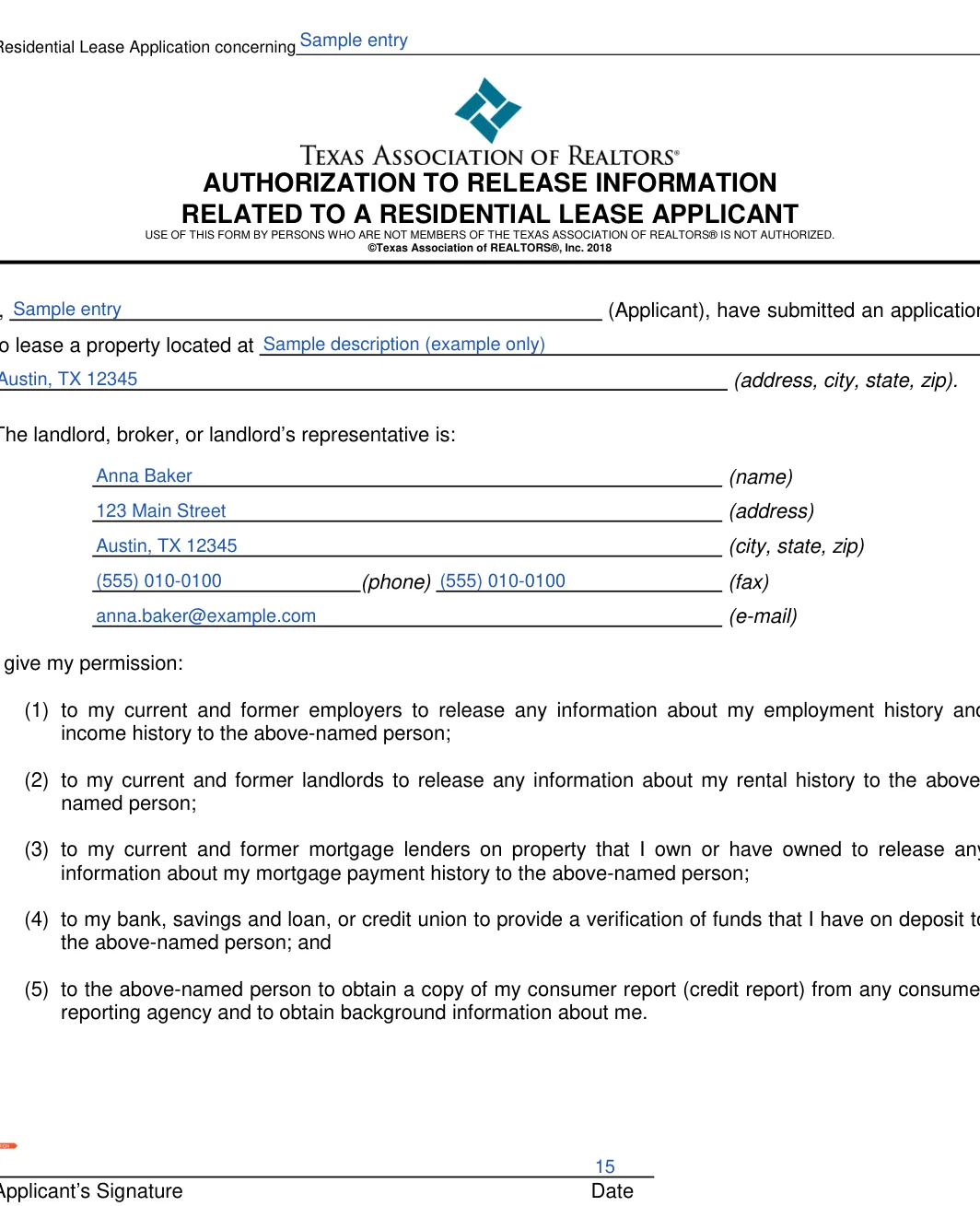
The Authorization to Release Information is the page that lets the landlord contact the applicant's references, such as past landlords and employers, to confirm the answers on the application. It names the applicant, the property applied for and the landlord, broker or representative who receives the information, and the applicant signs and dates it after reading its permissions.

Tell your references and past landlords that they may get a call. A reference that answers quickly helps the landlord finish the review.

How to Fill Out a Texas Rental Application Form

The Texas rental application is filled out part by part, in the order of the form, from the property details at the top to the release authorization at the end. Download the blank PDF from the top of the page and fill it in on your computer, or print it and write by hand.

The screenshots under each step show the form filled with sample entries in blue, so you can see where each answer goes. The names, addresses, dates and amounts are examples only.

Property, Applicant and Occupant Details

The first part of the form covers the home, the applicant and the household: the property and rent, how the applicant heard about it, the applicant's contact details and identity, an emergency contact and the list of occupants.
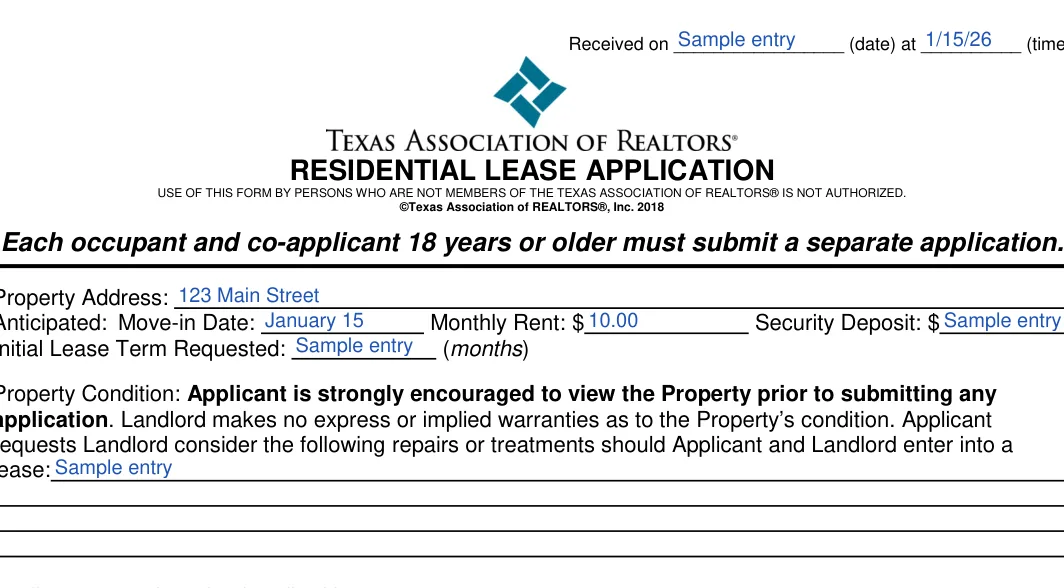
  1. Enter the property address, rent and lease term. Enter the property address, your expected move-in date, the monthly rent, the security deposit and the lease term you want, in months. Use the Property Condition lines to list any repairs you would like the landlord to consider. The Received on line at the top is for the landlord. Add your initials in the footer box at the bottom of the page.
    Texas Texas Rental Application: Property Address, filled with sample entries
    Step 1: sample entries, not a real document.
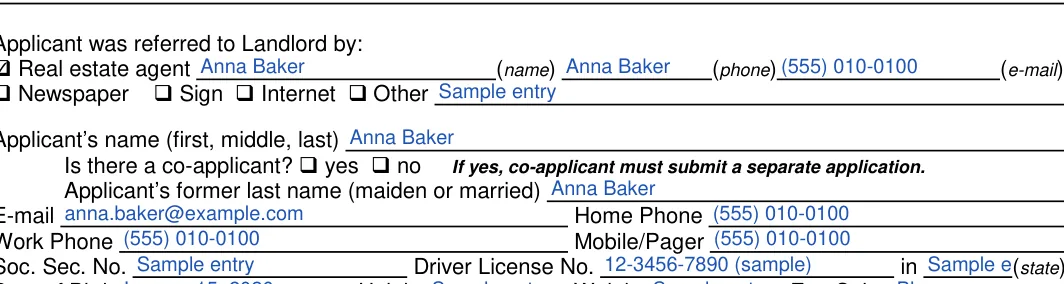
  2. Mark the referral source and add your contact details. Mark how you heard about the property. If a real estate agent sent you, add the agent's name, phone number and e-mail. Then enter your full name, say whether there is a co-applicant, and add any former last name, your e-mail and your home, work and mobile phone numbers.
    Texas Texas Rental Application: Applicant was referred to Landlord by, filled with sample entries
    Step 2: sample entries, not a real document.
  3. Fill in your ID numbers and personal description. Fill in your Social Security number, driver license number and state, date of birth, height, weight, eye color, hair color, marital status and country of citizenship.
    Texas Texas Rental Application: Soc. Sec. No, filled with sample entries
    Step 3: sample entries, not a real document.
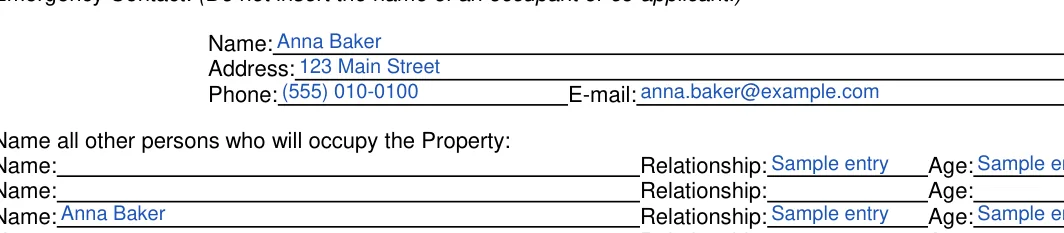
  4. Name an emergency contact and start the occupants list. Give the name, address, phone number and e-mail of an emergency contact. The form says not to name an occupant or a co-applicant here. Then start the list of other people who will live at the property, with each person's name, relationship to you and age.
    Texas Texas Rental Application: Name, filled with sample entries
    Step 4: sample entries, not a real document.
  5. Finish the occupants and give your current address. Finish the occupants list. Then enter your current street address, apartment number, city, state and zip code.
    Texas Texas Rental Application: Age, filled with sample entries
    Step 5: sample entries, not a real document.

Rental History, Employment, Vehicles and Pets

The middle part of the form covers where the applicant has lived and worked, with landlord and employer contacts the landlord can call, then the vehicles and pets that come with the household.
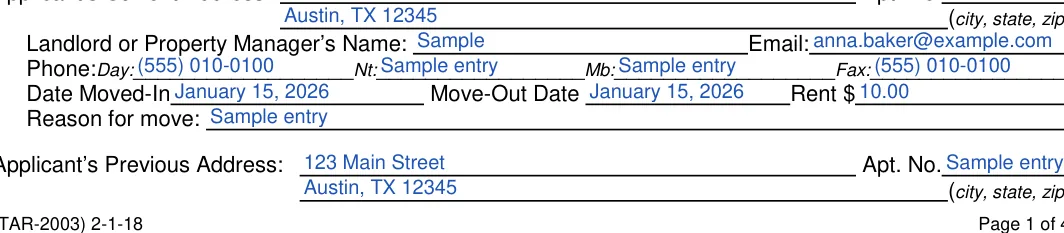

  1. List your current landlord and previous address. For your current home, give the landlord or property manager's name, e-mail and phone numbers, the date you moved in, your move-out date and the rent. Then begin your previous address with the street, apartment number, city, state and zip code.
    Texas Texas Rental Application: Email, filled with sample entries
    Step 6: sample entries, not a real document.
  2. Add your previous landlord. On page 2, write the property address on the line at the top. Then give your previous landlord or property manager's name, e-mail, phone numbers, move-in date, move-out date and rent.
    Texas Texas Rental Application: Email, filled with sample entries
    Step 7: sample entries, not a real document.
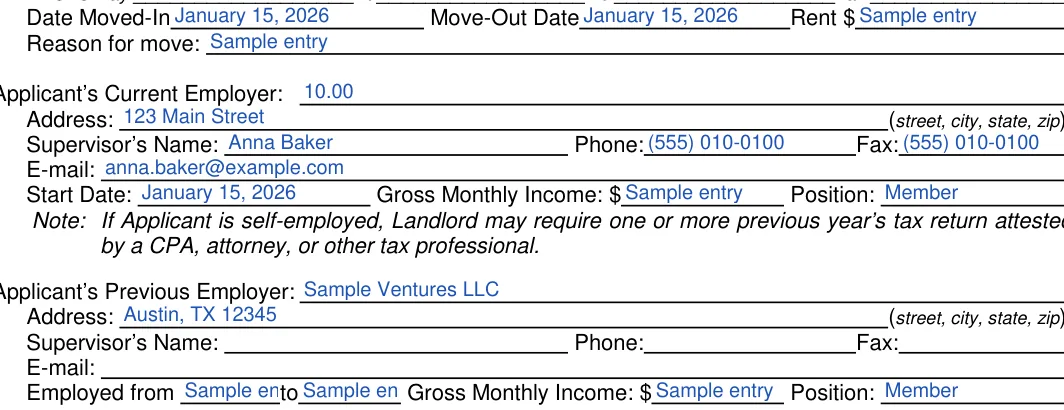
  3. Give your reason for moving and your employers. Write why you moved from your previous address. Then enter your current employer's name, address, supervisor, phone, fax, e-mail, start date, gross monthly income and position. Begin the previous employer block the same way.
    Texas Texas Rental Application: Reason for move, filled with sample entries
    Step 8: sample entries, not a real document.
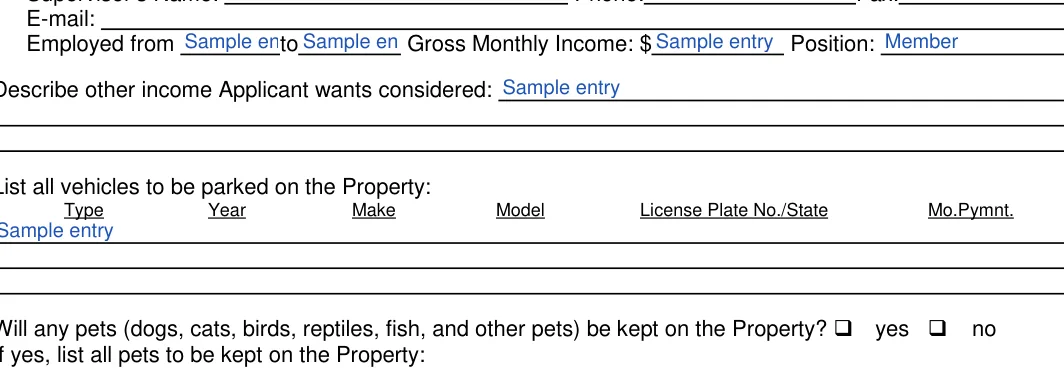
  4. Complete the previous job, other income and vehicles. Finish the previous employer with the dates you worked there, your gross monthly income and your position. Describe any other income you want the landlord to consider. List each vehicle that will be parked at the property with its type, year, make, model, license plate number and state, and monthly payment. Then answer yes or no to the pets question.
    Texas Texas Rental Application: Position, filled with sample entries
    Step 9: sample entries, not a real document.
  5. Describe your pets. If you have pets, list each one with its type and breed, name, color, weight, age and gender. Mark Y or N for neutered, declawed, rabies shots current and bite history.
    Texas Texas Rental Application: If yes, list all pets to be kept on the Property, filled with sample entries
    Step 10: sample entries, not a real document.
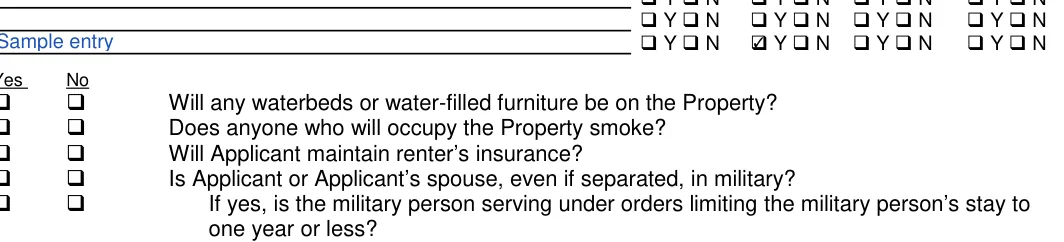
  6. Use the last pet row and answer the yes or no questions. Use the fourth pet row if you need it. Then answer yes or no for waterbeds or water-filled furniture, smoking, renter's insurance and military service. If the military answer is yes, also say whether the orders limit the stay to one year or less.
    Texas Texas Rental Application:  Y  N  Y  N, filled with sample entries
    Step 11: sample entries, not a real document.

History Questions, Fees and Signatures

The last part of the form covers the applicant's history questions, the fees and both signatures, ending with the Authorization to Release Information that lets the landlord check references.
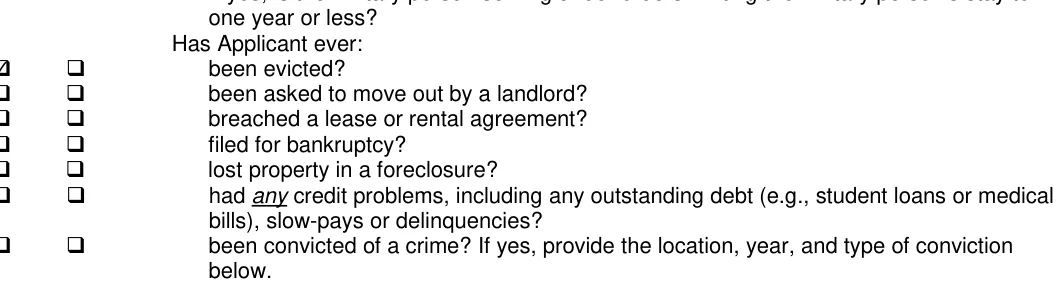
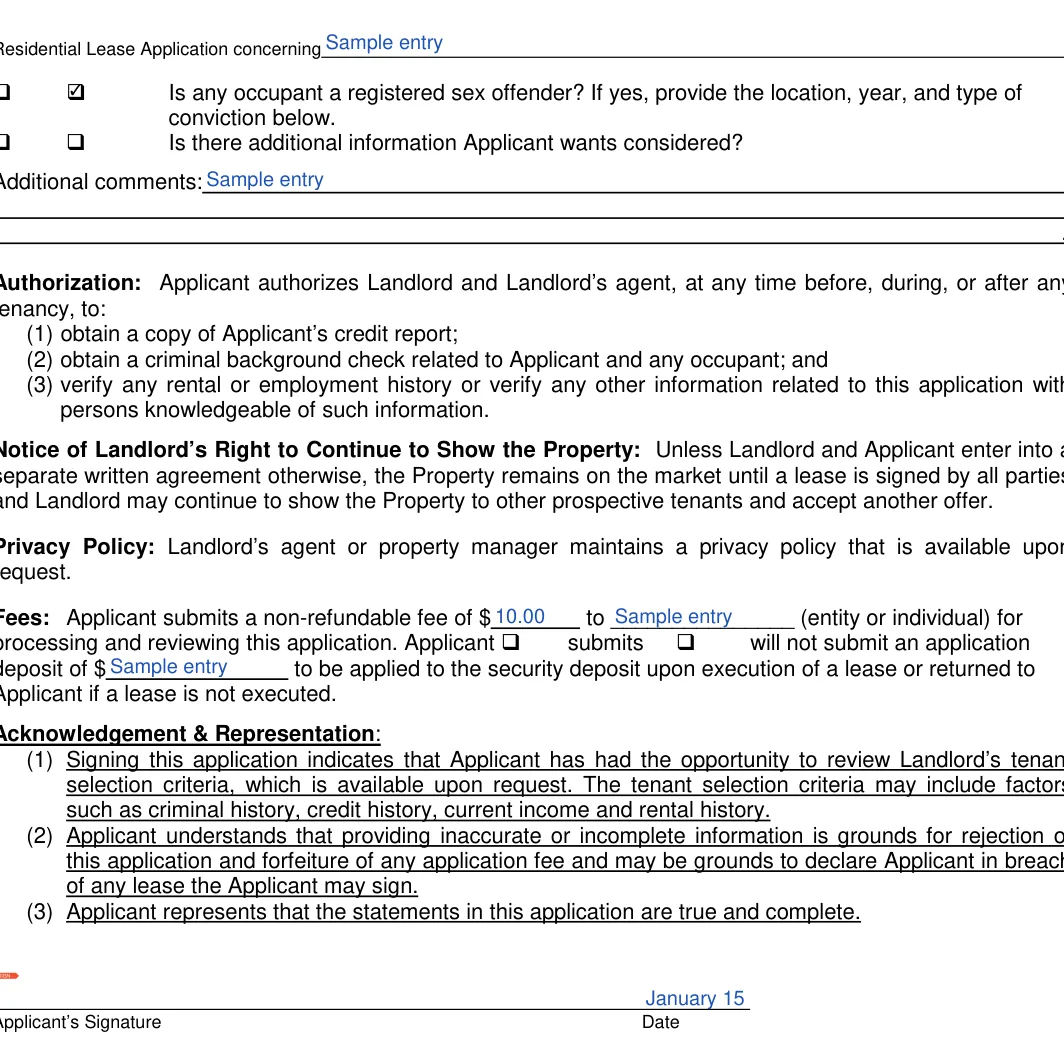
  1. Answer the history questions. Answer yes or no to each question about your past: being evicted, being asked to move out, breaching a lease, filing for bankruptcy, losing property in a foreclosure, having credit problems and being convicted of a crime. If you answer yes to the conviction question, add the location, year and type below it.
    Texas Texas Rental Application: Has Applicant ever, filled with sample entries
    Step 12: sample entries, not a real document.
  2. Complete the final questions and fees, then sign. Answer the questions about registered sex offenders and about additional information, and add any comments. In the Fees section, fill in the fee amount and the person or company it goes to. Then mark whether you submit an application deposit and enter its amount. Read the Authorization and Acknowledgement and Representation paragraphs, then sign and date on the Applicant's Signature line. Add your initials in the footer box on this page too.
    Texas Texas Rental Application: Additional comments, filled with sample entries
    Step 13: sample entries, not a real document.
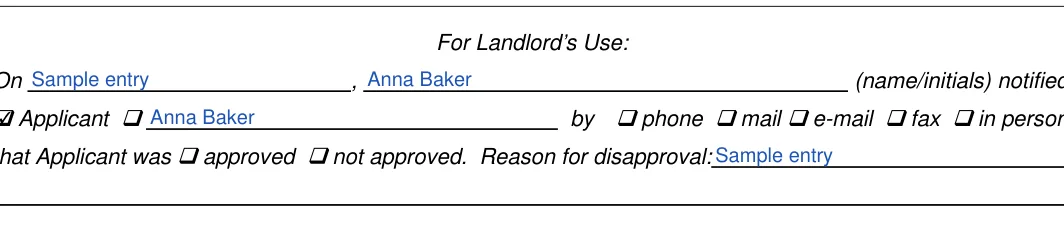
  3. Leave the For Landlord's Use box blank. Leave this box blank. The landlord uses it to record the date, who contacted you, how they reached you and whether the application was approved or not.
    Texas Texas Rental Application: For Landlord’s Use, filled with sample entries
    Step 14: sample entries, not a real document.
  4. Sign the Authorization to Release Information. On page 4, enter your name and the address of the property you applied for. Add the name, address, phone, fax and e-mail of the landlord, broker or representative. Read the five permissions, then sign and date on the Applicant's Signature line.
    Texas Texas Rental Application: RELATED TO A RESIDENTIAL LEASE APPLICANT, filled with sample entries
    Step 15: sample entries, not a real document.

Check that every name, date and amount matches your ID and pay records before you hand over the form. A mismatch can slow down the landlord's review.

How to Sign and Submit a Texas Rental Application

A finished Texas rental application is signed on two lines and initialed in the footer boxes, then handed to the landlord or property manager with any fee or deposit the Fees section lists.

  1. Read the Authorization and Acknowledgement and the Representation paragraphs.
  2. Sign and date the Applicant's Signature line of the application.
  3. Initial each footer box on the pages that have one.
  4. Sign and date the Authorization to Release Information.
  5. Ask each co-applicant to sign their own application.
  6. Give the signed form, with the fee or deposit, to the landlord or property manager.
  7. Keep a PDF or paper copy for yourself.

What Landlords Look for in a Tenant Application

A tenant application shows the landlord whether the applicant can afford the rent, whether past rental experience looks reliable and whether the property suits the household.

  • Employment: the employer, supervisor, start date and gross monthly income, so the landlord can compare income with the rent
  • Rental history: names and phone numbers of previous landlords, so the landlord can ask about the earlier lease
  • Personal information: matching names, ID numbers and contact details across every page
  • Household details: the number of tenants, pets and vehicles that will come with the property

An application form that is complete, legible and consistent gives the landlord fewer reasons to ask follow-up questions.

Mistakes to Avoid on a Texas Rental Application

A rental application is slowed most often by blank lines and mismatched details, since the landlord has to ask about each one before deciding.

  • Answer every line, and write N/A when a question does not apply to you
  • Use full legal names and complete addresses, matching your Texas ID, so the landlord can verify your information
  • Check your credit report ahead of time, since many landlords look at credit and rent payment history
  • List every adult occupant, since the landlord counts the household against the bedrooms
  • Keep a PDF copy of the signed application with your other rental forms

After the Application Is Approved

An approved application leads to the signed lease, and from that point the Texas Property Code and federal law set duties the landlord owes the new tenant.

Rule What it says Source
Copy of the lease The landlord provides at least one complete copy of the lease to at least one tenant who is a party to it, not later than the third business day after each party signs. Tex. Prop. Code § 92.024
Rekeying Except as subsection (e) provides, a security device operated by a key, card or combination is rekeyed at the landlord's expense not later than the seventh day after each tenant turnover date. Tex. Prop. Code § 92.156
Smoke alarms The landlord installs at least one smoke alarm in each separate bedroom in a dwelling unit. Tex. Prop. Code § 92.255
Flood history If the landlord knows that flooding damaged any part of the dwelling at least once in the five-year period before the lease's effective date, the landlord gives the tenant a written notice. Tex. Prop. Code § 92.0135
Lead-based paint In target housing, the lessor gives the tenant a lead hazard information pamphlet and discloses any known lead-based paint or lead-based paint hazards. 42 U.S.C. § 4852d
Target housing Housing built before 1978, except housing for the elderly or persons with disabilities or a 0-bedroom dwelling, unless a child under 6 years of age lives or is expected to live there. 42 U.S.C. § 4851b

More Texas Rental Forms

A rental application is the first of the forms in a Texas rental, and a Texas lease comes next once the landlord accepts the applicant. Keep a copy of your completed application so you can compare it with the lease later.

The Texas rental lease agreement templates page covers the other lease forms used in Texas.

Frequently Asked Questions

How long does it take to fill out a Texas rental application?

The form takes about 20 minutes to complete if you have your details ready. It has more than 200 fillable fields, but most are short lines for names, dates, phone numbers and addresses.

What should I have ready before I start?

Keep these items next to you while you fill in the form:

  • Your photo ID, Social Security number and date of birth
  • Phone numbers for your current and previous landlords and employers
  • Your gross monthly income
  • Details of any vehicles or pets

Having them ready saves time and keeps your answers consistent.

Can I use a Texas Realtors or apartment association lease application instead?

A landlord or listing agent can name the application to use, such as a residential lease application from a Realtors or apartment association, and the applicant then fills out that form. These forms ask for the same kinds of details: identity, occupants, rental history, employment, vehicles, pets and a release authorization.

Does a Texas rental application cover renting a room?

A rental application works for a room as well as a whole home. Under Tex. Prop. Code § 92.001, a dwelling means one or more rooms rented for use as a permanent residence under a single lease to one or more tenants.

What is the For Landlord's Use box?

That box at the bottom of page 3 is for the landlord. It records when you were told the result, how the landlord reached you and whether the application was approved. Leave it blank.

What if I have no previous landlord in Texas?

Write N/A on the previous landlord lines, or add a short note that explains your housing situation, such as living with family. A clear note works better than an empty line.

General information, not legal or tax advice.

Jennifer M. Settles
Jennifer M. Settles
Author & Attorney
With over 25 years of experience as a business and transactional attorney, Jennifer has mastered the craft of closing highly successful deals for her clients. Through her wide-ranging expertise in commercial contracts, real estate transactions, M&A and corporate law, Jennifer secures results that are second-to-none.