
A California DMV bill of sale is a written record of a sale between a buyer and a seller, most often used for a vehicle, boat, or firearm. It lists the parties, the item sold, the price, and the date, and it helps the buyer register the vehicle with the DMV.
FormsPal offers separate California bill of sale templates for vehicles, boats, firearms, and general property. You can build your own online or download a ready-made template. California does not require you to have the document witnessed or notarized.
Build Your Document
Answer a few simple questions to make your document in minutes
Save and Print
Save progress and finish on any device, download and print anytime
Sign and Use
Your valid, lawyer-approved document is ready
| Document Name | California Vehicle Bill of Sale Form |
| Other Names | California Car Bill of Sale, California Automobile Bill of Sale |
| DMV | California Department of Motor Vehicles |
| Vehicle Registration Fee | Varies depending on vehicle type, purchase price, city/county, dates etc. |
| Bill of Sale Required? | Situational |
| Avg. Time to Fill Out | 7 minutes |
| # of Fillable Fields | 28 |
A California DMV bill of sale is not always mandatory, but one becomes necessary when a DMV application is subject to use tax and must show the purchase price on the back of the Certificate of Title. Attaching a bill of sale meets that requirement instead of writing the price directly on the title. [4]
You do not have to use a specific state form. Any bill of sale that identifies the vehicle, even a handwritten one you write yourself, is acceptable to the California DMV. [3]
The downloadable form includes an optional notarization page. California does not require you to use it for this document, [2] but some private-party deals still ask for a notarized signature for extra assurance.
You can choose different types of bills of sale for any type of personal property transfer you make in California. The specific template usually contains all the needed information for the private agreement.
Use a California vehicle bill of sale to sell or buy motor vehicles to another private owner. This document will be needed for the registration of a new vehicle in the California DMV. In practice, buyers register the vehicle with the DMV soon after the purchase or the move, online or in person.
| Alternative Name | Car Bill of Sale |
| Seller’s Signature | Required |
| Buyer’s Signature | Required |
| Notarization | Optional |
| Download | PDF Template |

California bill of sale form for a boat is a legal document proving the private ownership transfer between two owners. In practice, a new owner registers the boat with the DMV, which issues its own title, and renews that registration periodically.
| Alternative Name | Vessel Bill of Sale |
| Seller’s Signature | Required |
| Buyer’s Signature | Required |
| Notarization | Optional |
| Download | PDF Template |

This California firearm bill of sale serves as a contract to sell and purchase a gun between two private entities. In practice, both parties keep a copy as their record of the transfer.
| Alternative Name | Gun Bill of Sale |
| Seller’s Signature | Required |
| Buyer’s Signature | Optional |
| Notarization | Optional |
| Download | PDF Template |

Use a general bill of sale for any type of transaction in the state of California. However, the form contains only common information and not specific details regarding a vehicle, or other personal property to be sold.
| Alternative Name | Generic Bill of Sale |
| Seller’s Signature | Required |
| Buyer’s Signature | Optional |
| Notarization | Optional |
| Download | PDF Template |
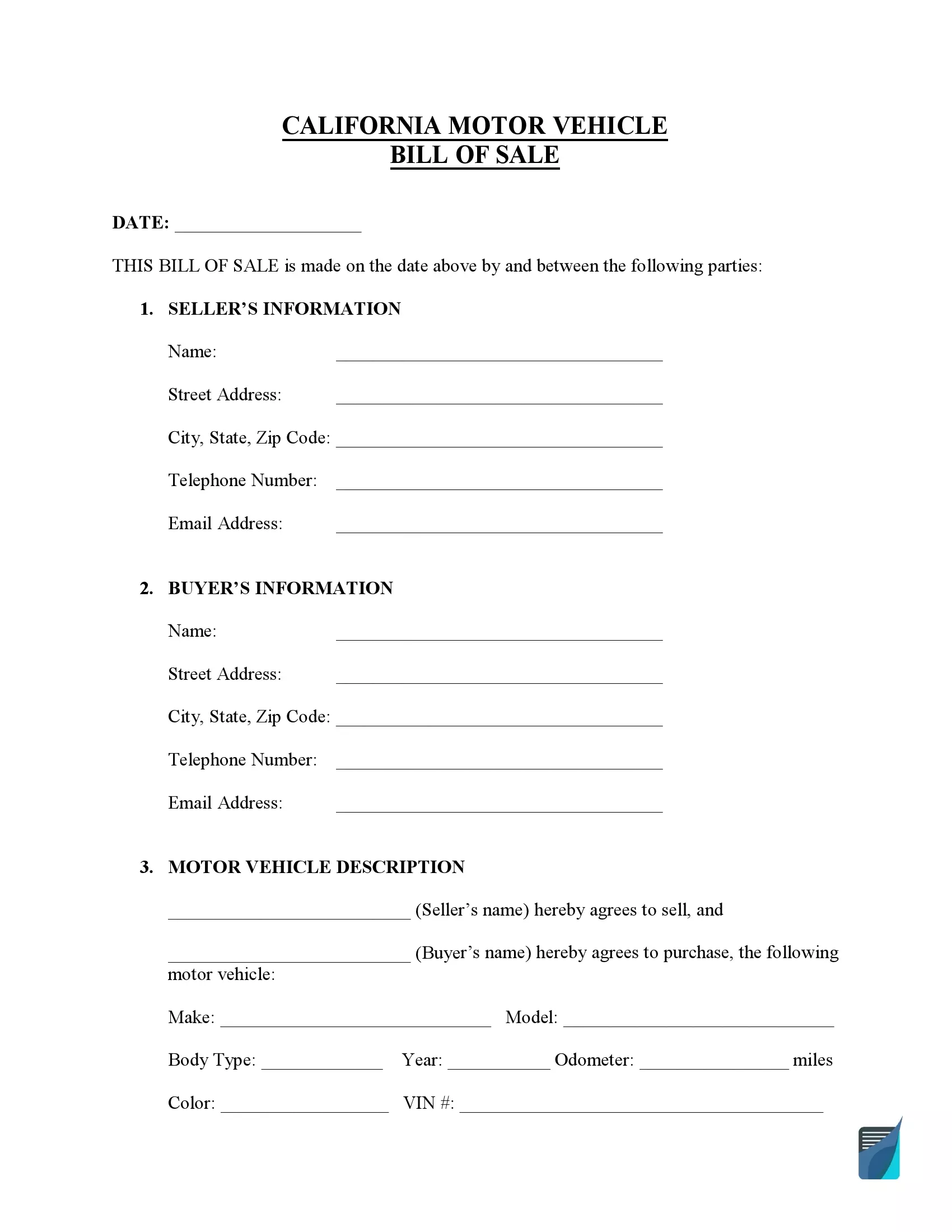
There is no required state form for a California DMV bill of sale, so FormsPal's template or the DMV's own Form REG 135 both work as long as the document identifies the vehicle. [3] The steps below follow FormsPal's template in order, so you can fill it out correctly the first time.
Last Updated: September 2026. This guide is reviewed and updated regularly to reflect current California law. If you notice an error or outdated information, please contact us.
Step 1: Enter the date
Fill in the date this bill of sale is made, at the top of page 1.
Step 2: Seller's information
Enter the seller's name, street address, city, state, zip code, phone number, and email.

Step 3: Buyer's information
Enter the buyer's name in all capital letters, then the buyer's street address, city, state, zip code, and phone number.

Step 4: Motor vehicle description
Confirm the seller's and buyer's names in the sale clause, then enter the vehicle's:
California accepts any bill of sale that identifies the vehicle this way. [3]

Step 5: Purchase date, price, and method
Enter the purchase date and total price, then mark how it was paid: all at once, trade-in (describe the traded vehicle), deposit with a balance due date, or gift. Pick the payment method and mark whether taxes are included.

Step 6: Miscellaneous provisions
Review the ownership, as-is condition, and entire-agreement statements in this section. No entries are required here.
Step 7: Signatures
The seller and buyer each sign, print their name, and date the form. If a witness is present, the witness also signs, prints their name, and dates it. California law lets the DMV require documents filed with it to be signed and submitted under penalty of perjury, so check every entry before you sign. [1]

Step 8: Acknowledgment
The form's last page has an optional notary acknowledgment. California does not require notarization or a witness for this document, [2] but if you and the other party want it notarized anyway, sign in front of the notary there, and they will record the county, date, and your name.
Make two identical copies so both the buyer and the seller keep a signed original.
Nothing changes for a California DMV bill of sale. State law does not require this document to be notarized or witnessed, so an unnotarized bill of sale is still valid for registering the vehicle with the DMV. [2] Some private deals still ask for notarization as extra proof, but it is not a state requirement.
After completing the sale, buyers with a California DMV bill of sale typically contact the DMV to book an appointment and register the vehicle. California law directs the DMV to prescribe and issue certificates of ownership through its own registration process. [1] Start the paperwork early to avoid last-minute delays.
If you buy from a dealer, the dealer commonly handles the registration paperwork. If you buy from a private party, you typically gather and submit the documents yourself.
First, complete a vehicle bill of sale to prove the transfer of ownership, then use it to help obtain the title for the car with an odometer reading. Federal law also requires the seller to give the buyer a written disclosure of the odometer's cumulative mileage as part of the transfer. [5] If the title is missing, sellers or buyers often file an Application for Title or Registration (Form REG 343) to resolve it.
California often requires a smog certification to register a car. Check the CA.gov website with your zip code for your local station and whether your county requires an inspection.
You will also need proof of identification and proof of insurance, since the DMV wants to confirm you are the legitimate purchaser. As a buyer, you typically pay the costs of title, CHP, and registration, plus any other applicable taxes.
A seller often files a Release of Liability (Form REG 138), a release of liability form that tells the state they are no longer responsible for the vehicle after the sale.
New California residents typically also show a residency document from the CA.gov website as part of the paperwork. Once you gather everything, submit it to the DMV office to register your car.
Application for Replacement Plates, Stickers, Documents is a form used to get new documents or plates due to a vehicle being lost, destroyed, or stolen.

Official Application for Vessel Certificate of Number – is a form you can use to register your vessel and get a certificate of ownership.

Application for Replacement or Transfer Title is used when the title owner wants to release a lien on a vehicle.

Firearm Ownership Report must be submitted after the gun purchase.


Other California Forms
General information, not legal or tax advice.


