
A New York bill of sale is a written record of a private sale. It names the seller and the buyer, describes what was sold, and states the price and date. For a vehicle, the New York DMV lists the seller's signature, the sale date, the purchase price and the VIN as details to include.[1] Use the free form below or create one online.
Last Updated: October 2026. This guide is reviewed and updated regularly to reflect current New York law. If you notice an error or outdated information, please contact us.
Build Your Document
Answer a few simple questions to make your document in minutes
Save and Print
Save progress and finish on any device, download and print anytime
Sign and Use
Your valid, lawyer-approved document is ready
| Document Name | New York Vehicle Bill of Sale Form |
| Other Names | New York Car Bill of Sale, New York Automobile Bill of Sale |
| DMV | New York Department of Motor Vehicles |
| Bill of Sale Required? | Answered in the FAQ below |
| Avg. Time to Fill Out | 7 minutes |
| # of Fillable Fields | 16 |
FormsPal has four New York bill of sale templates: motor vehicle, boat, firearm and general. Choose the one that matches what is being sold. The cards below show each template, and the main page lists every bill of sale form FormsPal offers.
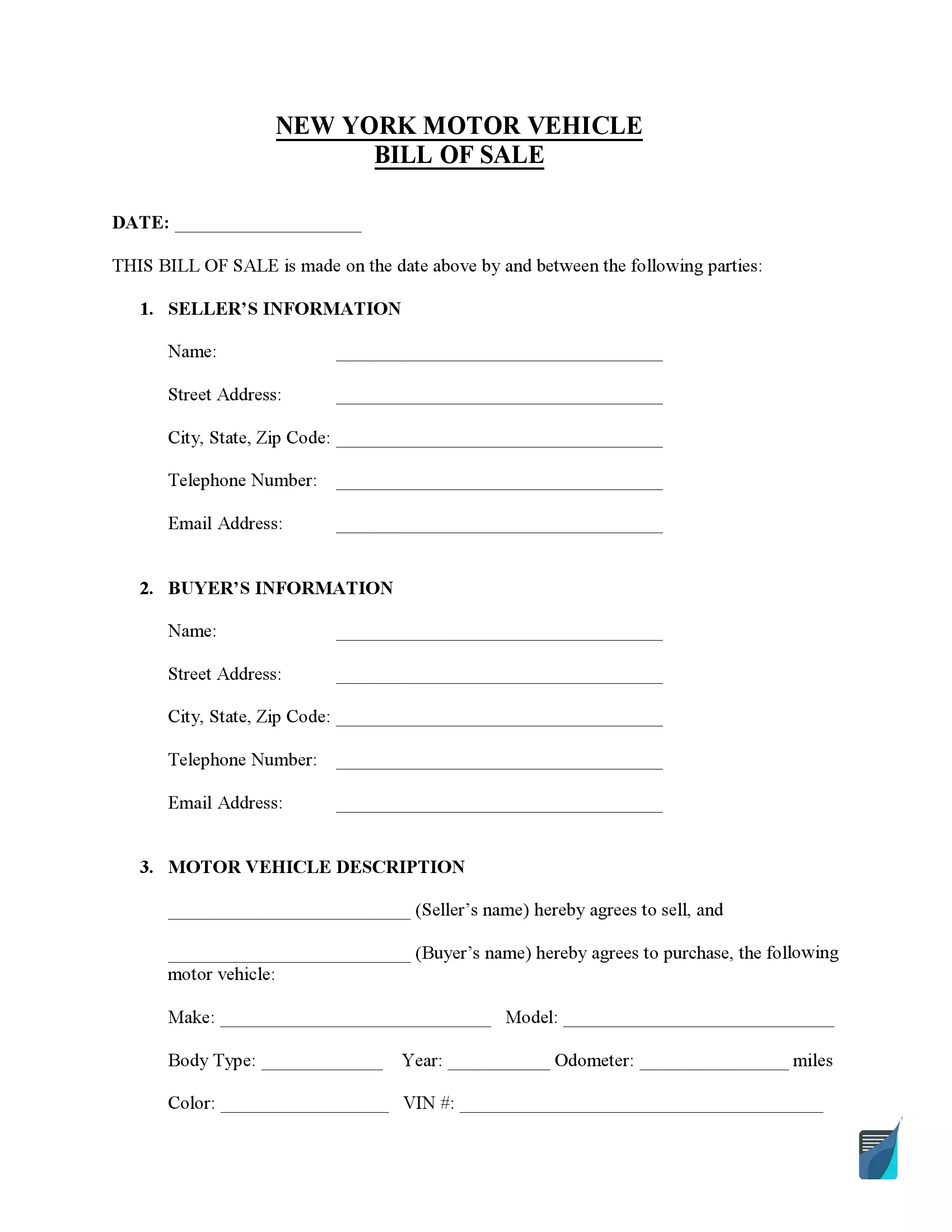
A New York motor vehicle bill of sale records the sale of a car, truck, motorcycle or other vehicle. It holds the vehicle description, the price, the sale date and both signatures. Copy the vehicle details exactly as they appear on the title.
| Alternative Name | Car Bill of Sale |
| Seller’s Signature | Signature line on the template |
| Buyer’s Signature | Signature line on the template |
| Notarization | Add a notary if you want one |
| Download | PDF Template |

A New York boat bill of sale records the sale of a boat or other vessel between a seller and a buyer. Include the hull identification number (HIN) so the vessel can be identified.
| Alternative Name | Vessel Bill of Sale |
| Seller’s Signature | Signature line on the template |
| Buyer’s Signature | Signature line on the template |
| Notarization | Add a notary if you want one |
| Download | PDF Template |

A firearm bill of sale records the sale of a firearm between a seller and a buyer. The firearm forms in the Relevant Official Forms section below come from state and city agencies.
| Alternative Name | Gun Bill of Sale |
| Seller’s Signature | Signature line on the template |
| Buyer’s Signature | Signature line on the template |
| Notarization | Add a notary if you want one |
| Download | PDF Template |

A general bill of sale covers the sale of personal property that has no template of its own, such as furniture or equipment. If a template exists for your item, such as a vehicle or a boat, use that one because it asks for the details specific to that item.
| Alternative Name | Generic Bill of Sale |
| Seller’s Signature | Signature line on the template |
| Buyer’s Signature | Signature line on the template |
| Notarization | Add a notary if you want one |
| Download | PDF Template |
A New York vehicle bill of sale is a written record of a sale between a seller and a buyer. The New York DMV's transfer guidance names four details for it, listed below.[1] Put all four on the bill of sale so it is a clear record of the sale.
The person whose name appears on the proof of ownership must sign the transfer section. The seller must also complete the odometer disclosure statement on the back of the title certificate.[1]
A photocopy of the title is not accepted as proof of ownership. The state certificate of title must be the original or a certified copy.[1]
New York has no statute that requires a bill of sale to be notarized, so a notary is a choice, not a condition.
The FormsPal New York motor vehicle bill of sale is a four-page form. Fill it out in the order below: the parties, the vehicle, the price and payment, then the signatures. Each step names the part of the form it covers. You can fill in the downloaded PDF on screen with our PDF editor, or build the document online with the form builder at the top of the page.
Step 1. Date and Seller's Information (page 1).
Enter the date at the top of the form. Then write the seller's name, street address, city, state and zip code, phone number and email address.
Step 2. Buyer's Information (page 1).
Write the buyer's name, street address, city, state and zip code, phone number and email address.
Step 3. Motor Vehicle Description (page 1).
Write the seller's and the buyer's names in the sentence that introduces the vehicle. Then fill in these fields:

Step 4. Purchase Date and Total Purchase Price (page 2).
Enter the purchase date and the total purchase price in U.S. dollars.

Step 5. How the Price Is Paid (page 2).
Tick how the price is paid: all at once, with a trade-in, as a deposit with a balance due later, or as a gift. Then tick the payment type: cash, check, cashier's check or money order.
Step 6. Taxes (page 2).
Tick whether taxes are included in the price or not included.
Step 7. Miscellaneous Provisions (page 3).
Read this part before you sign. It has no fields to fill in. It covers the seller's confirmation of ownership, the sale as is, and the entire agreement.

Step 8. Signatures (page 3).
The seller and the buyer each sign, print their name and date the signature. The form also has a witness signature line.


Step 9. Acknowledgment (page 4).
If you want the bill of sale notarized, sign before the notary in the notary acknowledgment on page 4.
After the sale, the new owner usually takes the signed papers to the DMV to put the vehicle in their name. The papers needed depend on the sale, so check the DMV's current instructions before you go. In practice, buyers often bring the items below.
If you only have a bill of sale and no title, read our guide on getting a vehicle title with a bill of sale.
Odometer and Damage Disclosure Statements should be attached to your bill of sale.

Statement of Transaction is used for gifted vehicles or deals without sales tax in the price.

These short answers cover the questions people ask most about a New York car bill of sale. Each answer comes from the New York DMV guidance listed in the Sources section.
New York has no statute that requires a bill of sale. To transfer ownership, the owner can use the transferable registration and a bill of sale.[1]
Fill in the form step by step, as shown in the how-to section above. For the transfer itself, the seller completes the odometer disclosure statement on the back of the title certificate. The title must be the original or a certified copy, and the person whose name appears on the proof of ownership signs the transfer section.[1]
The DMV guidance names three items for the transfer. The first is the state certificate of title, as the original or a certified copy. The second is the odometer disclosure statement on the back of the title certificate. The third is the signature of the person whose name appears on the proof of ownership, in the transfer section.[1]

Other New York Forms
General information, not legal or tax advice.


