
A Kansas last will form is a legally binding document that expresses the testator’s final wish in the form prescribed by the state law and ascertains the lawful distribution of the will creator’s property subsequently after their demise.
It is generally recommended that you prepare a last will. Even if you do not have a lot of assets, a last will might help your family situation and turn out to be vital to your household upon your death.
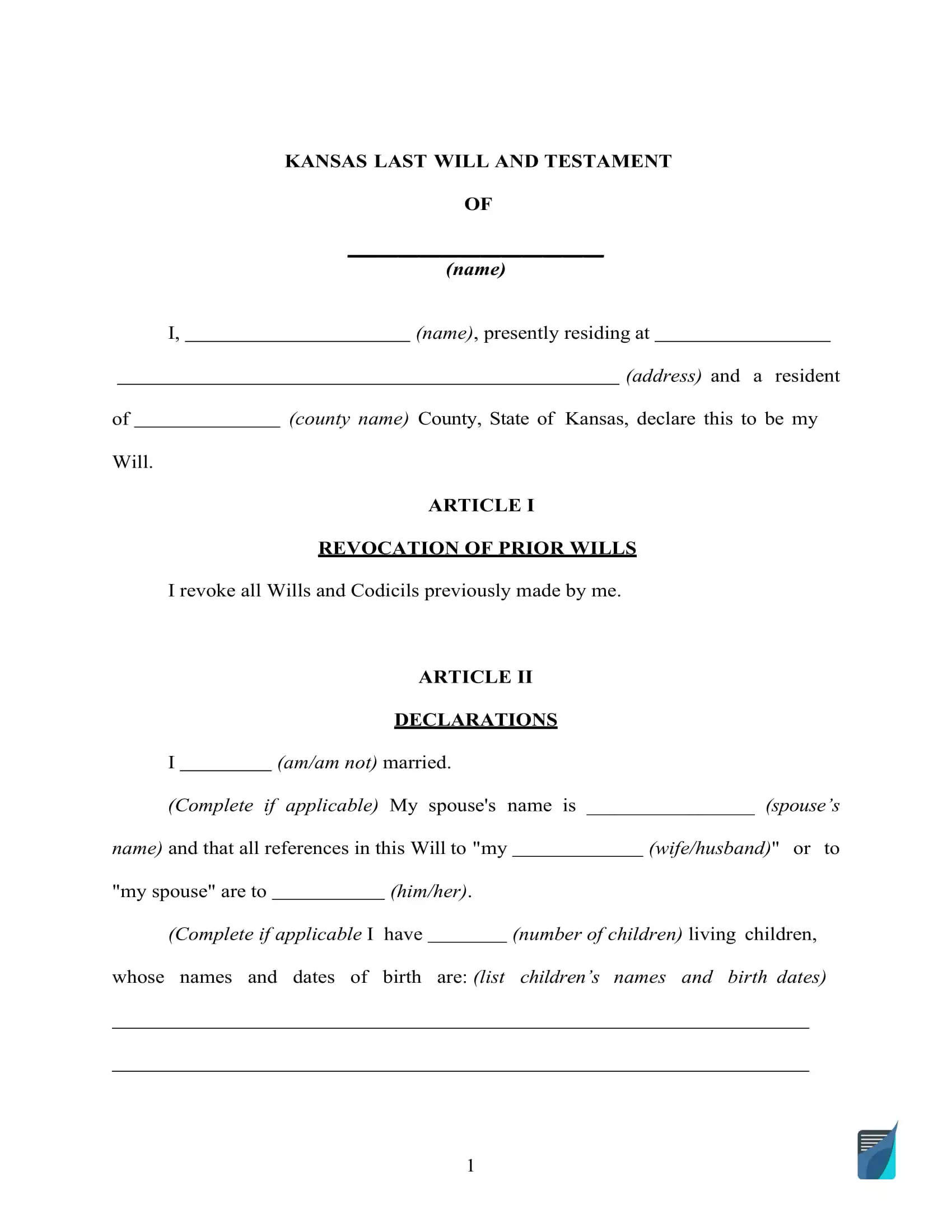
Here, we provide a free downloadable Kansas will template in DOC and PDF format, along with answers to frequent questions about this estate planning document. You can also use our tool to create a personalized will, or download the template below to fill in yourself.
Build Your Document
Answer a few simple questions to make your document in minutes
Save and Print
Save progress and finish on any device, download and print anytime
Sign and Use
Your valid, lawyer-approved document is ready
A last will is only valid in Kansas when it follows the state's execution rules. The will must be in writing and signed by the testator, or by someone else at the testator's direction and in their presence, at the end of the document, and it must be witnessed by two or more competent people.[2] The table below summarizes each requirement, what the law expects, and the statute behind it, so you can check your Kansas will template against every rule before you sign it.
Last Updated: September 2026. This guide is reviewed and updated regularly to reflect current Kansas law. If you notice an error or outdated information, please contact us.
| Requirements | State laws | |
| Definitions | Chapter 59, Probate Code, Article 1-102, Definitions | |
| Statutes | Chapter 59, Probate Code, Article 6, Wills | |
| Signing requirement | Two competent witnesses, signing in the testator's presence[2] | 59-606. Execution and attestation, self-proved wills and codicils, affidavits, form |
| Witness qualifications | Must be competent witnesses[2] | 59-606. Execution and attestation, self-proved wills and codicils, affidavits, form |
| Self-proving wills | Allowed[2] | 59-606. Execution and attestation, self-proved wills and codicils, affidavits, form |
| Handwritten (holographic) wills | Not recognized as a separate category. A handwritten will must still be signed and witnessed the same way as any other will[2] | 59-606. Execution and attestation, self-proved wills and codicils, affidavits, form |
| Oral wills | Recognized under certain circumstances[2] | 59-608. Nuncupative will |
Keep your signed will somewhere your executor can find it, and tell your witnesses where it is kept. A will that cannot be located can be treated as revoked.
A Kansas will template only produces a valid last will when three things are true. The document must be in writing and signed by the testator at the end, or by someone else at the testator's direction and in their presence. It must also be attested and subscribed by two or more competent witnesses who watched the signing or heard the testator acknowledge it.[2] You can download this Kansas will template above and check it against these requirements before you finalize it.
A written Kansas will can only be revoked or altered in three ways. You can write a new will, or sign a separate writing that revokes it using the same formalities as a will. You can also destroy the document with the intent to revoke it, whether you do it yourself or have someone act at your direction and in your presence.[1]
Yes. Kansas law lets you write your own will as long as it is in writing and signed at the end by you, or by someone else acting at your direction and in your presence.[2] It still needs two competent witnesses to be valid.
Filling out a Kansas last will and testament takes a few straightforward steps: naming your executor, listing your beneficiaries and assets, and signing the document in front of two witnesses. You can complete these steps by hand, with this downloadable Kansas will template, or with our online builder above. The steps below walk you through each part of the form.


Ready to finish your will? Download the free Kansas will template above, or use the button below to build and print it online right away.

A self-proving affidavit is an optional document you can add to your will, at signing or later, while you and your witnesses are still alive. It uses your and your witnesses' acknowledgments and affidavits so the witnesses don't have to testify in court during probate.[2] A notary public is needed to complete the affidavit.
It is not required in Kansas. However, adding a self-proving affidavit can be useful since it lets the witnesses' sworn statements stand in for their in-court testimony during probate.[2]
In many states, a surviving spouse can claim a minimum share of the estate even if the will tries to exclude them, so it is common to talk to an attorney before disinheriting a spouse.
Disinheriting other family members, such as adult children, is generally done by adding a specific disinheritance clause to the will naming the person and stating the intent to leave them nothing.
Yes. You can revoke or change your will the same way it was created: by writing a new one, by signing a separate document that revokes it, or by destroying the original with the intent to revoke it.[1] A contract you have already signed may limit this right.
In many states, a probate court will generally only accept the original signed will, not a copy, so a lost or damaged original can complicate probate.
When the original cannot be found, courts often presume it was intentionally destroyed and therefore revoked, unless someone can show otherwise. Proving that a lost will is still valid, and was not deliberately destroyed, can take significant time and evidence.
Under Kansas law, someone else may sign the will for you as long as it is done at your direction and in your presence.[2] You can give that direction by several means, including speaking, answering a question, or using a gesture.
A notary public can sign on behalf of a testator who is physically unable to do so, guided by the testator, in the presence of a witness. In practice, it is wise to choose witnesses who have no financial interest in the property the will covers.
| Related documents | When to create it |
| Codicil | There are a few minor adjustments you would like to make to your last will. |
| Self-proving affidavit | You want to save time and money for your will’s witnesses. |
| Living will | You would like to be sure your end-of-life treatment is carried out in line with your wishes. |
| Living trust | You want to skip probate by putting your assets in the possession of a trust. |
Last Will and Testament Forms for Other States
General information, not legal or tax advice.
