
Updated:
Get Form Now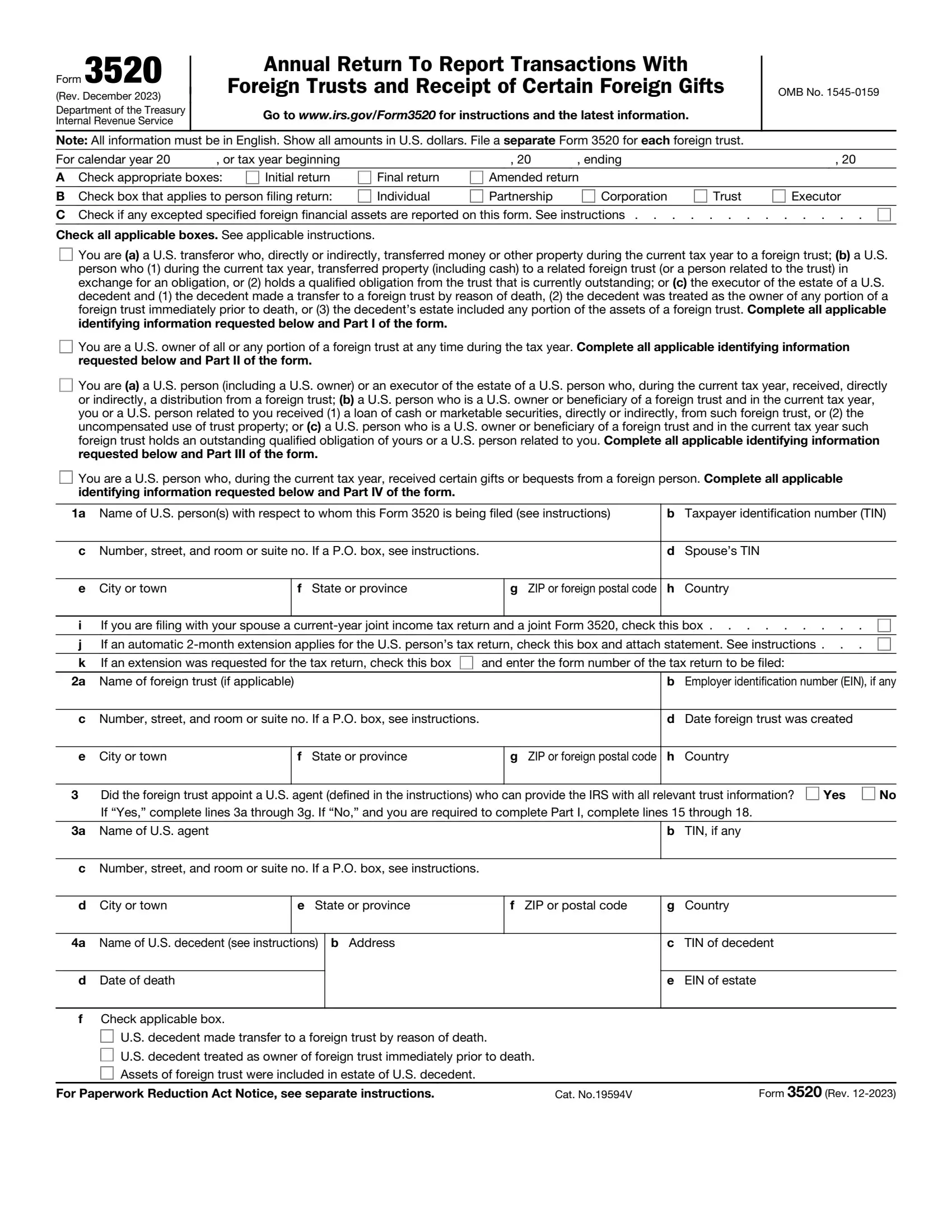
Form 3520 is a tax document used by U.S. persons to report certain transactions with foreign trusts and the receipt of large gifts or bequests from certain foreign persons. This form is required when a U.S. person:
It ensures that all such transactions are reported to the Internal Revenue Service (IRS), aiding in compliance with U.S. tax laws and regulations. The primary purpose of Form 3520 is to assist the IRS in identifying and obtaining information about international financial transactions that could affect U.S. tax liabilities. This includes understanding the nature and terms of U.S. ownership of foreign trusts and monitoring the movement of wealth across borders through substantial gifts or bequests. By requiring detailed disclosures, the IRS seeks to prevent tax evasion and ensure that all applicable taxes on international transactions are paid or reported.
Other IRS Forms for Trusts and Estates
The IRS requires certain categories of taxpayers to notify the Service of their acquisitions and actions. Check what other information these categories of taxpayers might need to report using other IRS forms.
What it is: Form 3520 is the Annual Return To Report Transactions With Foreign Trusts and Receipt of Certain Foreign Gifts.
Where and when to file: Form 3520 is due by the 15th day of the 4th month following the end of the taxpayer's tax year. However, taxpayers who live and work outside the United States have until the 15th day of the 6th month to file the form.[2]
U.S. persons (and executors of estates of U.S. decedents) file Form 3520 with the IRS to report certain transactions with foreign trusts, ownership of foreign trusts under the rules of sections 671 through 679, and receipt of certain large gifts or bequests from certain foreign persons.[2]
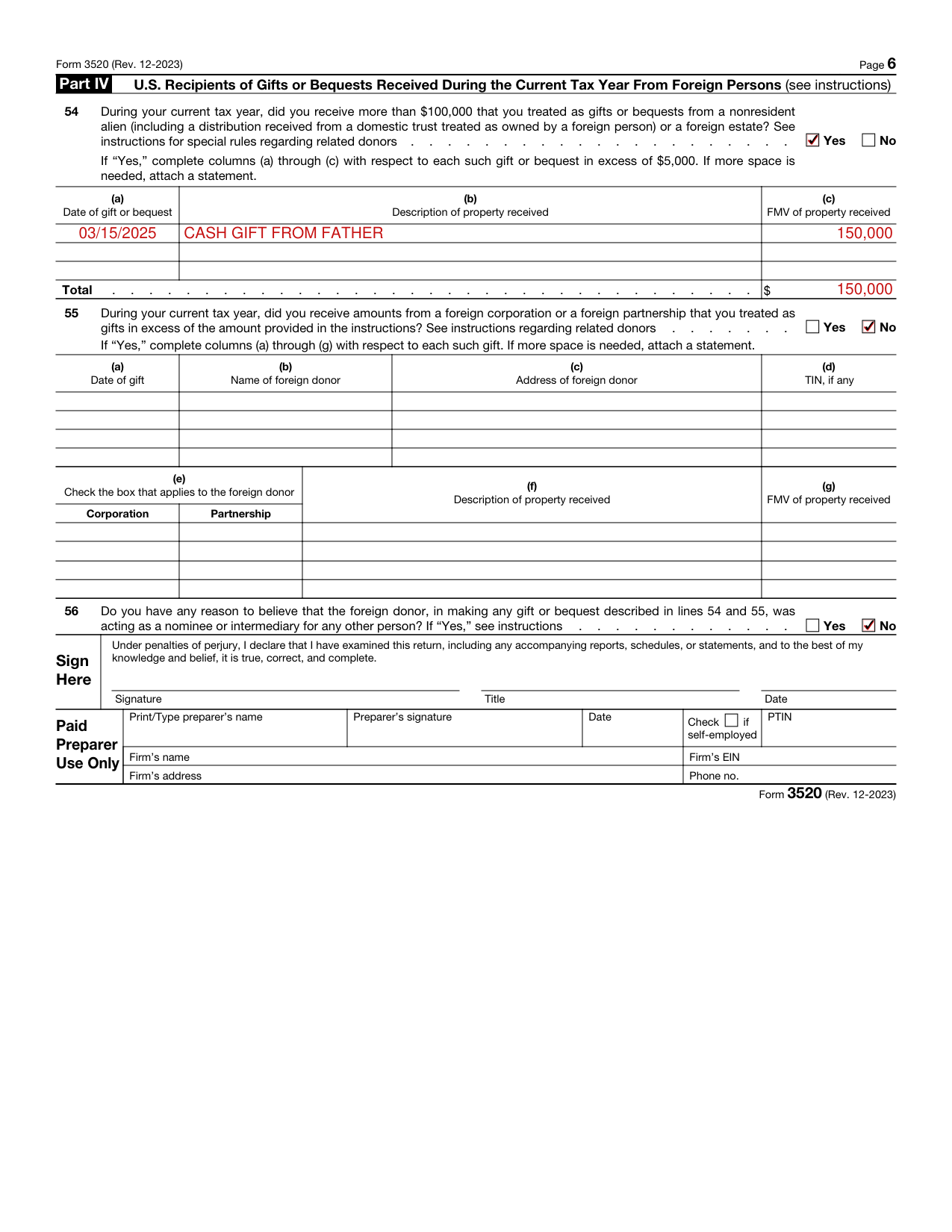

All information must be in English. Show all amounts in U.S. dollars. File a separate Form 3520 for each foreign trust.
For calendar-year filers, fill in the “calendar year” space at the top of the form. For fiscal-year filers, fill in the “tax year beginning” and “ending” spaces at the top of the form.
If this is the foreign trust's first return, check the “Initial return” box.
If the foreign trust ceases to exist, check the “Final return” box.
If this Form 3520 is filed to amend a previously filed Form 3520, check the “Amended return” box.
Check the box in Item C only if the Form 3520 filer also files Form 8938 for the same tax year and includes this form in the total number of Forms 3520 reported on line 15 of Part IV, Excepted Specified Foreign Financial Assets, of Form 8938.[2]
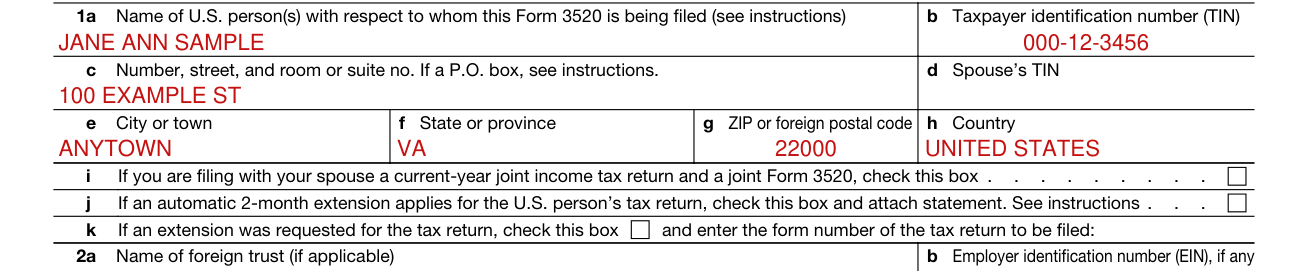
Line 1a identifies the person that is filing Form 3520.
If you and your spouse are filing a joint Form 3520, put your names and TINs in the same order as they appear on your Form 1040, U.S. Individual Income Tax Return, or Form 1040-SR, U.S. Tax Return for Seniors, and check the box on line 1i.
Use social security numbers (SSNs) or individual taxpayer identification numbers (ITINs) to identify individuals. Use employer identification numbers (EINs) to identify estates, trusts, partnerships, and corporations. Don't use an SSN in place of an EIN.[2]
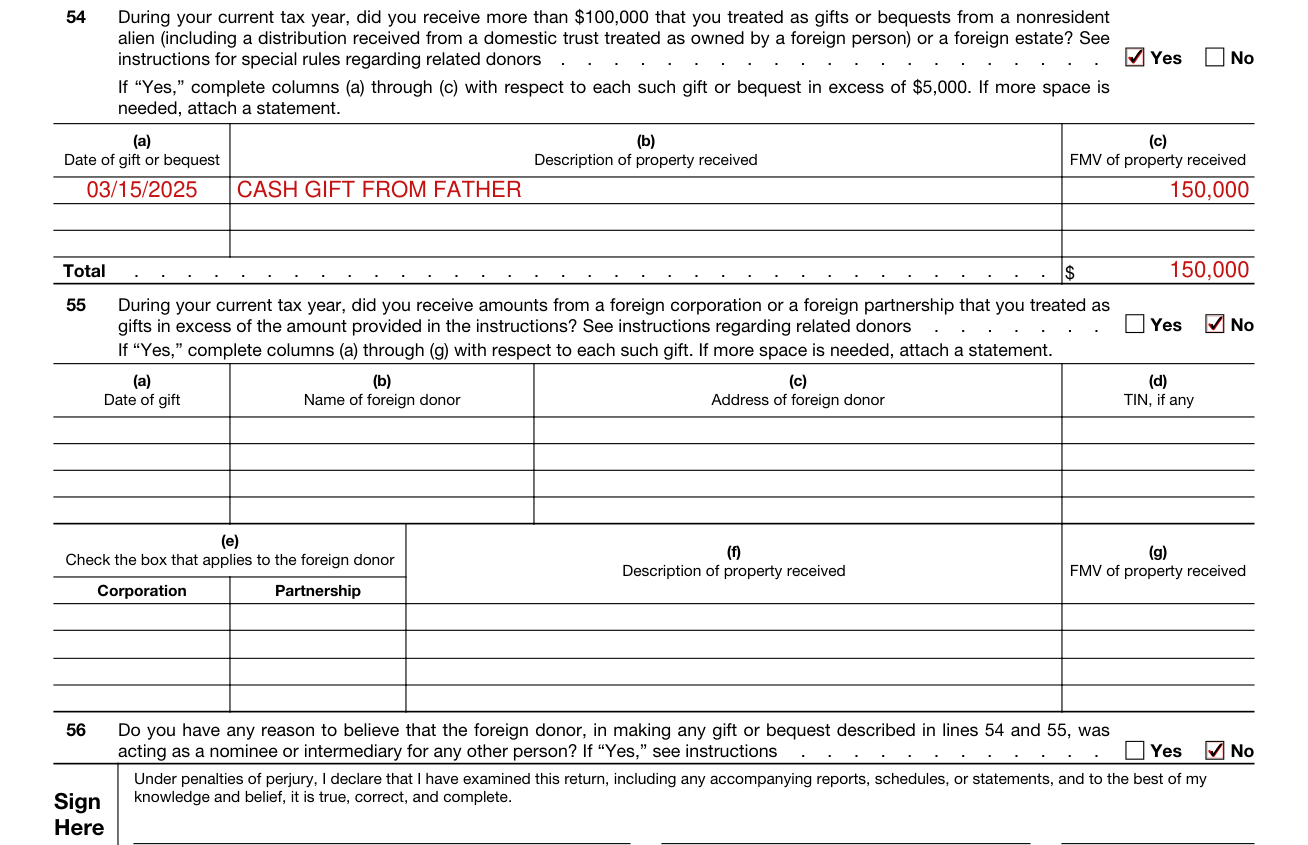
During your current tax year, did you receive more than $100,000 that you treated as gifts or bequests from a nonresident alien (including a distribution received from a domestic trust treated as owned by a foreign person) or a foreign estate? If “Yes,” complete columns (a) through (c) with respect to each such gift or bequest in excess of $5,000. (checked October 26, 2026)
If you answered “Yes” but none of the individual gifts or bequests received exceeds $5,000, do not complete columns (a) through (c). (checked October 26, 2026)
Instead, enter in column (b) of the first line, “No gifts or bequests exceed $5,000.” (checked October 26, 2026)
A gift to a U.S. person does not include any amount paid for qualified tuition or medical payments made on behalf of the U.S. person.
Check “Yes” if you received aggregate amounts in excess of the section 6039F threshold amount during the current tax year that you treated as gifts from any of the following: foreign corporations; foreign partnerships; any foreign persons that you know or have reason to know are related to such foreign corporations or foreign partnerships.
To obtain the threshold amount, go to IRS.gov/InflationAdjustment.
Check “Yes” if you have any reason to believe that the foreign donor, in making any gift or bequest described in lines 54 and 55, was acting as a nominee or intermediary for any other person. If the ultimate donor on whose behalf the reporting donor is acting is a foreign corporation or foreign partnership, attach an explanation including the ultimate foreign donor's name, address, TIN (if any) and whether it is a corporation or partnership.[2]

Under penalties of perjury, I declare that I have examined this return, including any accompanying reports, schedules, or statements, and to the best of my knowledge and belief, it is true, correct, and complete.
If Form 3520 is filed by an individual or a fiduciary, it must be signed and dated by that individual or fiduciary.
E-signatures are accepted.
When using a paid preparer, the paid preparer must complete the required preparer information at the bottom of page 6, including their name, Preparer Tax Identification Number (PTIN), and other identifying details; sign the return in the space provided for the preparer's signature; and provide a copy of the return to the filer.[2]
You are a U.S. owner of all or any portion of a foreign trust at any time during the tax year. Complete all applicable identifying information and Part II of the form.
You are required to complete Part II even if there have been no transactions involving the trust during the tax year.[2]
If you received an amount from a portion of a foreign trust of which you are treated as the owner, only complete lines 24 and 27.
If a foreign trust makes a distribution to a U.S. person, the U.S. person must report the amount as a distribution in Part III, rather than as a gift in Part IV.[2]
Send Form 3520 to Internal Revenue Service Center P.O. Box 409101 Ogden, UT 84409. Only a complete Form 3520 is considered timely filed. Form 3520 is considered complete only if all required attachments are included.[2]
A penalty applies if Form 3520 is not timely filed or if the information is incomplete or incorrect. The initial penalty is equal to the greater of $10,000 or the following (as applicable). It is 35% of the gross value of any property transferred to a foreign trust for failure by a U.S. transferor to report the creation of or transfer to a foreign trust in Part I. It is 35% of the gross value of the distributions received from a foreign trust for failure by a U.S. person to report receipt of the distribution in Part III. It is 5% of the gross value of the portion of the foreign trust's assets treated as owned by a U.S. person under the grantor trust rules (sections 671 through 679), if the foreign trust (a) fails to file a timely Form 3520-A and furnish the required annual statements to its U.S. owners and U.S. beneficiaries; or (b) does not furnish all of the information required by section 6048(b) or includes incorrect information. (checked October 26, 2026)
In the case of a failure to timely report foreign gifts described in section 6039F, the IRS may determine the income tax consequences of the receipt of such gift, and a penalty equal to 5% of the amount of such foreign gifts applies for each month for which the failure to report continues (not to exceed a total of 25%).[2]
Form 3520 is due by the 15th day of the 4th month following the end of the taxpayer's tax year. If a U.S. person is granted an extension of time to file an income tax return, Form 3520 is due no later than the 15th day of the 10th month following the end of the U.S. person's tax year. If the due date falls on a Saturday, Sunday, or legal holiday, file by the next day that is not a Saturday, Sunday, or legal holiday.[2]
Form 3520 does not have to be filed to report transfers to foreign trusts that have a current determination letter from the IRS recognizing their status as exempt from income taxation under section 501(c)(3).[2]
[1] Form 3520 (Rev. December 2023), Annual Return To Report Transactions With Foreign Trusts and Receipt of Certain Foreign Gifts, Department of the Treasury Internal Revenue Service (the Official source link on this page).
[2] Instructions for Form 3520 (Rev. December 2025), Department of the Treasury Internal Revenue Service.