
Updated:
Get Form Now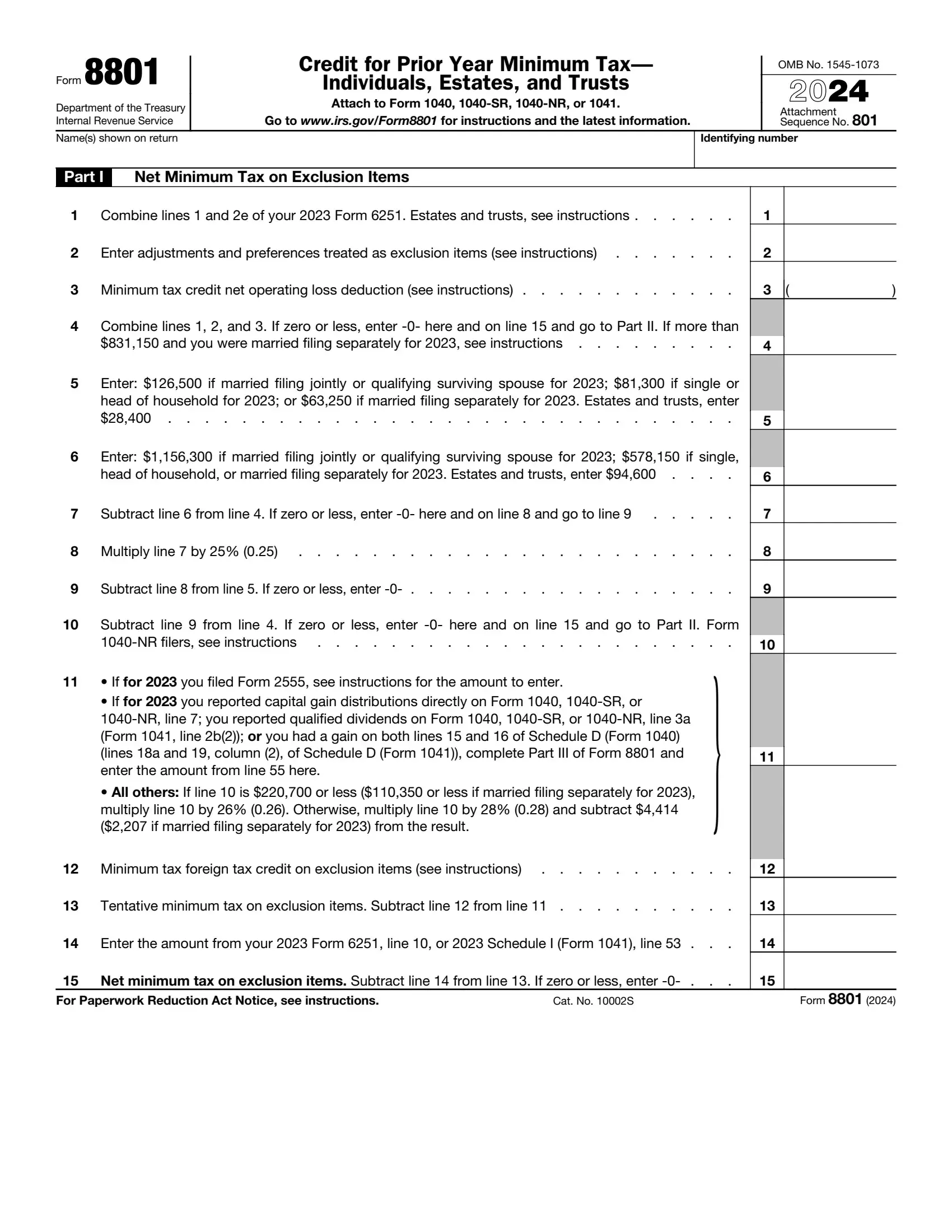
IRS Form 8801 is a U.S. tax document used to calculate the credit for prior year minimum tax for individuals, estates, and trusts. This form is particularly relevant for those subject to the alternative minimum tax (AMT) in a previous year. The AMT is a separate tax calculation intended to ensure that taxpayers with high incomes pay at least a minimum amount of tax.
Form 8801 allows taxpayers to determine if they can claim a credit on their current year’s tax return for any AMT paid in previous years. This credit ensures taxpayers are not doubly taxed on the same income over different years. It provides a mechanism to recover a portion of the AMT paid when the taxpayer’s regular tax exceeds their tentative minimum tax in a subsequent year.
What it is: Form 8801 is the Credit for Prior Year Minimum Tax form for individuals, estates, and trusts.
Where and when to file: Attach Form 8801 to Form 1040, 1040-SR, 1040-NR, or 1041.
Use Form 8801 if you are an individual, estate, or trust to figure the minimum tax credit, if any, for alternative minimum tax (AMT) you incurred in prior tax years and to figure any credit carryforward to 2026.[2]
Complete Form 8801 if you are an individual, estate, or trust that for 2024 had an AMT liability and adjustments or preferences other than exclusion items, a credit carryforward to 2025 (on 2024 Form 8801, line 26), or an unallowed qualified electric vehicle credit (see the instructions for line 20).[2]
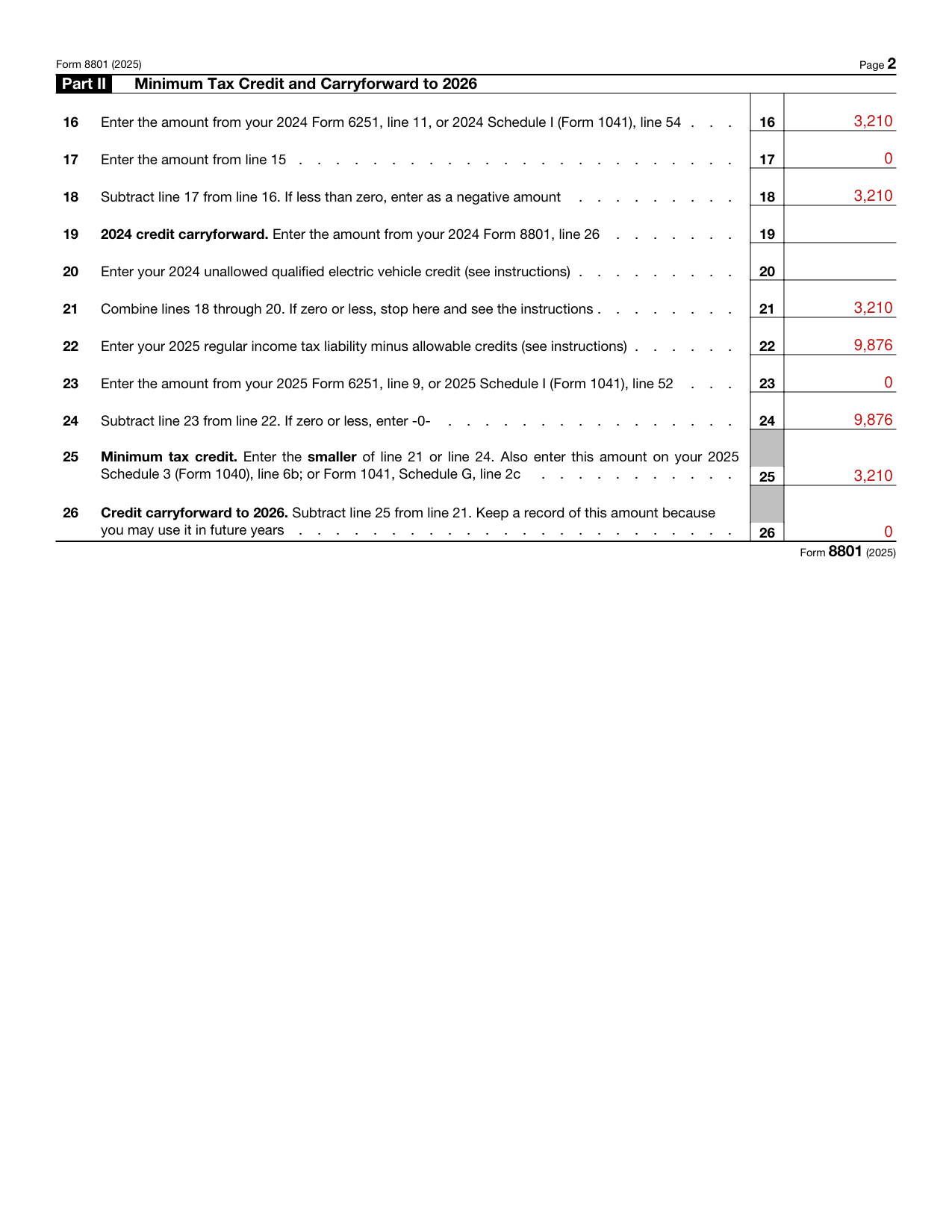

Enter the Name(s) shown on return and the Identifying number.
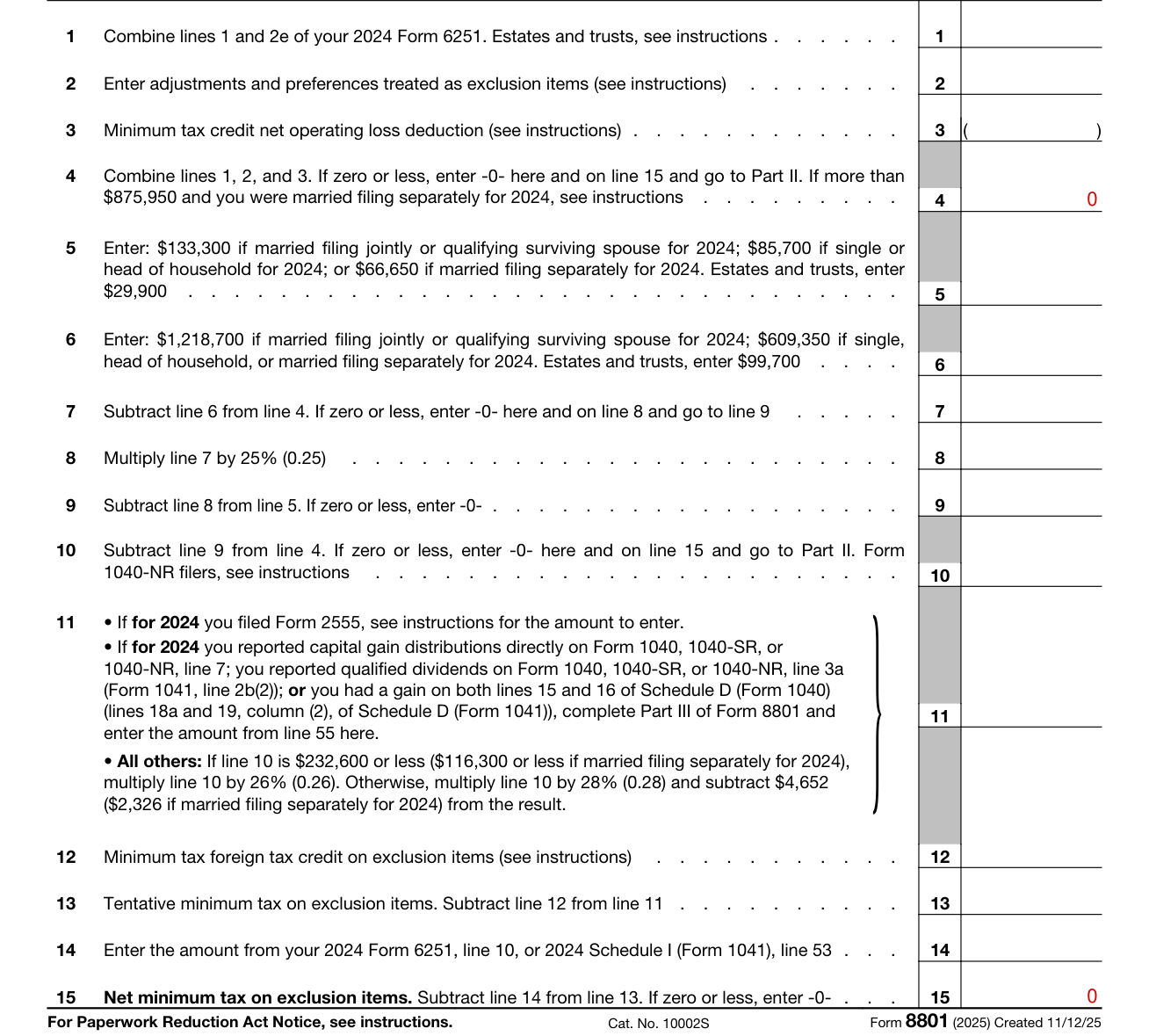
On line 1, combine lines 1 and 2e of your 2024 Form 6251. Estates and trusts, see instructions.
On line 2, enter adjustments and preferences treated as exclusion items (see instructions). Exclusion items are only the following AMT adjustments and preferences: certain itemized deductions (including any investment interest expense reported on Schedule E), certain tax-exempt interest, depletion, the section 1202 exclusion, the standard deduction, and any other adjustments related to exclusion items.
If you didn't file a Schedule A in 2024, include your 2024 standard deduction.
On line 3, enter the minimum tax credit net operating loss deduction (see instructions).
On line 4, combine lines 1, 2, and 3. If zero or less, enter -0- here and on line 15 and go to Part II. If more than $875,950 and you were married filing separately for 2024, see instructions (checked November 17, 2026).
On line 14, enter the amount from your 2024 Form 6251, line 10, or 2024 Schedule I (Form 1041), line 53. On line 15, subtract line 14 from line 13. If zero or less, enter -0-.[2]
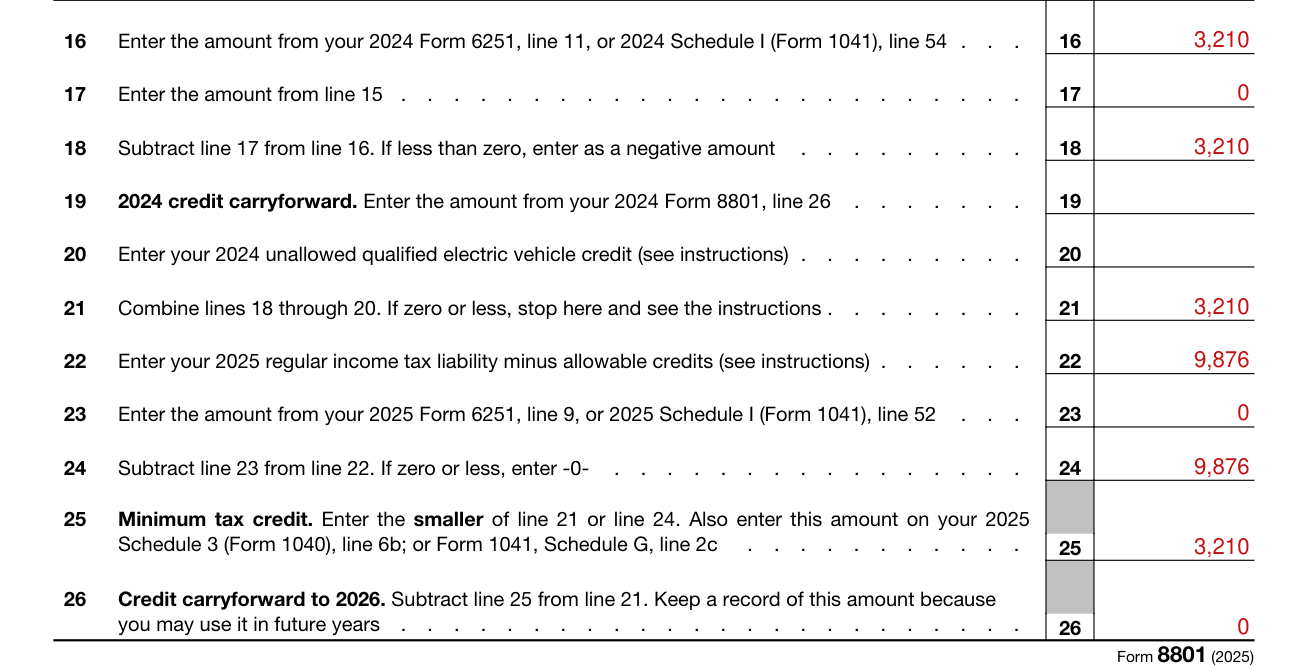
On line 16, enter the amount from your 2024 Form 6251, line 11, or 2024 Schedule I (Form 1041), line 54.
On line 17, enter the amount from line 15. On line 18, subtract line 17 from line 16. If less than zero, enter as a negative amount.
On line 19, enter the amount from your 2024 Form 8801, line 26 (2024 credit carryforward).
In Part II, Minimum Tax Credit and Carryforward to 2026, on line 20 enter your 2024 unallowed qualified electric vehicle credit (see instructions). Enter any qualified electric vehicle credit not allowed for 2024 solely because of the limitation under section 30(b)(3)(B) (as in effect prior to the amendment of section 30 by Public Law 111-5, the American Recovery and Reinvestment Tax Act of 2009).
On line 21, combine lines 18 through 20. If zero or less, stop here and see the instructions. If line 21 is zero or less, you don't have a minimum tax credit or a credit carryforward.
On line 22, enter your 2025 regular income tax liability minus allowable credits (see instructions). Follow the instructions below and refer to your 2025 income tax return to figure the amount to enter on line 22.
Form 1040, 1040-SR, or 1040-NR. Add the amounts from Form 1040, 1040-SR, or 1040-NR, line 16 and Schedule 2 (Form 1040), line 1z. Subtract from the result the total of any credits from Form 1040, 1040-SR, or 1040-NR, line 19 and Schedule 3 (Form 1040), lines 1 through 6z (not including any credit for prior year minimum tax on line 6b or any credit claimed on Form 8912, Credit to Holders of Tax Credit Bonds, on line 6k). Enter the result. If the result is zero or less, enter -0-.
On line 23, enter the amount from your 2025 Form 6251, line 9, or 2025 Schedule I (Form 1041), line 52. On line 24, subtract line 23 from line 22. If zero or less, enter -0-.
On line 25, enter the smaller of line 21 or line 24 as the minimum tax credit. Also enter this amount on your 2025 Schedule 3 (Form 1040), line 6b; or Form 1041, Schedule G, line 2c.
On line 26, subtract line 25 from line 21 for the credit carryforward to 2026. Keep a record of this amount because you may use it in future years.[2]
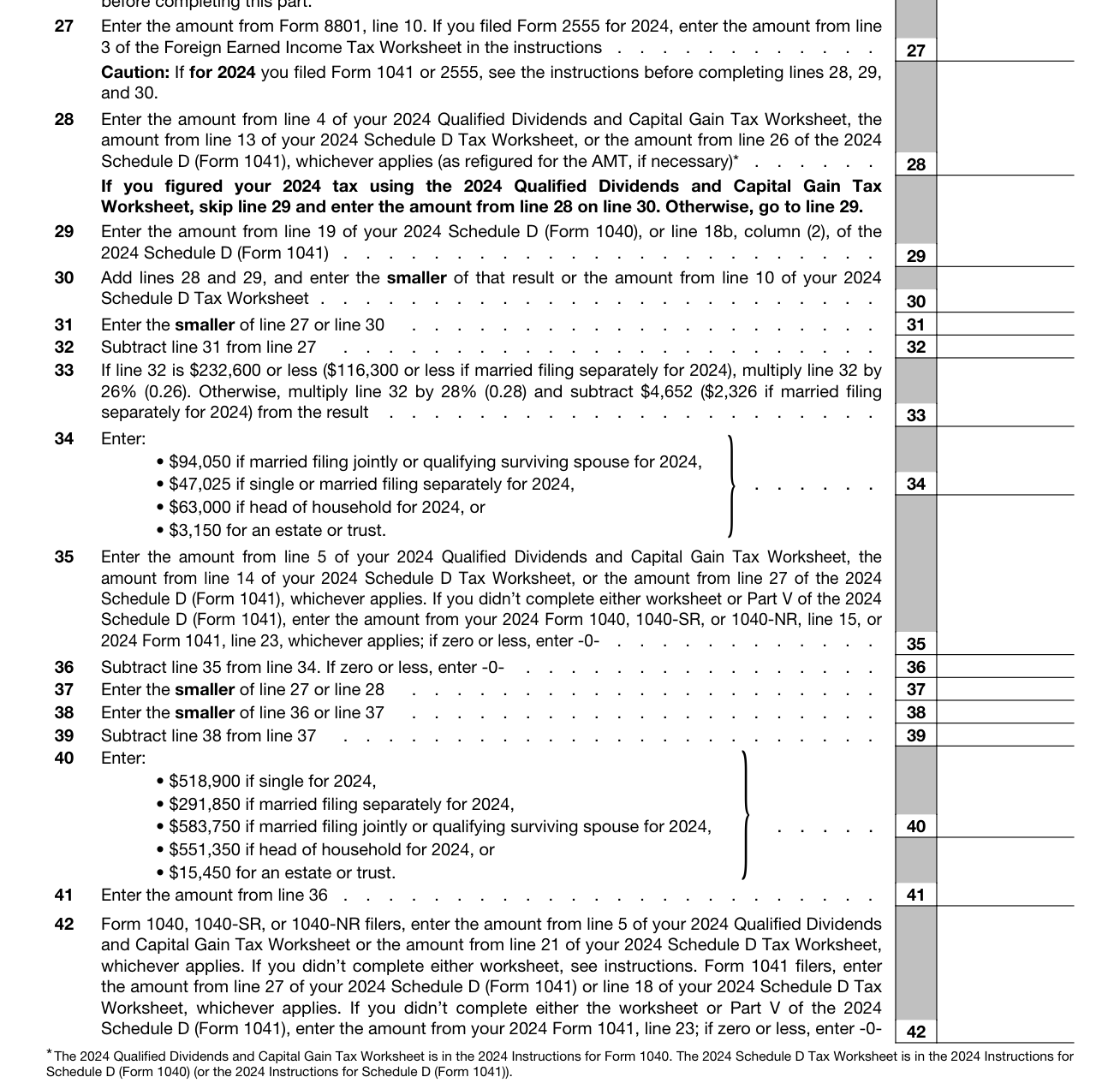
On page 3 of Form 8801 (2025), complete Part III only if you are required to do so by line 11 or by the Foreign Earned Income Tax Worksheet in the instructions.
Caution: If you didn't complete the 2024 Qualified Dividends and Capital Gain Tax Worksheet, the 2024 Schedule D Tax Worksheet, or Part V of the 2024 Schedule D (Form 1041), see the instructions before completing this part. On line 27, enter the amount from Form 8801, line 10.
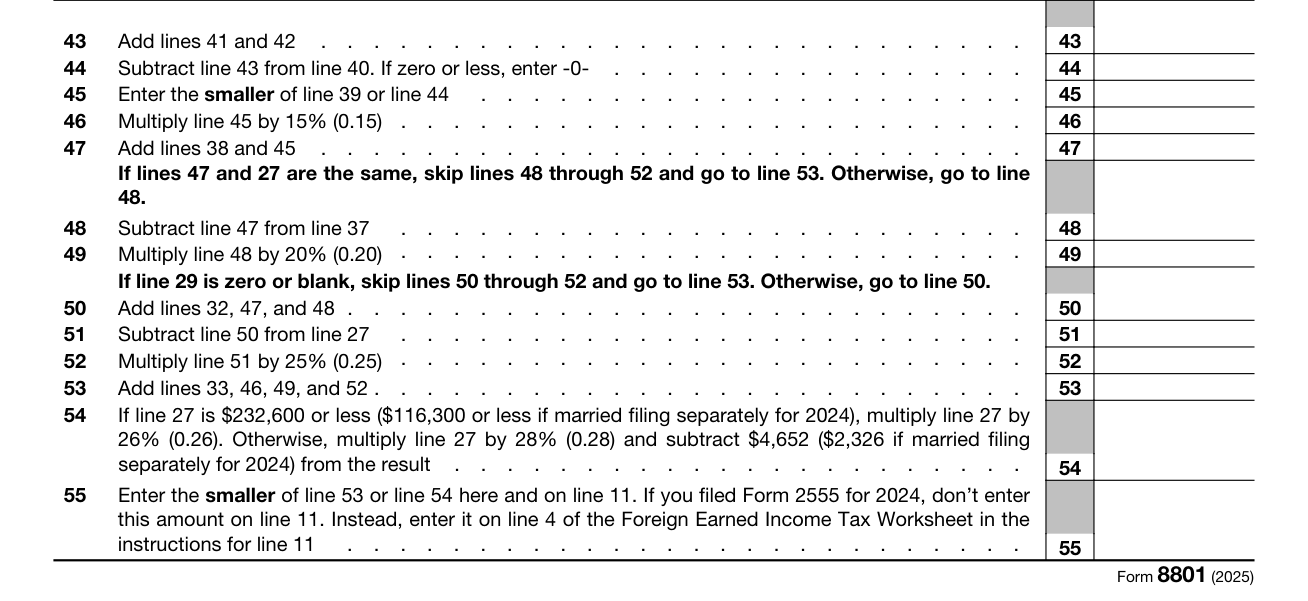
On page 4 of Form 8801 (2025), Part III Tax Computation Using Maximum Capital Gains Rates (continued): on line 55, enter the smaller of line 53 or line 54 here and on line 11. If you filed Form 2555 for 2024, don't enter this amount on line 11. Instead, enter it on line 4 of the Foreign Earned Income Tax Worksheet in the instructions for line 11.
If you are filing on behalf of an estate or trust, skip lines 1 through 3 of Form 8801.
To figure the amount to enter on line 4 of Form 8801, complete Parts I and II of another 2024 Schedule I (Form 1041), as a worksheet. If the amount on Schedule I, line 27, is zero or less, enter -0- on Form 8801, line 4.
If you complete Parts I and II of a 2024 Schedule I (Form 1041), as a worksheet to figure the amount to enter on 2025 Form 8801, line 4, don't attach that worksheet Schedule I to your tax return. Instead, keep it for your records.
Form 1041, Schedule G. Add the credits on lines 2a and 2b, plus any write-in credits on line 2e. Subtract the result from the total of lines 1a, 1b, and 1d, plus any Form 8978 amount included on line 1e. Enter the result. If the result is zero or less, enter -0-.[2]
Form 8801 is the Credit for Prior Year Minimum Tax form for individuals, estates, and trusts. The minimum tax credit is allowed only for the AMT caused by deferral items.[2]
File Form 8801 only if line 21 is more than zero.[2]
[1] Form 8801 (2025), Credit for Prior Year Minimum Tax, Individuals, Estates, and Trusts, Internal Revenue Service (the Official source link on this page).
[2] 2025 Instructions for Form 8801, Internal Revenue Service.