
Updated:
Get Form Now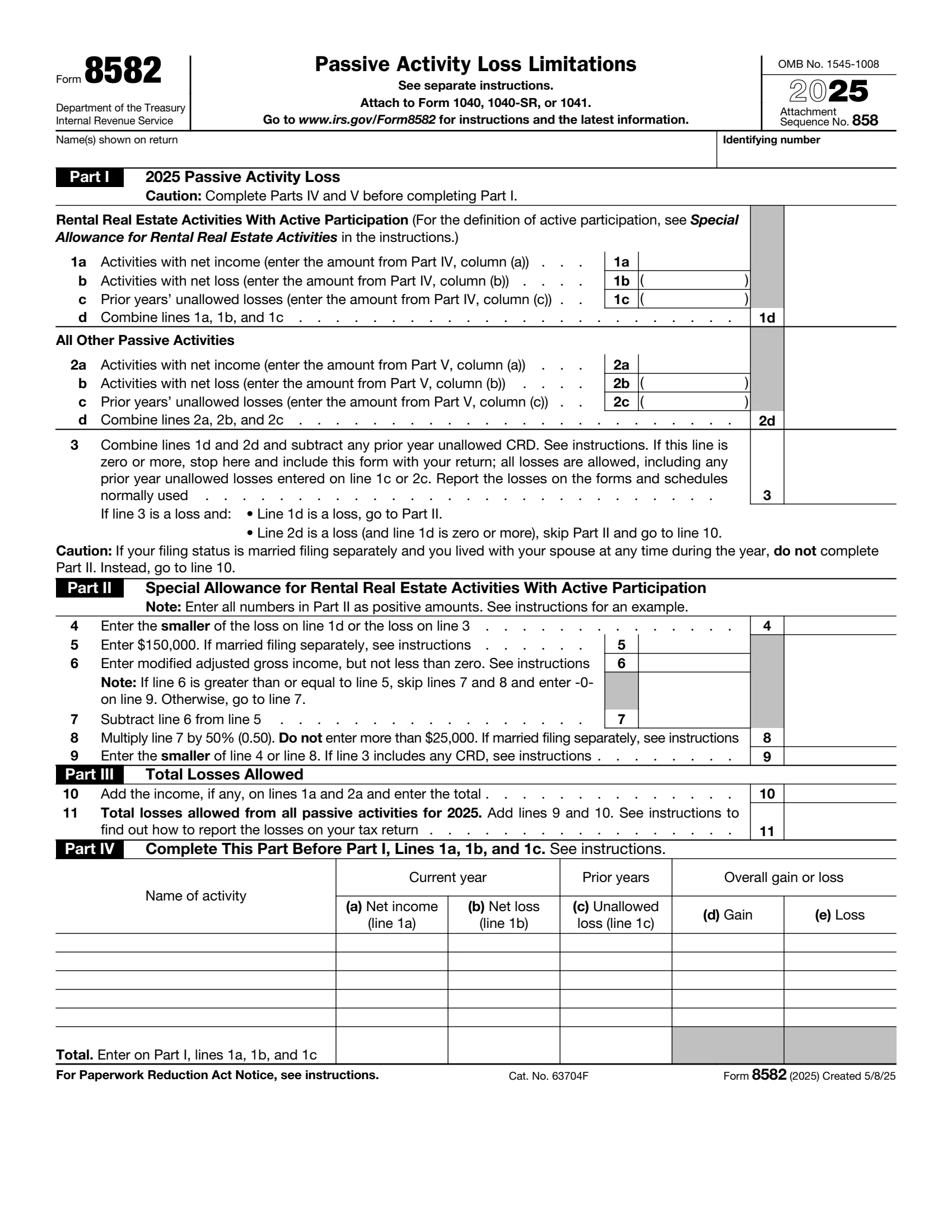
IRS Form 8582, titled “Passive Activity Loss Limitations,” is a tax form individuals, estates, and trusts use to report passive activity income and losses. This form calculates taxpayers’ allowable passive activity loss deduction on their tax returns.
The primary purpose of Form 8582 is to help taxpayers determine the amount of passive activity losses they can deduct against their passive activity income. Passive activities are business activities the taxpayer does not materially participate in, such as rental real estate activities or investments in limited partnerships. Form 8582 helps taxpayers determine if they are subject to the limitations of passive activity loss and calculate the amount of any losses that can be deducted in the current tax year. By completing this form, taxpayers can accurately report their passive activity income and losses and determine their overall tax liability.
Other IRS Forms for Trusts and Estates
The Form 8582 is a must-have for individuals, estates, and trusts who have passive activity deductions. Look through some other iRS forms that are mandatory for the same category of taxpayers.
What it is: Form 8582 (Passive Activity Loss Limitations) is used by noncorporate taxpayers to figure any passive activity loss for the current tax year and to report prior-year unallowed passive activity losses.[2]
Where and when to file: Attach Form 8582 to Form 1040, 1040-SR, or 1041.
Form 8582 is filed by individuals, estates, and trusts who have passive activity deductions (including prior year unallowed losses).[2]
You do not have to file Form 8582 if you meet the following exception: you actively participated in rental real estate activities, and you meet all of the following conditions.[2]
Rental real estate activities with active participation were your only passive activities.[2]
You have no prior-year unallowed losses from these (or any other passive) activities.[2]
Your total loss from the rental real estate activities wasn't more than $25,000 ($12,500 if married filing separately). (checked October 31, 2026)[2]
If you're married filing separately, you lived apart from your spouse all year.[2]
You have no current or prior-year unallowed credits from a passive activity.[2]
Your modified adjusted gross income was not more than $100,000 ($50,000 if married filing separately). (checked October 31, 2026)[2]
You don't hold any interest in a rental real estate activity as a limited partner or as a beneficiary of an estate or a trust.[2]
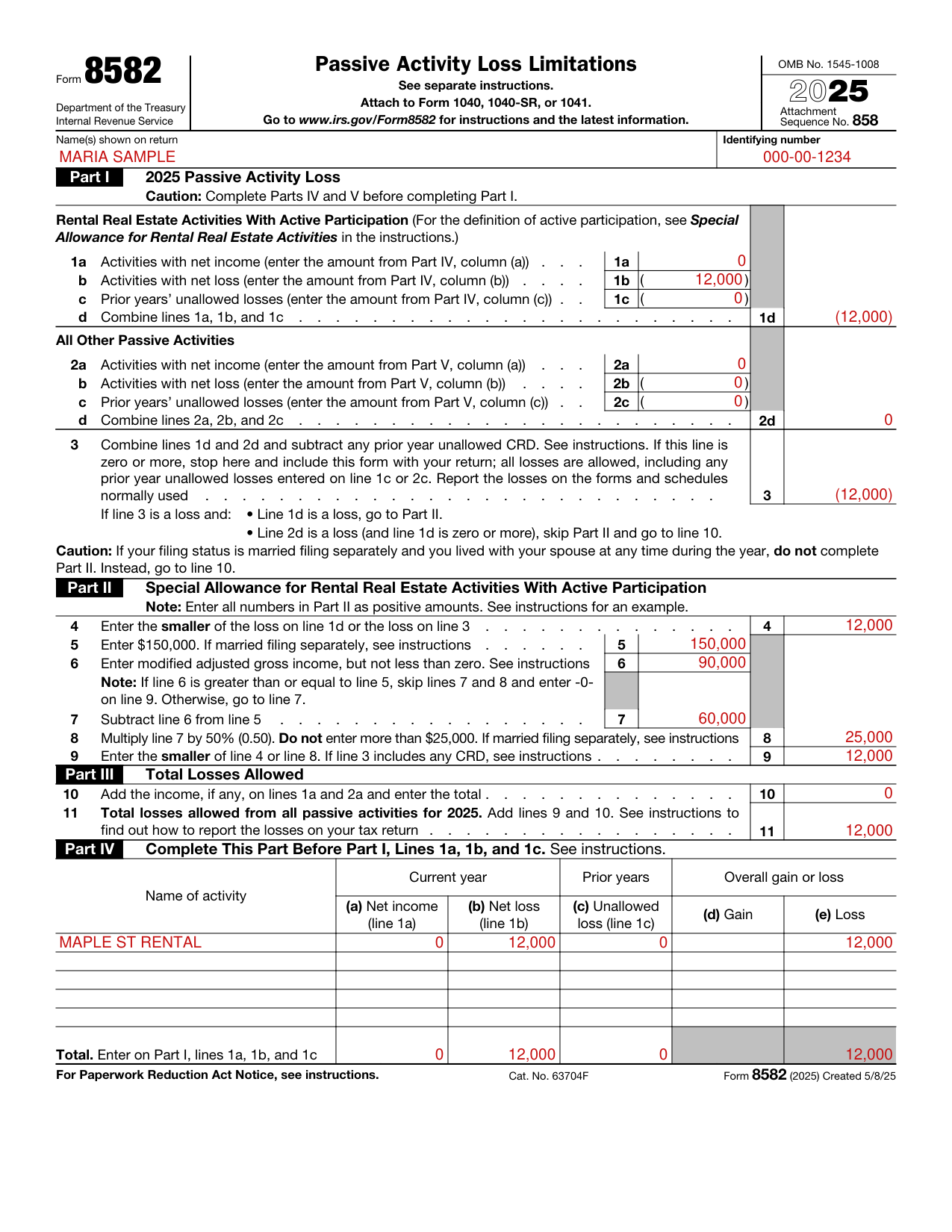

Enter the name(s) shown on return and the identifying number.
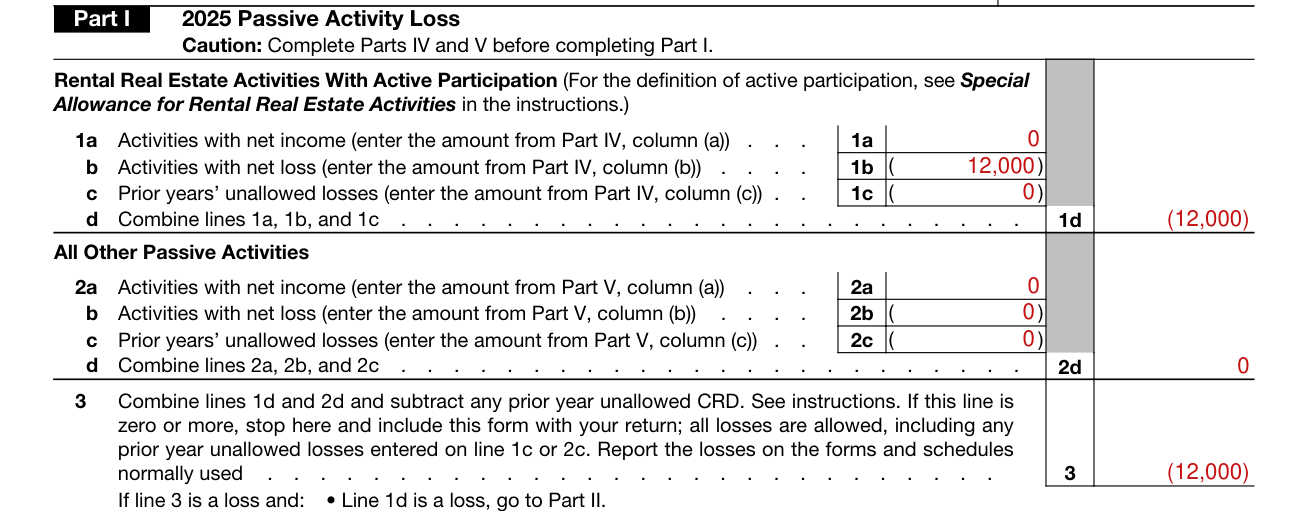
Complete Parts IV and V before completing Part I.
On line 3, combine lines 1d and 2d and subtract any prior year unallowed CRD. If this line is zero or more, stop here and include this form with your return; all losses are allowed, including any prior year unallowed losses entered on line 1c or 2c. Report the losses on the forms and schedules normally used. If line 3 is a loss and line 1d is a loss, go to Part II. If line 3 is a loss and line 2d is a loss (and line 1d is zero or more), skip Part II and go to line 10. If your filing status is married filing separately and you lived with your spouse at any time during the year, do not complete Part II. Instead, go to line 10.
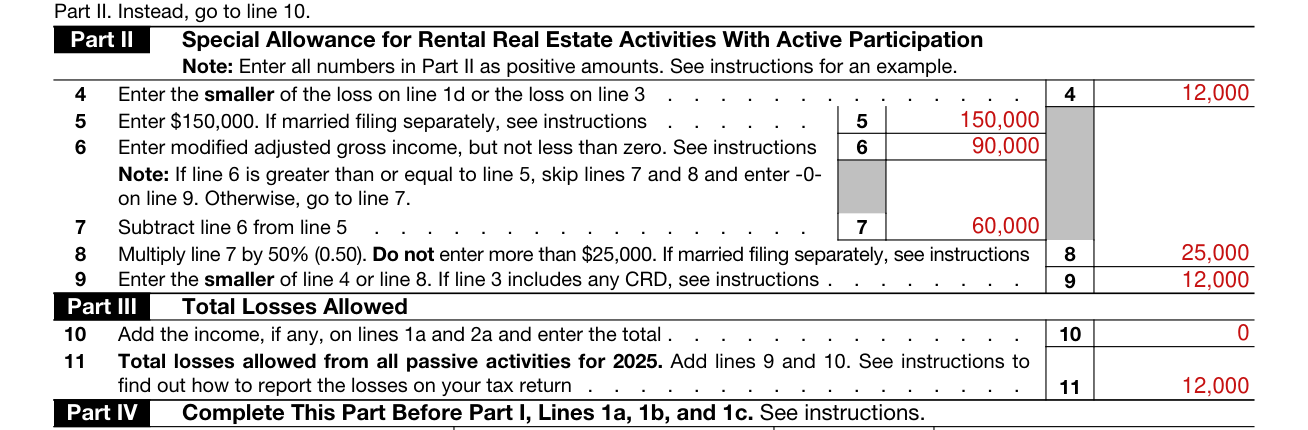
Part II is the special allowance for rental real estate activities with active participation. Enter all numbers in Part II as positive amounts. On line 4, enter the smaller of the loss on line 1d or the loss on line 3. On line 5, enter $150,000; if married filing separately, see instructions. (checked October 31, 2026) On line 6, enter modified adjusted gross income, but not less than zero. If line 6 is greater than or equal to line 5, skip lines 7 and 8 and enter -0- on line 9. Otherwise, go to line 7. On line 7, subtract line 6 from line 5. On line 8, multiply line 7 by 50% (0.50) and do not enter more than $25,000; if married filing separately, see instructions. (checked October 31, 2026) On line 9, enter the smaller of line 4 or line 8; if line 3 includes any CRD, see instructions. Part III is the total of the losses allowed. On line 10, add the income, if any, on lines 1a and 2a and enter the total. On line 11, total losses allowed from all passive activities for 2025, add lines 9 and 10; see instructions to find out how to report the losses on your tax return.
Married persons filing separate returns who lived apart from their spouses at all times during the year must enter $75,000 on line 5 instead of $150,000. (checked October 31, 2026)
Don't enter more than $12,500 on line 8 if you're married filing a separate return and you and your spouse lived apart at all times during the year. (checked October 31, 2026)[2]
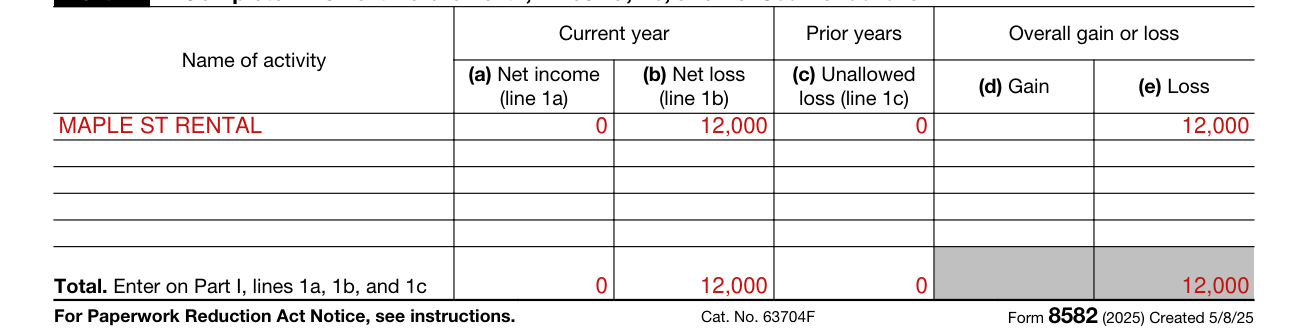
Individuals and qualifying estates who actively participated in rental real estate activities must include the income or loss from those activities in Part IV to figure the amounts to enter on Part I, lines 1a through 1c, of Form 8582.
Don't enter a prior-year unallowed loss in column (c) of Part IV unless you actively participated in the activity in both the year the loss arose and the current tax year. If you didn't actively participate in both years, enter the prior-year unallowed loss in column (c) of Part V.
Married individuals who file separate returns and lived with their spouses at any time during the tax year don't qualify under the active participation rule and must use Part V instead of Part IV.
Box 7, Column (a): Enter the current year net income from each activity.
Box 7, Column (b): Enter the current year net loss for each activity. Don't enter any prior-year unallowed losses in this column.
Box 7, Column (c): Enter the prior-year unallowed losses for each activity. You find these amounts in Part VII, column (c), of your 2024 Form 8582.
Parts IV and V, columns (d) and (e), show whether an activity had an overall gain or loss.
Don't enter amounts from columns (d) and (e) in Part I, II, or III of Form 8582.[2]
A PAL occurs when total losses (including prior-year unallowed losses) from all your passive activities exceed the total income from all your passive activities.
Generally, passive activities include trade or business activities in which you did not materially participate for the tax year, and rental activities, regardless of your participation.[2]
If you actively participated in a passive rental real estate activity, you may be able to deduct up to $25,000 of loss from the activity from your nonpassive income. (checked October 31, 2026) The special allowance isn't available if you were married, are filing a separate return for the year, and lived with your spouse at any time during the year.
If your modified adjusted gross income (see the instructions for line 6) is $100,000 or less ($50,000 or less if married filing separately), your loss is deductible up to the amount of the maximum special allowance. (checked October 31, 2026) If your modified adjusted gross income is more than $100,000 ($50,000 if married filing separately) but less than $150,000 ($75,000 if married filing separately), your special allowance is limited to 50% of the difference between $150,000 ($75,000 if married filing separately) and your modified adjusted gross income. (checked October 31, 2026) Generally, if your modified adjusted gross income is $150,000 or more ($75,000 or more if married filing separately), there is no special allowance. (checked October 31, 2026)[2]
To figure modified adjusted gross income, combine all the amounts used to figure adjusted gross income, except don't take into account: any passive activity loss as defined in section 469(d)(1); any rental real estate loss allowed to real estate professionals; or the taxable amount of social security and tier 1 railroad retirement benefits.
Except don't take into account: deductible contributions to traditional individual retirement accounts (IRAs) and section 501(c)(18) pension plans; the deduction allowed for the deductible part of self-employment taxes; the exclusion from income of interest from series EE and I U.S. savings bonds used to pay higher education expenses; the exclusion of amounts received under an employer's adoption assistance program; the student loan interest deduction; or the deduction allowed for foreign-derived intangible income and global intangible low-taxed income.[2]
Corporations subject to the passive activity rules must use Form 8810, Corporate Passive Activity Loss and Credit Limitations.[2]
[1] Form 8582 (2025), Passive Activity Loss Limitations, Internal Revenue Service (the Official source link on this page).
[2] Instructions for Form 8582 (2025), Internal Revenue Service.