
Updated:
Get Form Now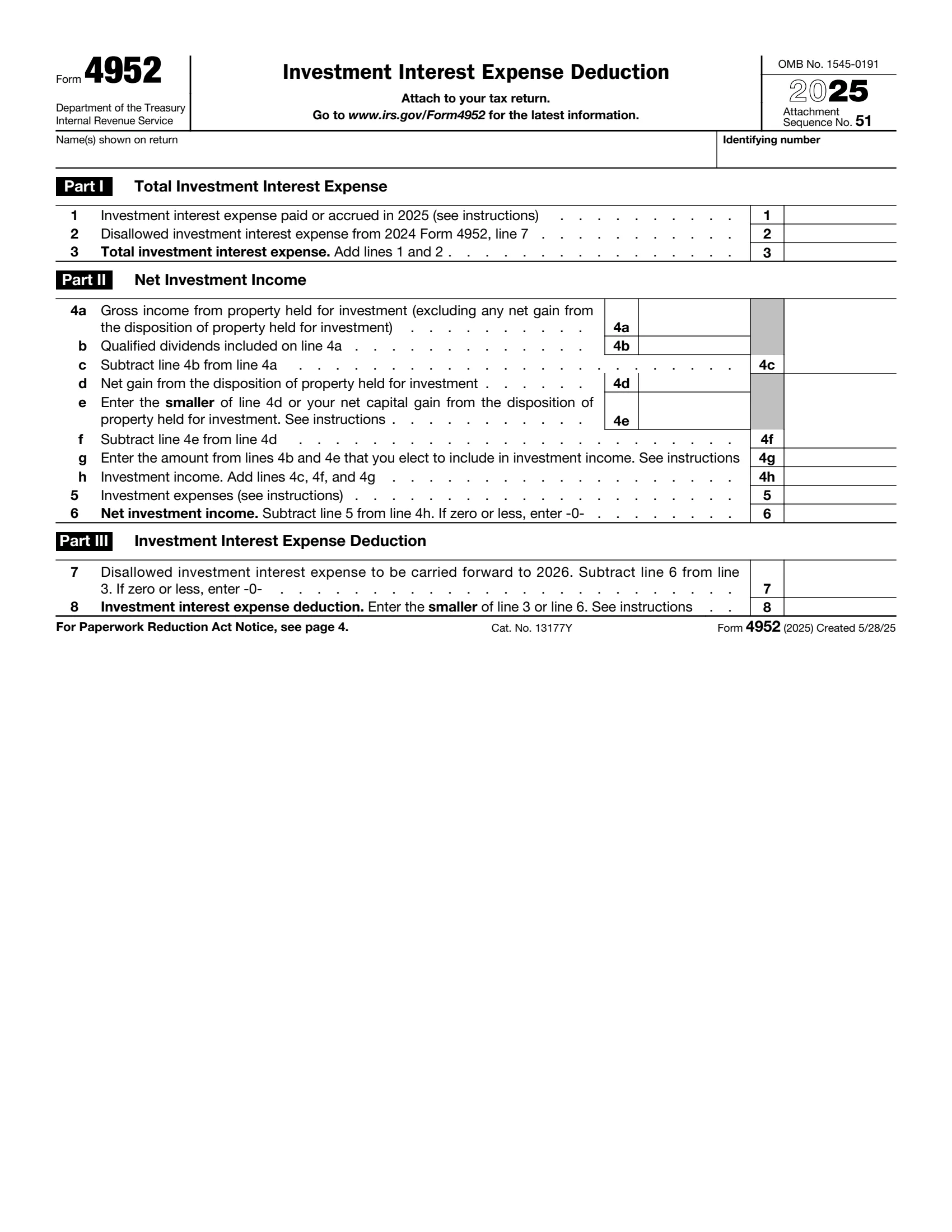
IRS Form 4952 is a tax form taxpayers use to calculate and report their investment interest expense deduction. This deduction applies to individuals and certain entities who have incurred interest expenses on loans to purchase or carry investment property, such as stocks, bonds, mutual funds, or rental properties. Form 4952 helps taxpayers determine the amount of investment interest they can deduct on their tax returns, subject to certain limitations and restrictions outlined by the Internal Revenue Service (IRS).
When completing Form 4952, taxpayers must provide detailed information about their investment interest expenses, including the amount of interest paid, the type of investment property financed with the loan, and any related income generated from the investments. The form also requires taxpayers to calculate the deductible amount of investment interest based on their net investment income, which may include interest, dividends, capital gains, and other investment-related income. By accurately completing Form 4952, taxpayers can claim the appropriate deduction for investment interest expenses, reducing their taxable income and potentially lowering their overall tax liability.
What it is: Form 4952 is the 2025 Investment Interest Expense Deduction form.
Where and when to file: Attach Form 4952 to your tax return.
If you are an individual, an estate, or a trust, you must file Form 4952 to claim a deduction for your investment interest expense.
You don't have to file Form 4952 if all of the following apply.
Your investment income from interest and ordinary dividends minus any qualified dividends is more than your investment interest expense.
You don't have any other deductible investment expenses.
You don't have any carryover of disallowed investment interest expense from 2024.

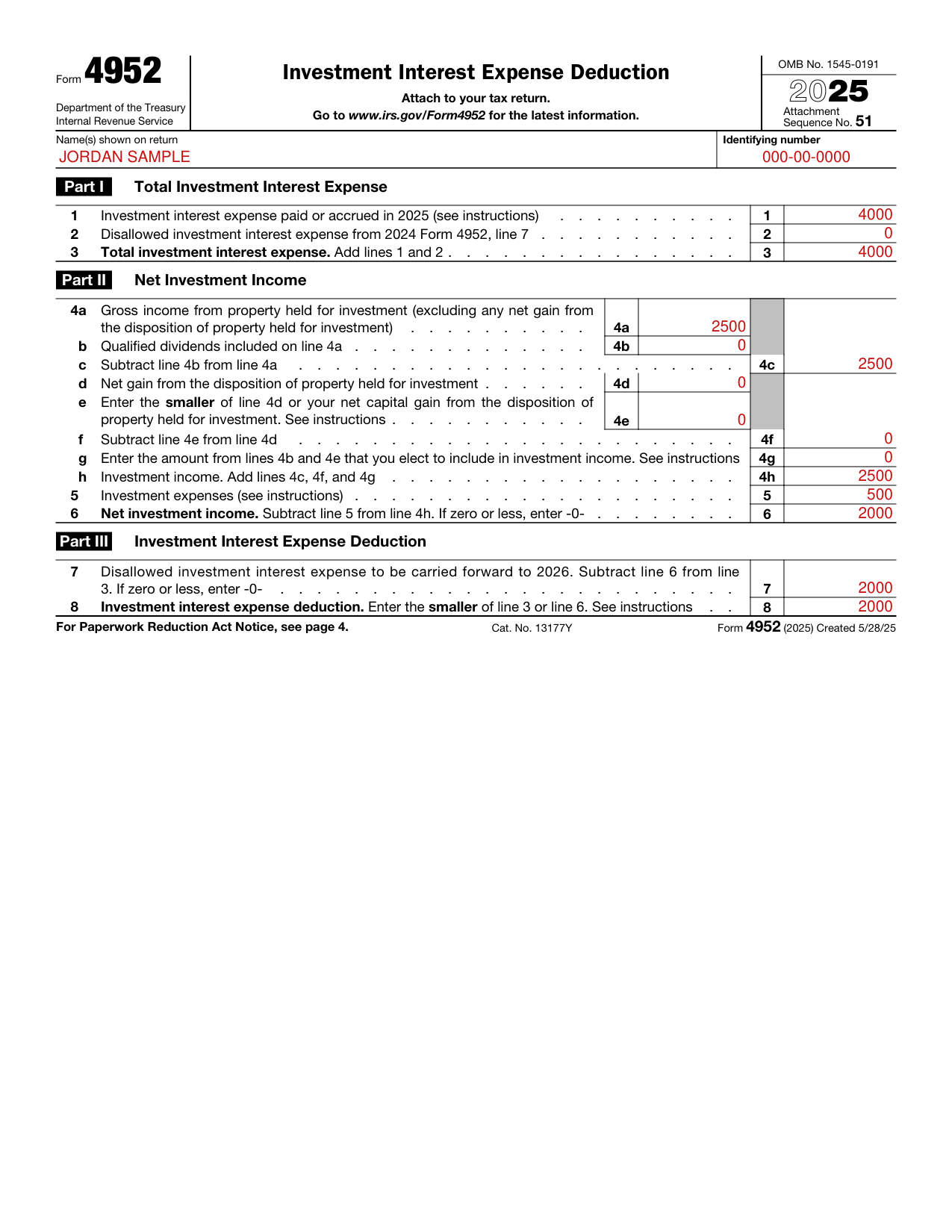
Enter the name(s) shown on your return and your identifying number.

On line 1, enter the investment interest expense paid or accrued during the tax year, regardless of when you incurred the indebtedness.
Include on line 1 investment interest expense reported to you on Schedule K-1 from a partnership or an S corporation.
Investment interest expense doesn't include personal interest under section 163(h), including qualified residence interest, or interest expense that is properly allocable to a passive activity.
On line 2, enter the disallowed investment interest expense from 2024 Form 4952, line 7.
On line 3, add lines 1 and 2 to get the total investment interest expense.
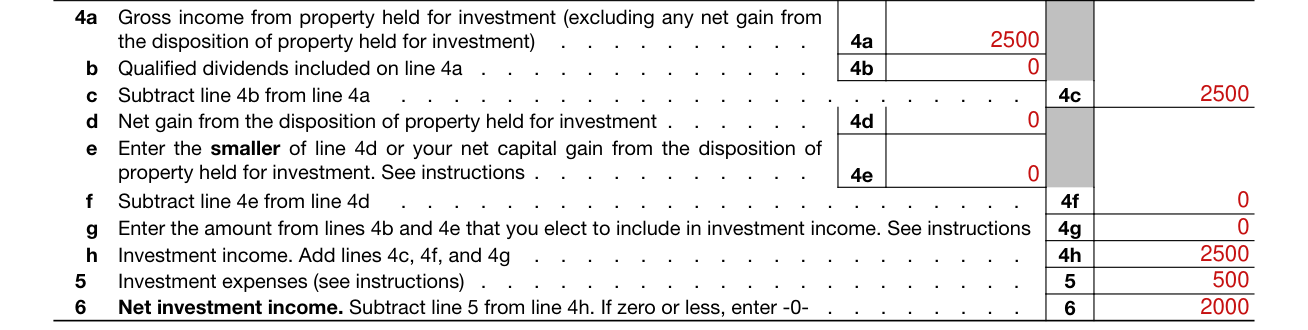
On line 4a, enter the gross income from property held for investment (excluding any net gain from the disposition of property held for investment).
Don't include on line 4a any net gain from the disposition of property held for investment. Instead, enter it on line 4d.
On line 4b, enter the portion of ordinary dividends included on line 4a that are qualified dividends.
On line 4c, subtract line 4b from line 4a.
On line 4d, enter the net gain from the disposition of property held for investment, which is the excess, if any, of your total gains over your total losses from the disposition of property held for investment.
On line 4e, enter the smaller of line 4d or your net capital gain from the disposition of property held for investment.
On line 4f, subtract line 4e from line 4d.
On line 4g, in general, qualified dividends and net capital gain from the disposition of property held for investment are excluded from investment income. But you can elect to include part or all of these amounts in investment income.
To make the election, enter on line 4g the amount you elect to include in investment income (don't enter more than the sum of lines 4b and 4e). The qualified dividends and net capital gain that you elect to include in investment income on line 4g aren't eligible to be taxed at the qualified dividends or capital gains tax rates. Once made, the election can be revoked only with IRS consent.
On line 4h, add lines 4c, 4f, and 4g to get the investment income.
Investment expenses on line 5 are your allowed deductions, other than interest expense, directly connected with the production of investment income.
Don't include any miscellaneous itemized deductions, which aren't allowed deductions in tax years beginning after December 31, 2017, and before January 1, 2026.
On line 6, subtract line 5 from line 4h. If zero or less, enter -0-.

On line 7, subtract line 6 from line 3. If zero or less, enter -0-. This is the disallowed investment interest expense to be carried forward to 2026.
On line 8, enter the smaller of line 3 or line 6 as the investment interest expense deduction.
Individuals: generally, enter the amount from line 8 (excluding any amount included on Form 6198, line 4) on Schedule A (Form 1040), line 9, even if all or part of it is attributable to a partnership or an S corporation.
Estates and trusts: enter the amount from line 8 (excluding any amount included on Form 6198, line 4) on Form 1041, line 10.
Your investment interest expense deduction is limited to your net investment income.
Use Form 4952 to figure the amount of investment interest expense you can deduct for 2025 and the amount you can carry forward to future years.
[1] Form 4952 (2025), Investment Interest Expense Deduction, Internal Revenue Service.