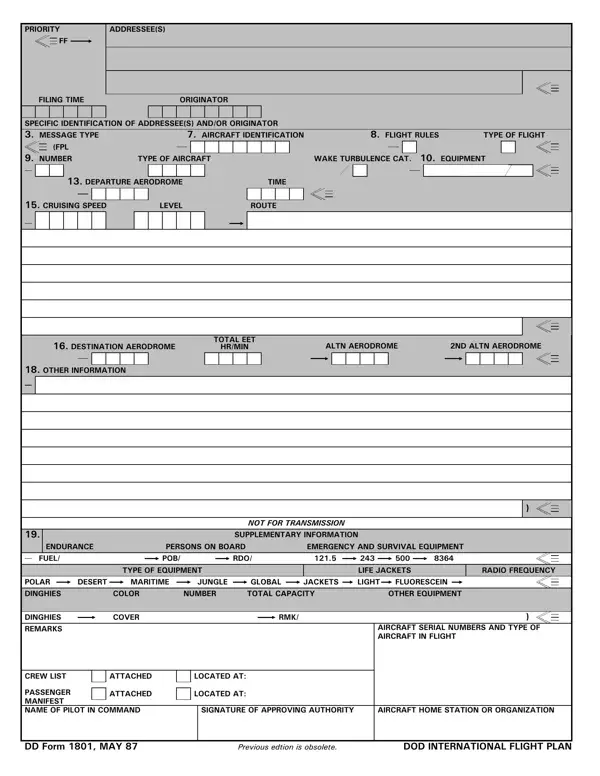
Dd Form 1801 PDF Details
The DoD International Flight Plan is a crucial document designed to provide comprehensive information about flight details for military and certain government operations. This form captures information for international flight plan submissions, from aircraft identification through emergency equipment details, ensuring every flight is properly coordinated with air traffic control authorities.
Key Sections of the DoD International Flight Plan
The form is organized into several major sections that pilots and crew must complete accurately before submitting their flight plan:
- Flight Information: Aircraft identification (ICAO type designator), flight rules (IFR or VFR), type of flight (S, N, G, M, or X), and number of aircraft in formation
- Departure Details: ICAO identifier of the departure aerodrome, departure time in UTC (Zulu time), and requested cruising speed
- Cruising Level and Route: Initial cruising altitude, full route description with significant waypoints, airways, and change of level points
- Destination and Alternates: Destination aerodrome, total estimated elapsed time (EET), first and second alternate aerodromes for contingency planning
- Emergency Equipment: Emergency radio frequencies (121.5 or 243.0 MHz), life jackets, dinghies (number, capacity, color, cover type), and survival equipment for polar, desert, maritime, or jungle conditions
- Supplementary Information: Fuel endurance in hours and minutes, total persons on board, emergency contact information, and aircraft color and markings
Who Uses This International Flight Plan Form
Military aviators, government contractors, and authorized DoD personnel submit this form when operating international flights. The DoD International Flight Plan is required for all international flight plan submissions to air traffic control authorities along IFR and VFR international routes. Civilian pilots may use it for flights coordinated with military air traffic control facilities.
When to File Your International Flight Plan
IFR international flight plans must be filed no later than 3 hours before estimated off-block time (EOBT). VFR international flight plans should be filed at least 30 minutes before departure. All times entered on this plan must use UTC (Coordinated Universal Time), also known as Zulu time. Using local time is a common error that results in rejected or delayed flight plan processing.
How to Complete the Other Information Field
The OTHER INFORMATION field (field 18) is frequently misused in this international flight plan document. Enter supplementary data using approved ICAO code indicators. For example: STS/ for special handling, PBN/ for performance-based navigation, and DOF/ for date of flight. All entries in this field generate more errors than any other part of the plan. Double-check every code before final submission.
Common Mistakes to Avoid
Pilots regularly make errors when completing this flight plan document:
- Using local time instead of UTC (Zulu) for departure and arrival times
- Omitting alternate aerodromes when required by flight rules
- Leaving the emergency equipment section incomplete
- Incorrect aircraft identification codes (use ICAO designators, not FAA N-numbers)
- Failing to include the full route description with all significant flight waypoints
- Entering the wrong cruising level format (use FL for flight levels or altitude in feet)
Related Aviation and Flight Plan Forms
If you work with international aviation documents, you may also need the
International Flight Plan form for ICAO-standard submissions or the
ASA Flight Planning Sheet for VFR cross-country flight planning. DoD personnel frequently use the
DD Form 1351-2 for travel claims associated with flight operations. The
DD Form 149 is used for military aviation records corrections.
| Question | Answer |
|---|
| Form Name | Dd Form 1801 |
| Form Length | 1 pages |
| Fillable? | No |
| Fillable fields | 0 |
| Avg. time to fill out | 15 sec |
| Other names | dd 1801, 1801 fillable, dd form 1801 pdf, tar 1801 fillable |