Free Power of Attorney NJ Form for General Financial Matters
A New Jersey general financial power of attorney is a written document in which a person, the principal, names an agent to handle their money and property. If you need a power of attorney NJ form for financial matters, FormsPal's free PDF is ready to fill out online, print, and sign. It does not cover medical decisions. You can also browse every New Jersey power of attorney form in one place.
Last Updated: October 2026. This guide is reviewed and updated regularly to reflect current New Jersey law. If you notice an error or outdated information, please contact us.
Create a high-quality New Jersey General Financial Power of Attorney Form now!
Build Your Document
Answer a few simple questions to make your document in minutes
Save and Print
Save progress and finish on any device, download and print anytime
Sign and Use
Your valid, lawyer-approved document is ready
... or download your New Jersey General Financial Power of Attorney Form as a PDF file
What Are the New Jersey General Power of Attorney Requirements?
New Jersey state law sets the basic rules for creating a power of attorney. The power of attorney must be in writing, and the principal must sign it. It must also be notarized, because the law requires the signature to be acknowledged in the manner set out in R.S. 46:14-2.1.[1.3]
The statute puts the rule this way:
A power of attorney must be in writing, duly signed and acknowledged in the manner set forth in R.S.46:14-2.1.
Tip: The form includes an acknowledgment block for a notary public on page 5. See our New Jersey notary acknowledgment page for that part, and the FAQ below for the notarization rule.
Additionally, under Section 46:2B-8.11, any third party presented with a power of attorney may rely upon a photocopy or a certified copy of the original signed document.[2.1]
The rest of this page walks through the form itself and then explains how a New Jersey power of attorney ends, based on the statute sections listed under Sources.
New Jersey General Power of Attorney Form Details
Document Name
New Jersey General Power of Attorney Form
Other Name
New Jersey Financial Power of Attorney
Relevant Laws
N.J.S.A. 46:2B-8.5(b), 46:2B-8.6(a), 46:2B-8.9 and 46:2B-8.10
Avg. Time to Fill Out
10 minutes
# of Fillable Fields
41
Available Formats
Adobe PDF
How to Fill Out the New Jersey General Power of Attorney Form
The New Jersey general financial power of attorney form has five pages and 41 fillable fields. Work through it in the order below, from the principal and agent names on page 1 to the notary acknowledgment on page 5.
The screenshots under each step show the FormsPal New Jersey general power of attorney template filled with sample entries in blue, so you can see where each answer goes. The names, addresses, dates and amounts are examples only.
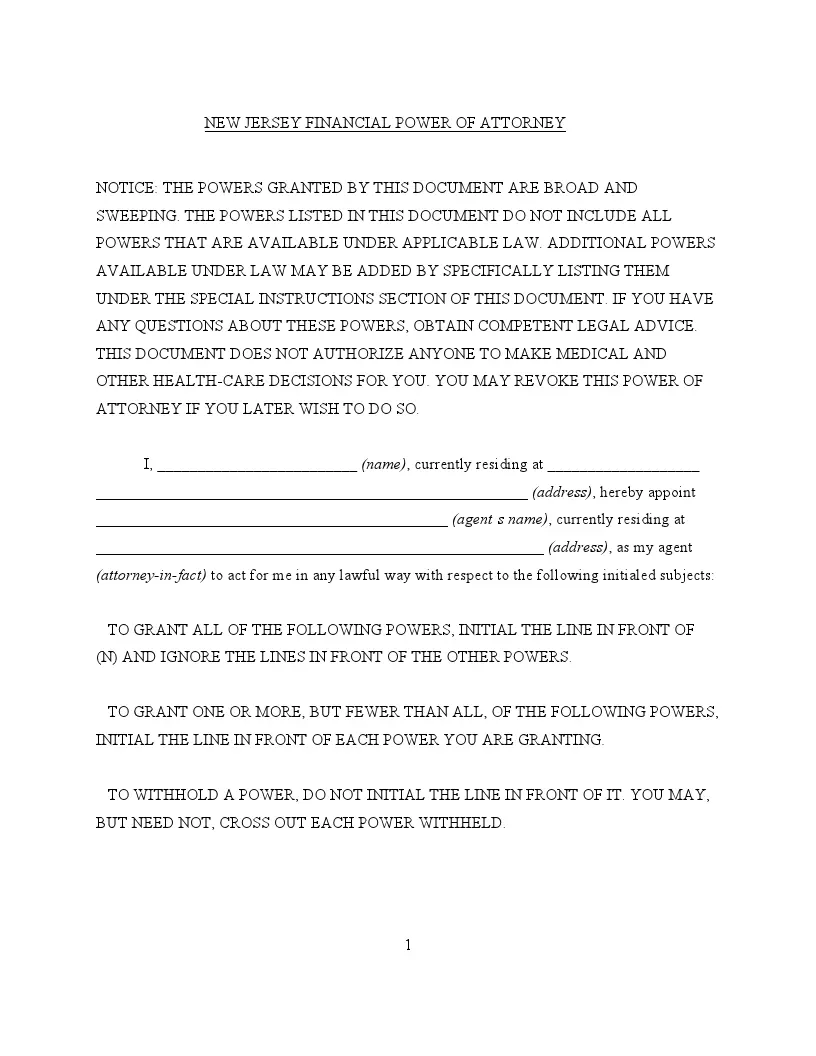
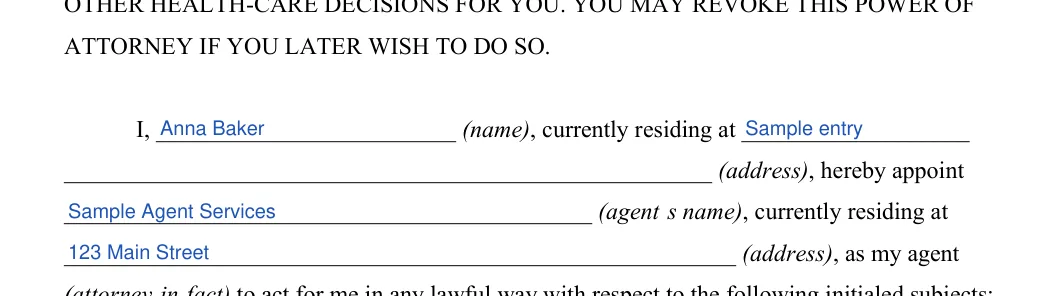
Principal and agent (page 1). Read the notice at the top, which says the powers are broad and that the form does not cover medical decisions. Then type your name and address, and your agent's name and address, in the opening paragraph.Step 1: sample entries, not a real document.
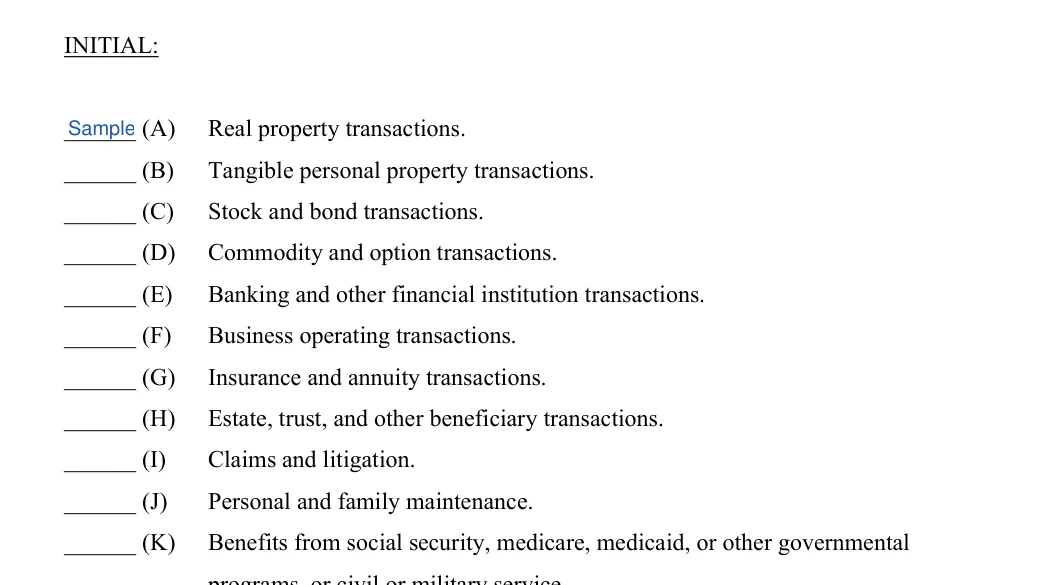
Initial the powers (A) to (K) (page 2). Write your initials on the line in front of each power you are granting, from (A) real property transactions to (K) benefits from social security, medicare, medicaid, or other governmental programs. Leave a line blank to withhold that power.Step 2: sample entries, not a real document.
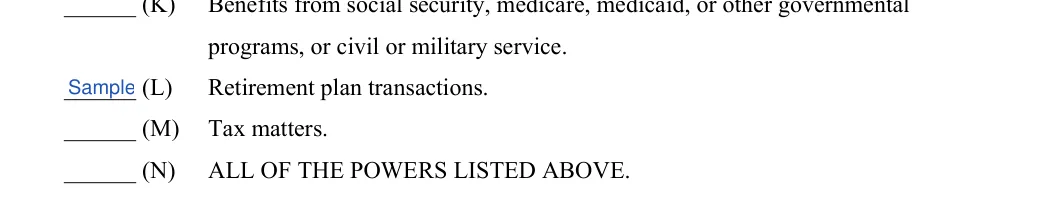
Powers (L) to (N) and Special Instructions (page 2). Initial (L) retirement plan transactions and (M) tax matters if you want to grant them. To grant every listed power, initial only line (N), ALL OF THE POWERS LISTED ABOVE. The form says you need not initial any other line then. The three Special Instructions below the list are preprinted, so there is nothing to fill in. They cover medical claims, retirement and savings accounts, and digital assets.Step 3: sample entries, not a real document.
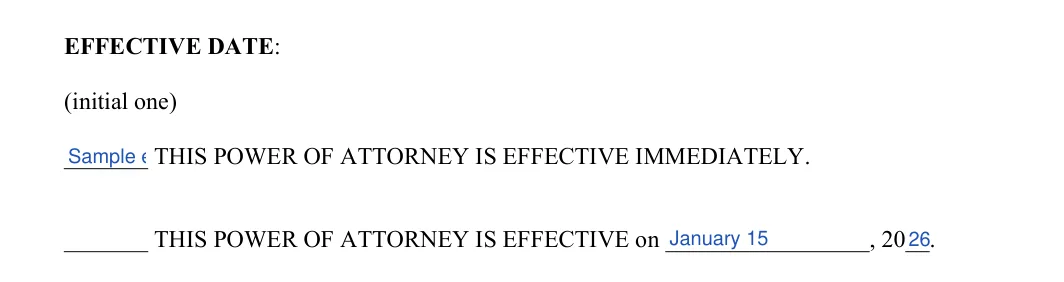
Effective date (page 3). Under Effective Date, initial one line. Pick the line that starts the power of attorney right away, or the line with a start date, and write that date and year in the blanks.Step 4: sample entries, not a real document.
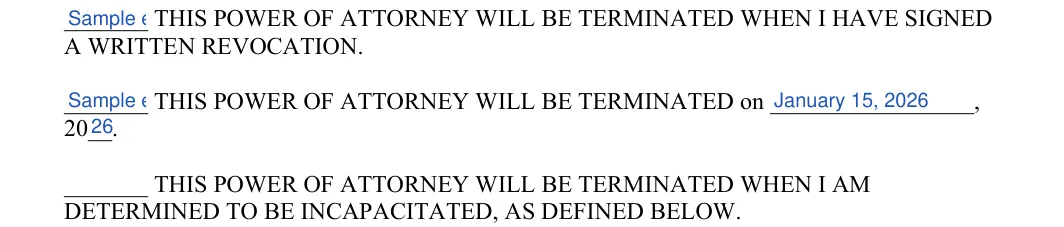
Termination date: written revocation (page 3). Under Termination Date, the form says to initial one line. Initial the first line if the power of attorney should end when you have signed a written revocation.Step 5: sample entries, not a real document.
Termination date: a set date or incapacity (page 3). Instead, initial the second line and write the date and year it ends, or initial the third line to end it when you are determined to be incapacitated. The form defines incapacity just below, continuing onto page 4. It means a court finding that you are incompetent, a court-appointed conservator or guardian for your estate, or written certification from two physicians who are unrelated to you or to each other.Step 6: sample entries, not a real document.
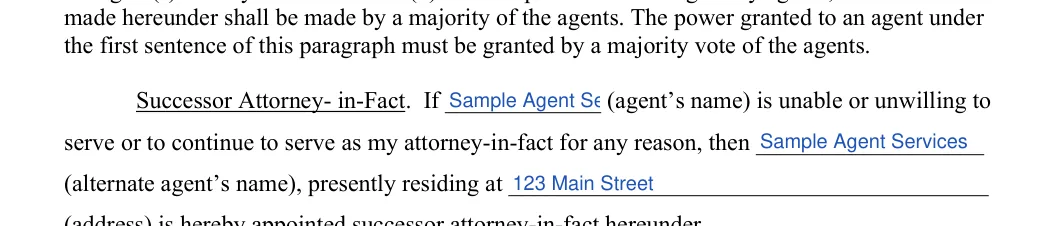
Successor attorney-in-fact (page 4). In the successor paragraph, type your agent's name, then the name and address of the alternate agent. The alternate steps in if your agent is unable or unwilling to serve. Just above it, a printed paragraph covers more than one agent acting together, and it has no blanks to fill.Step 7: sample entries, not a real document.
Date and sign (page 4). Fill in the day, month, and year on the "Signed this" line, then sign above (signature) and print your name below it. The form has no line for the agent to sign.Step 8: sample entries, not a real document.
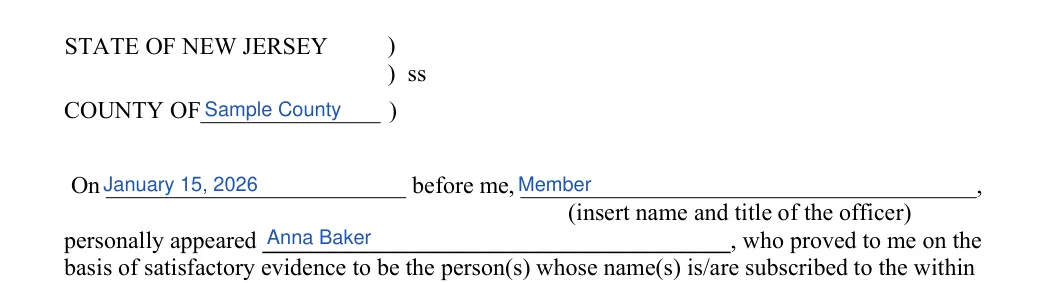
Notary acknowledgment (page 5). The notary completes the acknowledgment with the county, the date, the officer's name and title, and your name. The certificate says the notary verifies only the identity of the person who signed, not the truthfulness, accuracy, or validity of the document.Step 9: sample entries, not a real document.
Officer signature and seal (page 5). The notary signs on the Signature line at the end of the acknowledgment and adds the seal.Step 10: sample entries, not a real document.
Common Mistakes When Filling Out the Form
Most problems with this form come from the initial lines. The form asks you to initial in several places, and it tells you how many lines to initial in each place. Check these points before you sign.
Initialing nothing in the powers list. A power you do not initial is withheld, so initial each power you mean to grant, or initial only line (N) to grant them all.
Initialing both Effective Date lines. The form says to initial one.
Initialing more than one Termination Date line. The form says to initial one.
Leaving the alternate agent blank when you want a backup. The successor paragraph on page 4 needs the alternate agent's name and address.
Signing without the notary. The law requires the signature to be acknowledged, so the notary completes the certificate on page 5.[1.3]
Other New Jersey Power of Attorney Forms
A general financial power of attorney is one of several types of power of attorney. Depending on what you need, one of these other FormsPal forms may fit better. Each page has its own free PDF to fill out online and print.
New Jersey durable power of attorney: the law treats a durable power of attorney differently from a non-durable one when the principal becomes incapacitated, as the FAQ below shows.
What Is a New Jersey General Financial Power of Attorney?
A general financial power of attorney lets the principal give an agent authority to act for them on money and property matters. On this form, the principal chooses the powers, which run from (A) real property transactions to (M) tax matters, or grants all of them by initialing line (N). The form does not authorize anyone to make medical or other health-care decisions.
The form's own notice says the powers are broad and sweeping, and that they do not include every power available under applicable law. It also says to get competent legal advice if you have questions about the powers, and that you may revoke the power of attorney if you later wish to do so.
Does a power of attorney need to be notarized in New Jersey?
Yes. The statute says a power of attorney must be in writing, duly signed, and acknowledged in the manner set forth in R.S. 46:14-2.1, so it must be notarized.[1.3] The acknowledgment block on page 5 of the form is where the notary completes the certificate.
How Does a Power of Attorney End in New Jersey?
A New Jersey power of attorney does not have to run forever. The principal can end it, and the state's power of attorney law names three ways to do that. Under that law, a power of attorney is revoked in any of these cases:[1.4]
The principal causes all executed originals of the power of attorney to be physically destroyed.
The principal signs, and causes to be acknowledged, a written instrument of revocation.
The principal delivers a written revocation to the attorney-in-fact.
A written instrument of revocation is acknowledged in the same manner as the power of attorney itself, under R.S. 46:14-2.1.[1.4] Our power of attorney revocation page for more on putting a revocation in writing.
Does a new power of attorney cancel an older one in New Jersey?
Not by itself. The subsequent execution of another power of attorney does not revoke an earlier one unless the later document expressly provides that the earlier one, or all other powers of attorney, are revoked.[1.4]
Does the principal's incapacity end a power of attorney in New Jersey?
If a power of attorney is not durable, the principal's incapacity does not revoke or terminate it as to an agent or other person. That holds when the person acts in good faith under it without actual knowledge of the incapacity.[1.1]
Can someone keep relying on a New Jersey power of attorney after it ends?
In some cases, yes. The law protects people who act in good faith under a power of attorney without knowing it has ended:[1.2]
Termination or suspension of an agent's authority, or of the power of attorney, is not effective as to an agent or other person who acts in good faith under it without actual knowledge or notice of it.
For a durable power of attorney, a third party may rely on the authority granted until it has received actual notice of the revocation, the end or suspension of the agent's authority, or the principal's death.
Create a high-quality New Jersey General Financial Power of Attorney Form now!
General information, not legal or tax advice.
Sources
Each bracketed number in the text above points to the New Jersey statute listed below. Open the link to read the provision in full, and check the current text before you rely on it.
Mara has been practicing estate planning and trust law in California since 2003, taking pride in helping clients of all backgrounds and asset profiles form a complete and customized estate plan. Her specialties are: estate planning, wills and trusts, trust and probate administration.