
A Maryland durable power of attorney is a written document that lets a principal name an agent to make financial decisions on their behalf. The agent's authority continues even if the principal later becomes incapacitated.[1] Reasons to create a sample durable power of attorney range from a health diagnosis to simple advance planning, though the document itself does not let an agent make medical decisions.
The form gives the agent access to the principal’s bank accounts and property once it is signed, so the agent should be someone the principal trusts completely. Maryland law also requires the document to be notarized before it takes effect.[2] See Maryland power of attorney templates for other types of powers of attorney used in the state.
Build Your Document
Answer a few simple questions to make your document in minutes
Save and Print
Save progress and finish on any device, download and print anytime
Sign and Use
Your valid, lawyer-approved document is ready
Last Updated: September 2026. This guide is reviewed and updated regularly to reflect current Maryland law. If you notice an error or outdated information, please contact us.
Maryland's rules for a durable financial power of attorney come from the Estates and Trusts article of the Maryland Code.[1][2][4] The document must be signed, notarized, and witnessed by two adults before it is valid. It stays in effect even if the principal later becomes incapacitated.
Consider the crucial terms you need to know while filling out a Durable Power of Attorney form in Maryland:
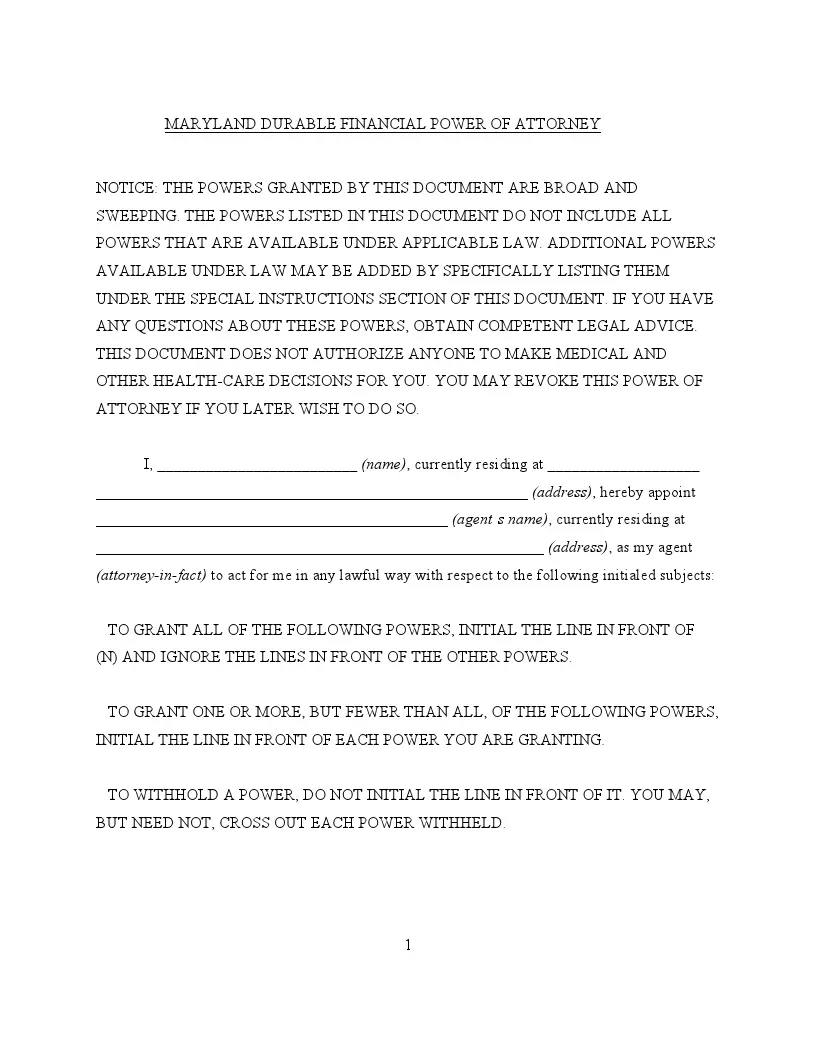
The FormsPal template lets you grant specific powers by initialing only the ones you want, rather than writing your own list from scratch. This mirrors the initial-based structure Maryland's own statutory form uses.[4]
To be valid, the document must be signed by the principal, or by someone else signing in the principal's presence and at the principal's direction. It must also be acknowledged before a notary public, in person or electronically. At least two adult witnesses must sign in the presence of the principal and each other.[2]
The FormsPal template below does not include witness signature lines, but Maryland law still requires two adult witnesses.[2] Arrange for two witnesses to be present, along with a notary public, when you sign.
Maryland law also provides an optional statutory short form personal financial power of attorney.[4] You are not required to use that exact wording. A form that meets the signing and notarization requirements above is valid even if it does not follow the statutory form word for word.
| Document Name | Maryland Durable Power of Attorney Form |
| Other Names | Maryland Financial Durable Power of Attorney, MD DPOA |
| Relevant Laws | Md. Code, Estates and Trusts, Title 17 (Power of Attorney) |
| Signing Requirements | Notary Public and Two Witnesses |
| Avg. Time to Fill Out | 10 minutes |
| # of Fillable Fields | 37 |
| Available Formats | Adobe PDF |
Popular Local Durable POA Forms
Durable POA forms are frequently in each state. Find out more about several other printable DPOA forms frequently completed by Americans.
Yes. Maryland law requires a durable power of attorney to be notarized before it is valid.[2] The principal must sign the document in the physical or electronic presence of a notary public, who then completes the acknowledgment section. Maryland also requires two adult witnesses to sign, separate from the notarization requirement.
A durable power of attorney lets you choose in advance who manages your finances if you become unable to do so yourself, whether from an accident, an illness, or age-related decline. Without one in place, family members may need to ask a court to appoint a guardian or conservator, a process that takes time and puts the decision in a judge's hands rather than yours.
Because this form is durable, it keeps working through that kind of incapacity instead of automatically ending, which is the main reason people create one before they need it rather than after.
The Maryland durable power of attorney form lets you authorize your agent to act on your behalf across 14 subject areas, from real property and banking to tax matters and retirement accounts. You decide which powers to grant by initialing only the ones that apply, or you can initial a single line to grant all of them at once.
Your agent may act only within the subjects you authorize. Unless you state otherwise in the special instructions, the agent's authority to act under any granted subject continues for as long as the power of attorney itself remains in effect.
A general power of attorney grants broad authority across most or all of the subjects listed above. A limited power of attorney grants authority over only specific tasks, such as selling one piece of property or managing a single bank account. This form can serve as either one, depending on how many of the 14 subject areas you initial.
If you initial only one or two subjects, you have effectively created a limited durable power of attorney. If you initial line (N) to grant everything, you have created a general durable power of attorney. Choose the scope that matches how much control you actually want to hand over.
Yes. The Maryland form lets you name co-agents and lets you state whether they must act together or may act separately. If you designate two or more agents to act separately, any one of them may sign documents or complete transactions on your behalf, and third parties may rely on that action. If you require them to act together, decisions are made by a majority of the agents.
You can also name a successor agent who steps in if your first agent becomes unable or unwilling to serve, so your affairs do not go unmanaged while a replacement is found.
A Maryland power of attorney ends automatically when the principal dies, revokes it, or when the document's own terms provide for its termination. It also ends when its purpose is accomplished.[3.1] Unless the document says otherwise, the agent's authority continues despite any lapse of time since it was signed.[3.3]
The power of attorney itself ends when:
Separately, an individual agent's authority under the power of attorney terminates when:
Below is a step-by-step walkthrough of the form based on its actual layout. Complete each part in order, and review the whole document with your agent before you sign it. Mistakes or blank fields can create confusion for banks and other institutions later.


Once you have reviewed the signing and notarization requirements above, download the form as a PDF, or use the document builder below to create it online. Both versions produce the same legally valid document once you sign, witness, and notarize it.
This page is general information about Maryland durable powers of attorney, not legal advice. For advice on your situation, talk to a Maryland attorney.
Unless noted otherwise, the sources below are from the Md. Code, Est. & Trusts.