
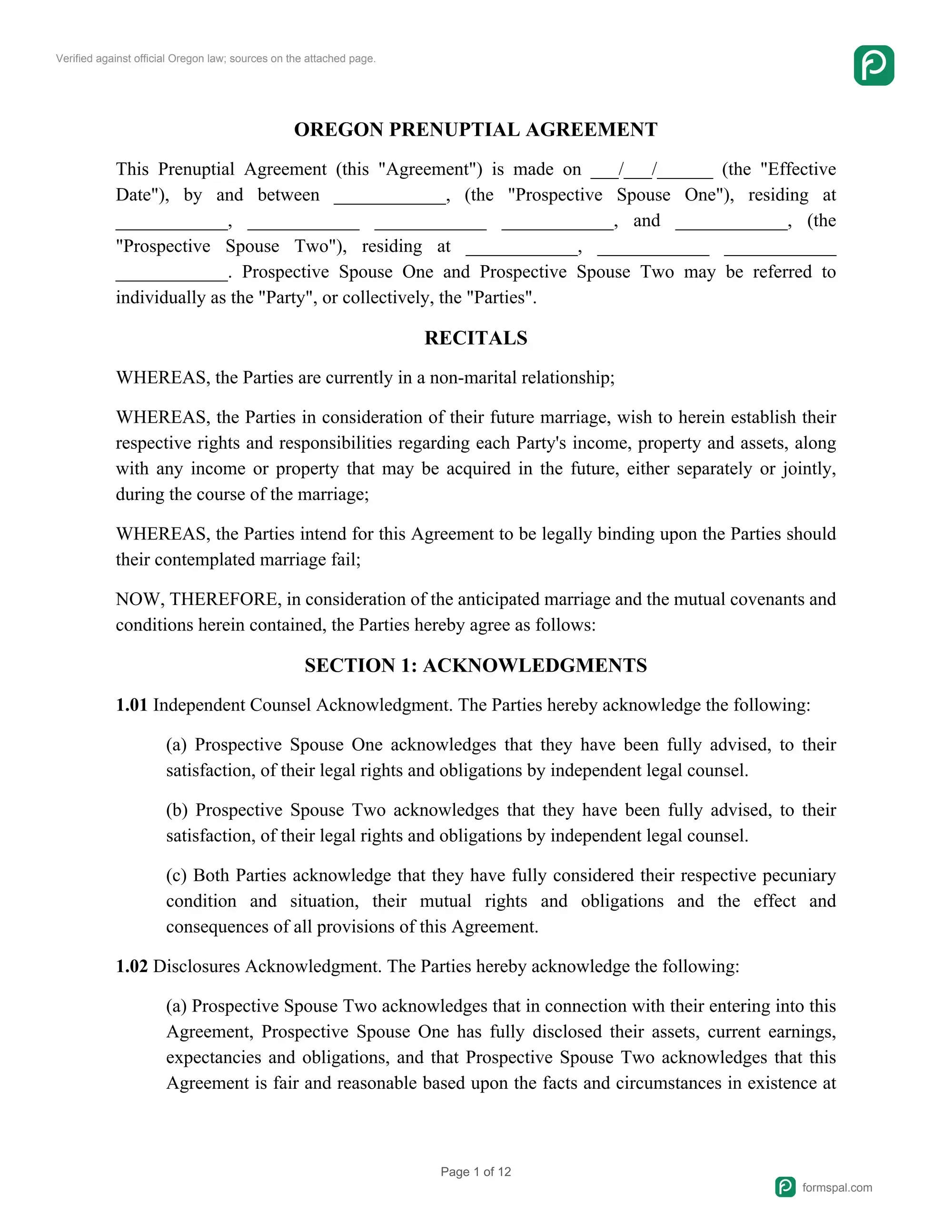
An Oregon prenuptial agreement is a written contract that two people sign before their wedding to set how their property, debts, and spousal support will be handled if the marriage ends. Oregon's statutes call it a premarital agreement and define it as an agreement between prospective spouses made in contemplation of marriage and to be effective upon marriage.[1.1]
It must be in writing and signed by both parties, and it is enforceable without consideration.[1.2] It takes effect on the day you marry.[1.4] It cannot reduce a child's right to support.[1.3] Our prenup agreement template covers the terms Oregon allows and leaves out the ones it does not.
Build Your Document
Answer a few simple questions to make your document in minutes
Save and Print
Save progress and finish on any device, download and print anytime
Sign and Use
Your valid, lawyer-approved document is ready
Oregon's statutes call this document a premarital agreement. You will also see it called a prenup, a prenuptial agreement, or an antenuptial agreement. All four name the same contract signed before the wedding, and the Oregon Revised Statutes use "premarital" throughout.
Under Section 108.700 of the Oregon Revised Statutes, a premarital agreement is an agreement between prospective spouses made in contemplation of marriage and to be effective upon marriage. In plain terms, it is a contract you sign before the wedding so that an Oregon court applies your own financial terms instead of the state's default rules.[1.1]
A completed Oregon prenuptial agreement answers questions like these:
Popular Local Prenuptial Agreement Forms
Oregon's premarital agreement rules sit in the Oregon Revised Statutes, Title 11, Chapter 108, at Sections 108.700 through 108.735. They set out what the document must contain, what it may decide, when it takes effect, and when a court can refuse to enforce it. Oregon adopted the Uniform Premarital Agreement Act in 1987, so these rules will look familiar to anyone who has signed a prenup in another state.
Section 108.705 of the Oregon Revised Statutes sets two requirements and no others:
The same section adds that the agreement is enforceable without consideration.[1.2] Neither spouse has to give the other money or property in exchange for signing.
A premarital agreement must be in writing and signed by both parties. It is enforceable without consideration.
Oregon law does not require a notary or witnesses. Notarizing the signatures is still common practice, and it makes them easier to prove years later if one spouse disputes them.
An Oregon premarital agreement becomes effective upon marriage. Signing it does nothing on its own. If the wedding never happens, the agreement never starts, because the statute ties its effect to the marriage itself and to nothing else.[1.4]
A void marriage does not erase it entirely. If a marriage is determined to be void, the agreement is enforceable only to the extent necessary to avoid an inequitable result.[1.7]
After marriage, an Oregon premarital agreement may be amended or revoked only by a written agreement signed by the parties. A spoken understanding does not change it, and neither does one spouse acting as though a term no longer applies. Put every change in writing, and have both spouses sign it the same way they signed the original.[1.5]
Time limits work differently inside a marriage. Any statute of limitations applicable to a claim under a premarital agreement is tolled during the marriage of the parties.[1.8] Equitable defenses that limit the time for enforcement, including laches and estoppel, stay available to either party.[1.8]
Section 108.710 of the Oregon Revised Statutes lists what a premarital agreement may decide, and the list is broad. It reaches assets either spouse owns now and property acquired in the future, wherever that property sits. It also covers spousal support, wills and trusts, life insurance proceeds, and the law that governs how the contract is read.[1.3]
Parties to an Oregon premarital agreement may contract about each of the following:
A prenup can modify or eliminate spousal support, but that choice is not absolute. If the change would leave one spouse eligible for public assistance or medical assistance at separation or dissolution, a court may step in. It can order the other spouse to pay support to the extent needed to avoid that eligibility.[1.6]
Two limits apply. A premarital agreement cannot reduce a child's right to support, and it cannot include a term that violates public policy or a statute imposing a criminal penalty. Everything else on the list in Section 108.710 is open to negotiation between the two of you.[1.3]
The right of a child to support may not be adversely affected by a premarital agreement.[1.3] That right belongs to the child rather than to the parents, so the parents cannot trade it away. Oregon prenups also leave child custody to the court.
The public policy limit is the wider of the two. A prenup may settle any other matter between the spouses, including their personal rights and obligations. The limit is that the term must not violate public policy or a statute imposing a criminal penalty.[1.3]
Yes, in most cases. Oregon courts enforce valid premarital agreements, and the burden sits on the spouse trying to escape one. Section 108.725 of the Oregon Revised Statutes gives that spouse only two routes. Either the agreement was not signed voluntarily, or it was unconscionable when executed and the disclosure rules were not met.[1.6]
A court refuses to enforce an Oregon premarital agreement when the party resisting it proves one of the following:
Whether an agreement is unconscionable is decided by the court as a matter of law.[1.6] The test looks at the agreement as it stood when it was executed, not at how the marriage turned out.
Yes. Section 108.705 of the Oregon Revised Statutes asks for a written document signed by both parties and nothing more. No statute requires a lawyer, a notary, or witnesses. What a template cannot do for you is check that your own financial disclosure is complete, and three of the four grounds for refusing an Oregon agreement turn on disclosure.[1.6]
Work through the document in this order, and finish it well before the wedding:
Oregon law does not require either spouse to have an attorney review the agreement first. Paying for an hour of independent review each is still a common step before signing.
No. Oregon divides marital property by equitable distribution, which means a divorce court splits what the couple built by what is fair in their circumstances rather than down the middle. Oregon is not a community property state, so nothing becomes half yours automatically on the wedding day. Prenuptial agreements are how couples replace that judicial discretion with a rule of their own.
Without an agreement, an Oregon judge decides all of the following at the end of the marriage:
With a prenup, the property named in the agreement is governed by terms both of you set in advance. That reach covers any property of either or both of you, whenever and wherever acquired.[1.3]
Last Updated: September 2026 - This guide is reviewed and updated regularly to reflect current Oregon law. If you notice an error or outdated information, please contact us.

Other Prenuptial Agreement Forms by State