A California commercial lease agreement is a written contract in which a landlord rents business space to a tenant for a set term at an agreed rent. The form names the landlord and the tenant, describes the commercial property, and sets out the rent, the security deposit, the use of the space and who handles repairs. Every name, date and amount should be exact before anyone signs.
Last Updated: October 2026. This guide is reviewed and updated regularly to reflect current California law. If you notice an error or outdated information, please contact us.
Create a high-quality California Commercial Lease Agreement Form now!
Build Your Document
Answer a few simple questions to make your document in minutes
Save and Print
Save progress and finish on any device, download and print anytime
Sign and Use
Your valid, lawyer-approved document is ready
... or download your California Commercial Lease Agreement Form as a PDF file
The FormsPal California commercial lease agreement is a six-page form that a landlord and a tenant complete together. It starts with the parties, the premises and the lease term, then moves through rent, deposits, use of the space, maintenance, insurance and dispute resolution. Signatures and the brokers' details come last.
Parties, premises and term (paragraphs 1 and 2): the lease runs for a fixed term or continues month to month.
Base rent and payments (paragraphs 3, 4 and 7): the rent amounts, the due day, where rent is paid and a table of amounts due.
Early possession and security deposit (paragraphs 5 and 6): when the tenant can take possession and the deposit amount.
Parking and additional storage (paragraphs 8 and 9): the spaces, any fees and the storage the tenant may use.
Late charge, interest and NSF checks (paragraph 10).
Condition, zoning, expenses, rules and maintenance (paragraphs 11 to 17).
Subletting, possession, damage, hazardous materials, condemnation and insurance (paragraphs 22 to 29).
Dispute resolution, notices and other terms (paragraphs 34, 36 and 39).
Two paragraphs deserve a close read. Paragraph 22 says the tenant may not sublet or assign the lease without the landlord's prior written consent, and that the consent may not be unreasonably withheld. If a tenant plans to sublet, see our commercial sublease agreement. Paragraph 34 starts with mediation, and the arbitration provision comes with a space for both sides to initial.
Extra terms that do not fit the printed blanks go on the lines under Paragraph 39, one point per line. Check any supplement or exhibit you attach in the same paragraph, so every page travels with the lease.
Under Section 1938(c) of the California Civil Code, the commercial property owner or lessor is presumed responsible for any repairs or modifications needed to correct violations of construction-related accessibility standards noted in a CASp report, unless the landlord and the tenant agree otherwise.[2.1]
If the premises have not been issued a disability access inspection certificate, Section 1938(e) requires the commercial property owner or lessor to include the statement that section prescribes on the lease form or rental agreement.[2.2]
California Commercial Lease Agreement Form Details
Create a high-quality California Commercial Lease Agreement Form now!
Notice to End a California Commercial Tenancy
Under Section 1946.1(b) of the California Civil Code, an owner who ends a tenancy must give at least 60 days of notice before the proposed termination date.[1.2] If the tenant has lived in or occupied the property for less than one year, subdivision (c) shortens the minimum to 30 days.[1.3]
An owner of a residential dwelling or commercial real property hired by a qualified commercial tenant giving notice pursuant to this section shall give notice at least 60 days prior to the proposed date of termination.
Notwithstanding subdivision (b), an owner of a residential dwelling or commercial real property hired by a qualified commercial tenant giving notice pursuant to this section shall give notice at least 30 days prior to the proposed date of termination if a tenant or resident has resided in the dwelling or occupied the property for less than one year.
The statute names an owner of a residential dwelling or commercial real property hired by a qualified commercial tenant. Check that your tenancy fits that description before you rely on these periods.[1.1]
Note the date the tenancy began, because one year of occupancy decides which minimum applies.
Pick the proposed termination date, then count the days back with our deadline calculator.
Put the notice in writing and keep a copy for your records. Our lease termination letter can help with the wording.
Paragraph 2B of the form covers a month-to-month tenancy. It says either party may end the tenancy with written notice at least 30 days before the intended end date, subject to any applicable laws. Read it next to the periods above before you sign.
How to Fill Out the California Commercial Lease Agreement
To fill out the lease, work through the form in the order it prints, from the parties and the premises on page 1 to the signatures on page 6. The 15 steps below follow the form's own parts, and each picture shows that part filled with sample entries.
The screenshots under each step show the FormsPal California commercial lease agreement template filled with sample entries in blue, so you can see where each answer goes. The names, addresses, dates and amounts are examples only.
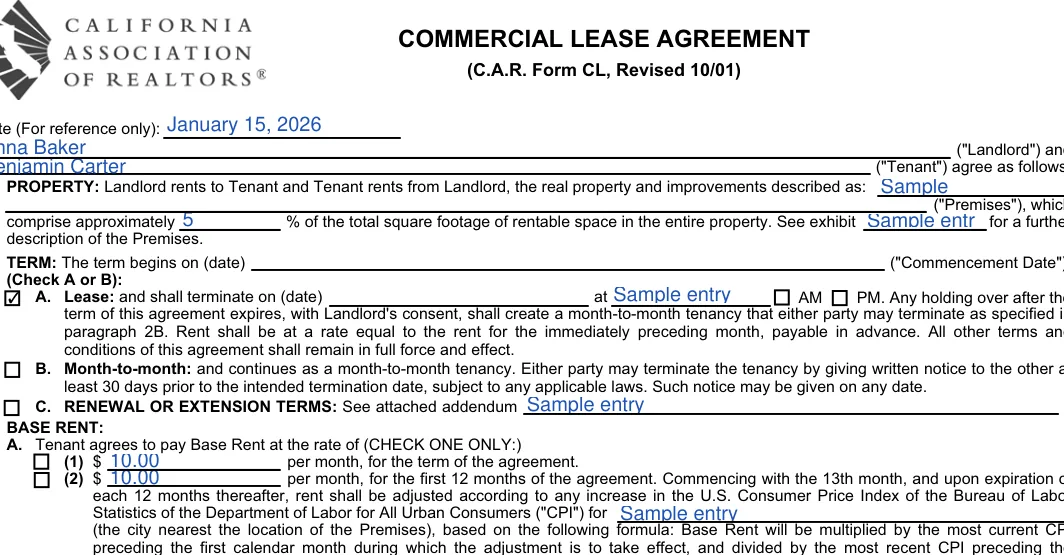
Parties, Property and Term (Paragraphs 1 and 2) with Base Rent options 1 and 2 (page 1). Enter the date, the Landlord and the Tenant. Describe the Premises and the percentage of the total rentable space. Under Term, check A for a fixed lease and give the start and end dates, or check B for month-to-month. Then start Base Rent with option (1), a flat monthly amount, or option (2), with the city used for the CPI adjustment.Step 1: sample entries, not a real document.
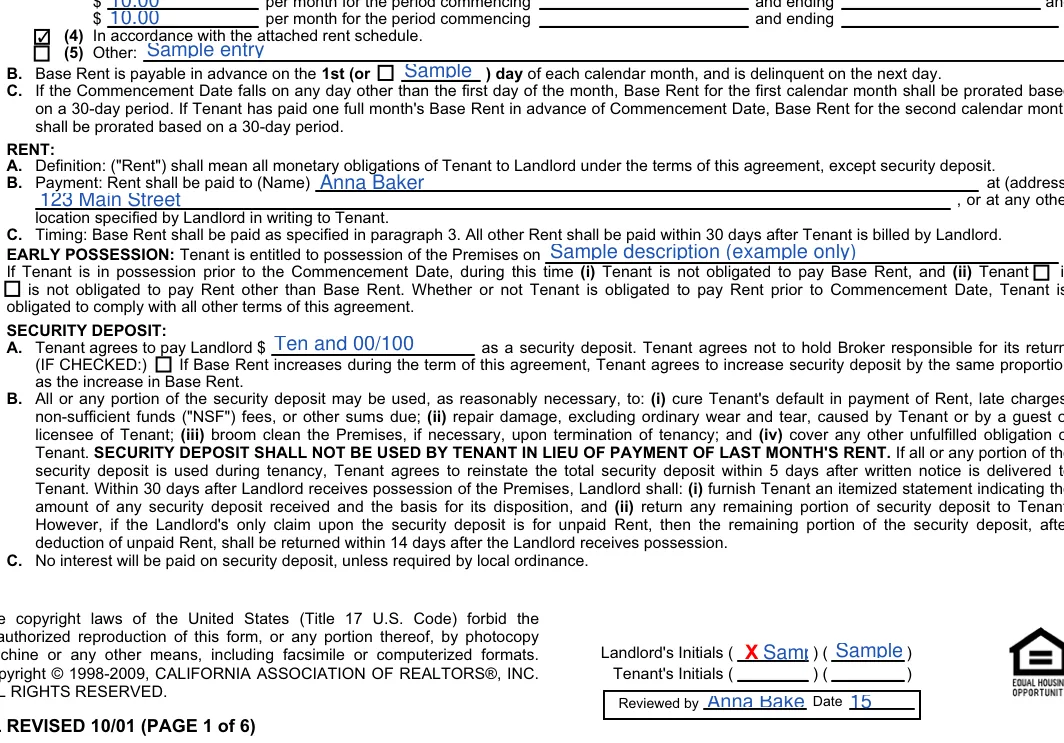
Base Rent, option (3): rent by period (page 1). If rent changes over time, check option (3). Enter the monthly amount with the commencing and ending dates for each of the three periods.Step 2: sample entries, not a real document.
Rent schedule, payment, early possession and security deposit (Paragraphs 3.A(4) to 6) (page 1). Check option (4) if a rent schedule is attached, or option (5) and write the other arrangement. Set the due day, and give the name and address where rent is paid. Enter the possession date in Paragraph 5 and the security deposit amount in Paragraph 6. Both parties then initial and date the foot of page 1.Step 3: sample entries, not a real document.
Page 2 header: Premises and Date (page 2). Repeat the Premises description and the date in the header line at the top of page 2.Step 4: sample entries, not a real document.
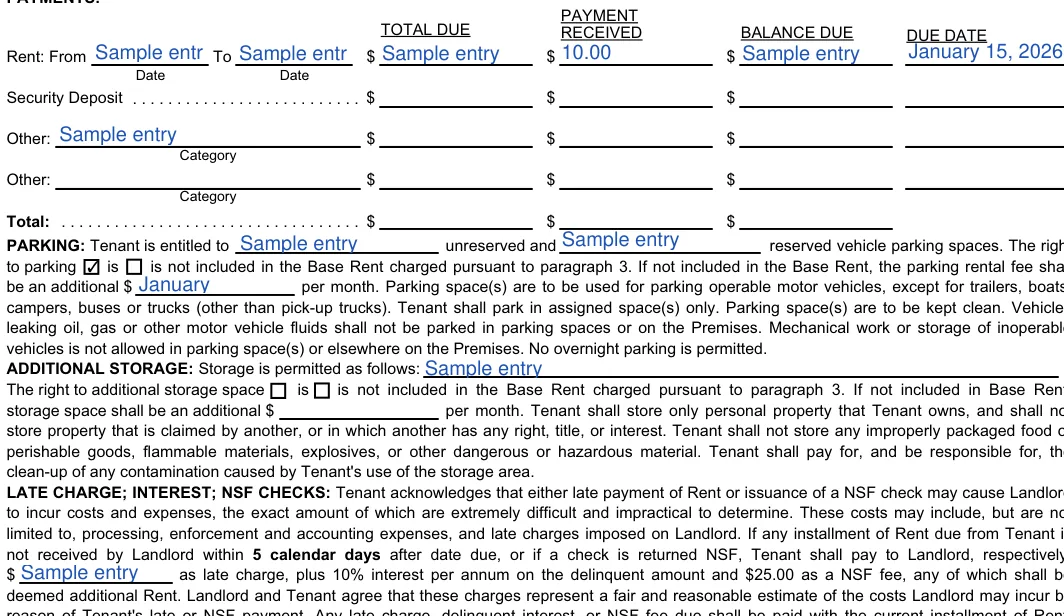
Payments, Parking, Storage and Late Charge (Paragraphs 7 to 10) (page 2). Fill the payments table with the total due, amount received, balance due and due date for rent, security deposit and other items. Then give the parking spaces and whether parking is included in Base Rent, the permitted storage and its fee, and the late charge amount.Step 5: sample entries, not a real document.
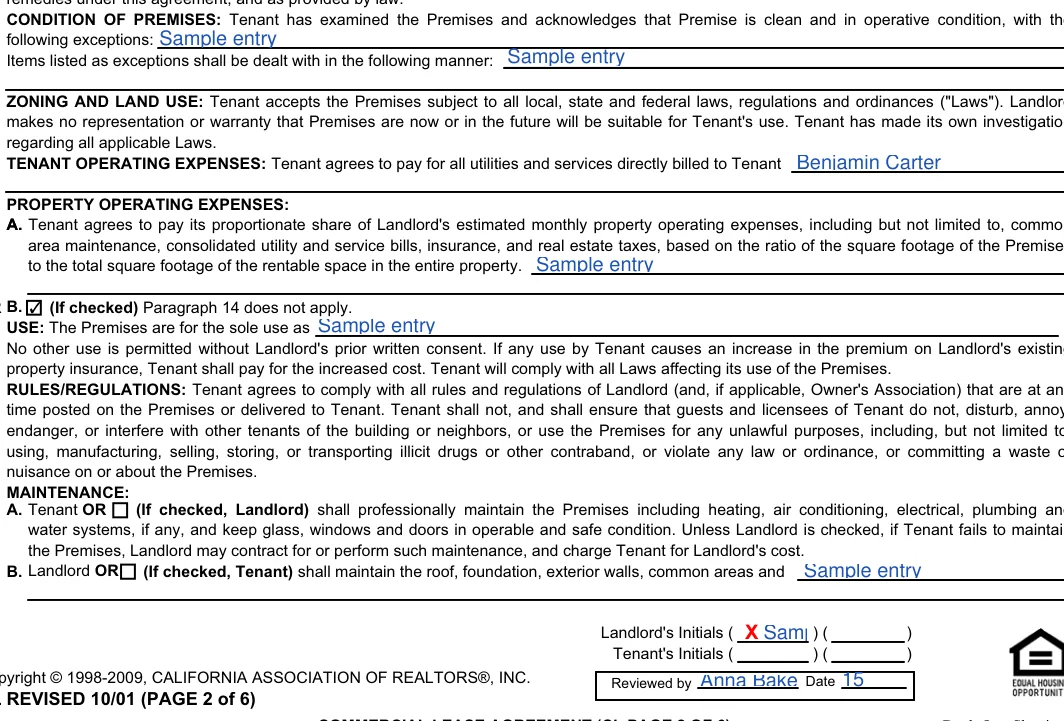
Condition, expenses, use and maintenance (Paragraphs 11 to 17) (page 2). List any exceptions to the condition of the Premises and how they will be handled. Name the utilities billed to the Tenant and check whether Paragraph 14 applies. Write the sole use of the Premises and mark who maintains each item in Paragraph 17. Both parties then initial and date the foot of page 2.Step 6: sample entries, not a real document.
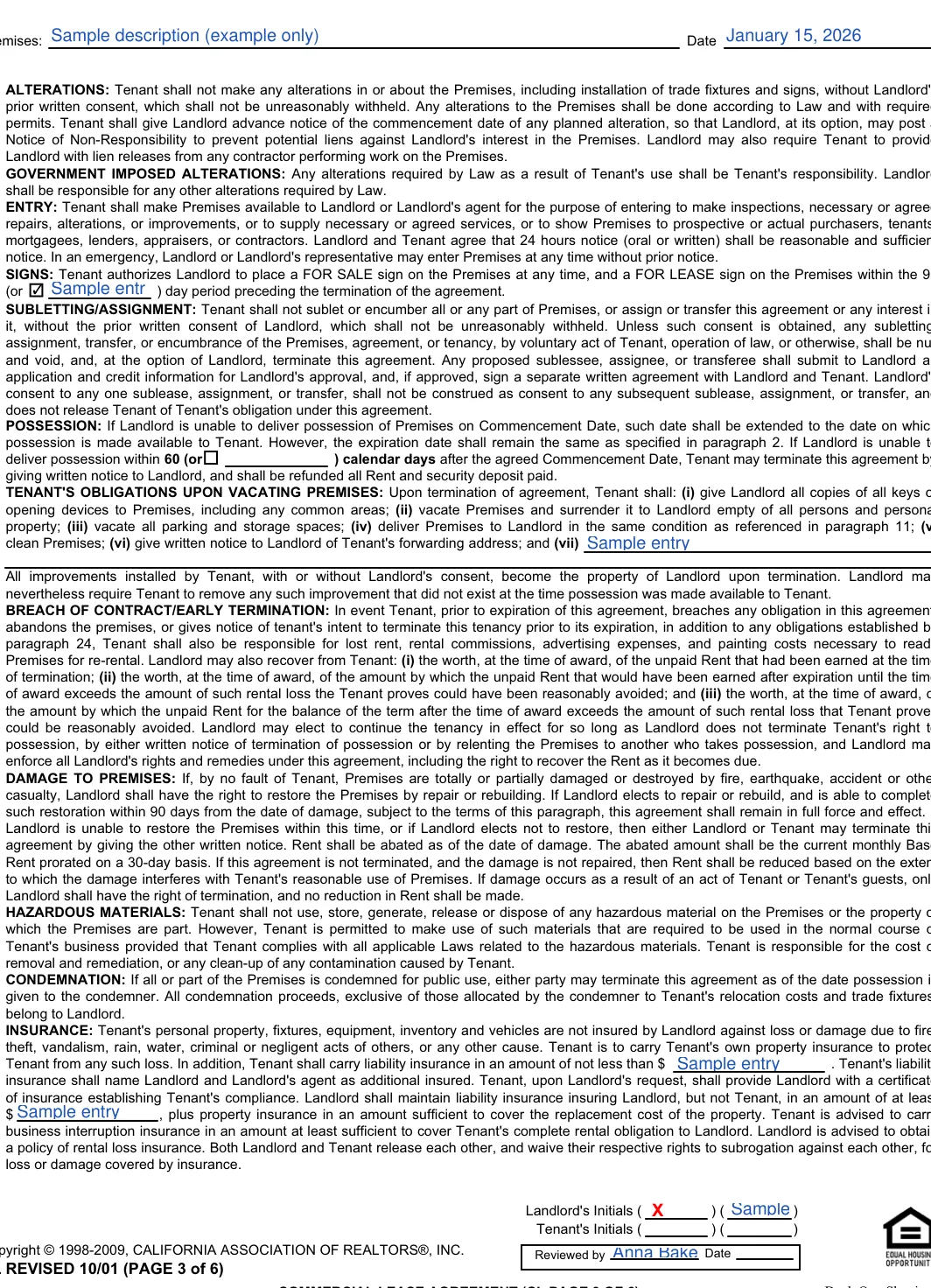
Signs, Possession, Vacating and Insurance blanks (Paragraphs 18 to 29) (page 3). Read Paragraphs 18 to 28, then complete the blanks. These are the alternate FOR LEASE sign period in Paragraph 21, the possession days in Paragraph 23, any extra move-out item in Paragraph 24(vii) and the liability insurance amounts in Paragraph 29. Both parties then initial and date the foot of page 3.Step 7: sample entries, not a real document.
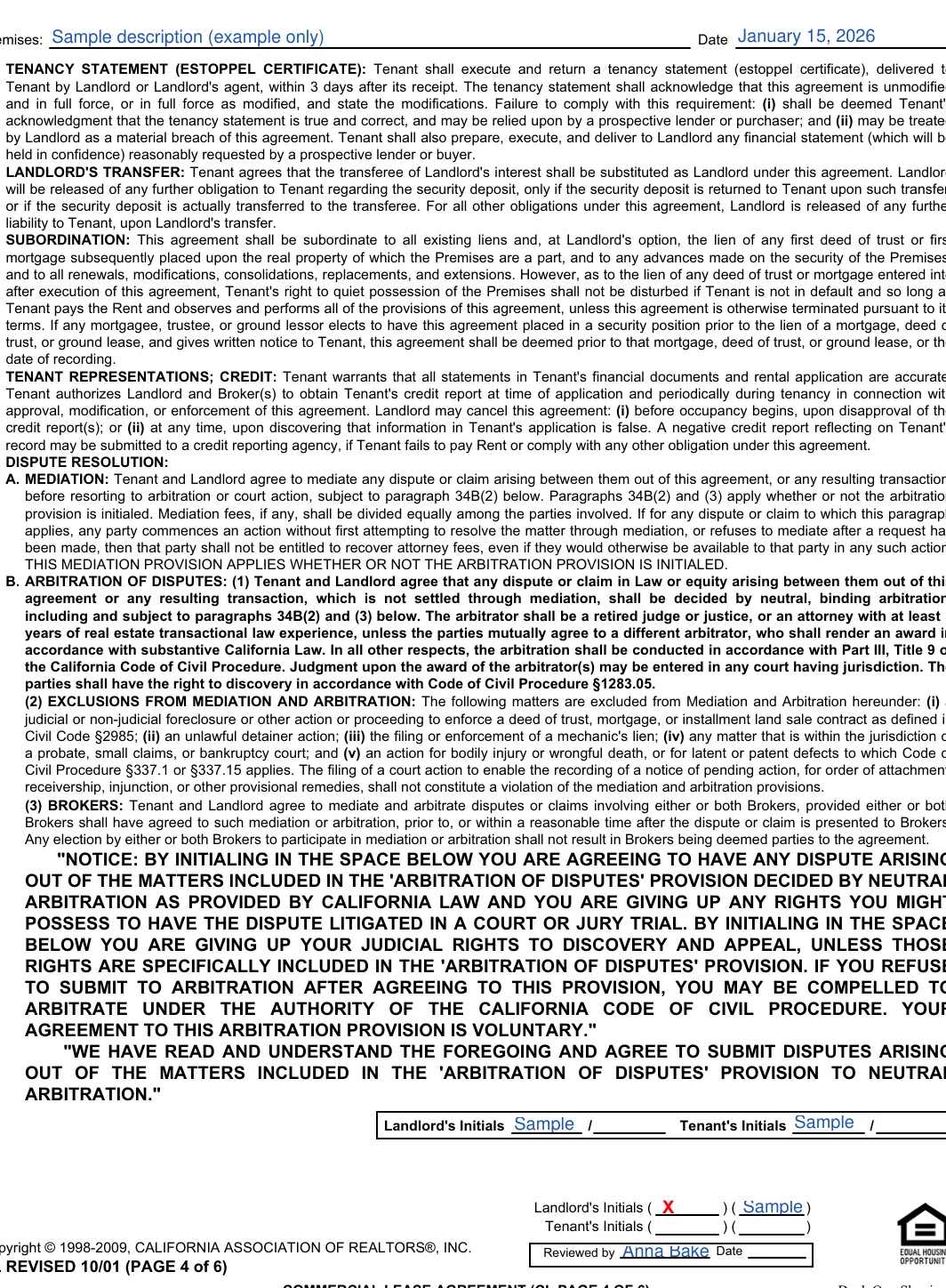
Dispute Resolution and arbitration initials (Paragraph 34) (page 4). Read Paragraphs 30 to 34. If both parties choose arbitration, the Tenant and the Landlord each initial in the space under the arbitration paragraph. The form states that its mediation provision applies whether or not the arbitration provision is initialed. Then initial and date the foot of page 4.Step 8: sample entries, not a real document.
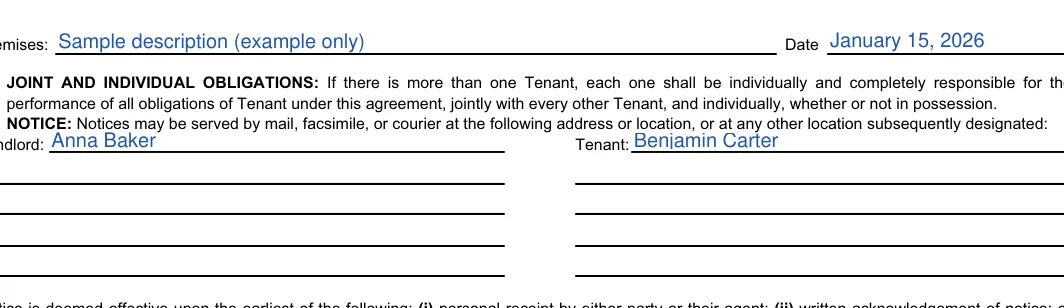
Delivery addresses (Paragraph 36) (page 5). Enter the address or location where each of the Landlord and the Tenant can be reached by mail, fax or courier.Step 9: sample entries, not a real document.
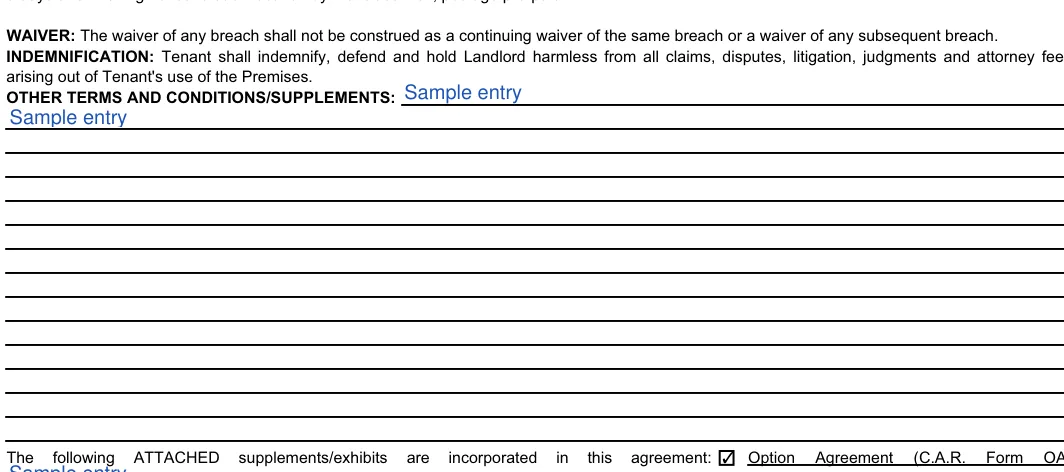
Other terms and conditions (Paragraph 39) (page 5). Write any extra terms on the lines under Paragraph 39, one point per line.Step 10: sample entries, not a real document.
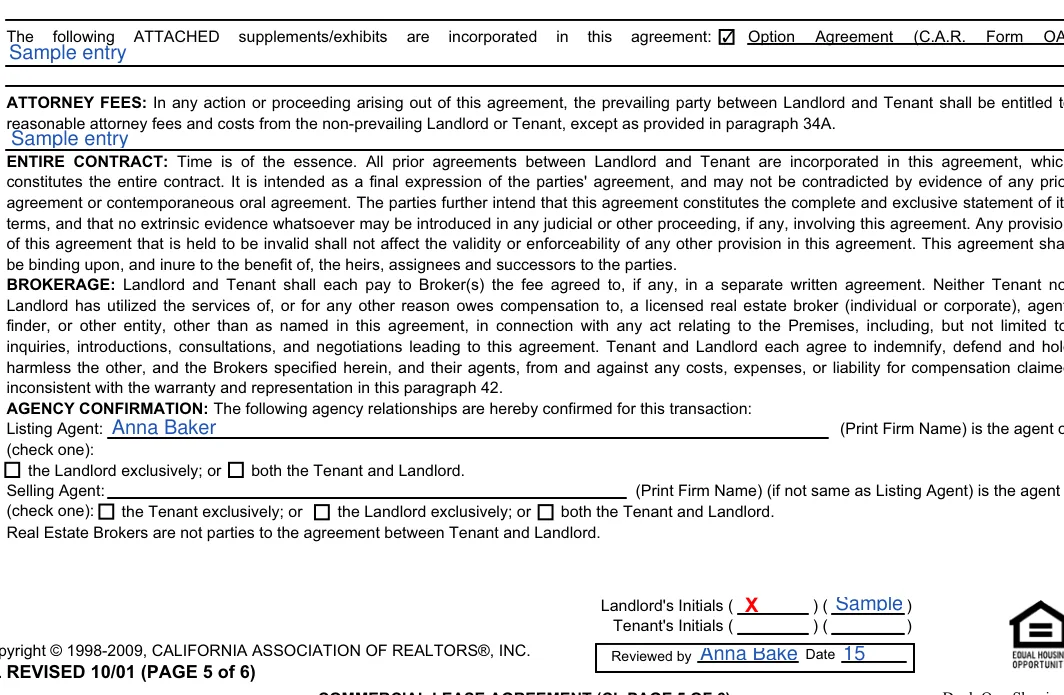
Attached supplements and Agency Confirmation (Paragraphs 39 and 43) (page 5). Check any supplement or exhibit attached to the agreement. In Paragraph 43, print the Listing Agent and Selling Agent firm names and check whom each represents. Both parties then initial and date the foot of page 5.Step 11: sample entries, not a real document.
Page 6 header: Premises and Date (page 6). Repeat the Premises description and the date in the header line at the top of page 6.Step 12: sample entries, not a real document.
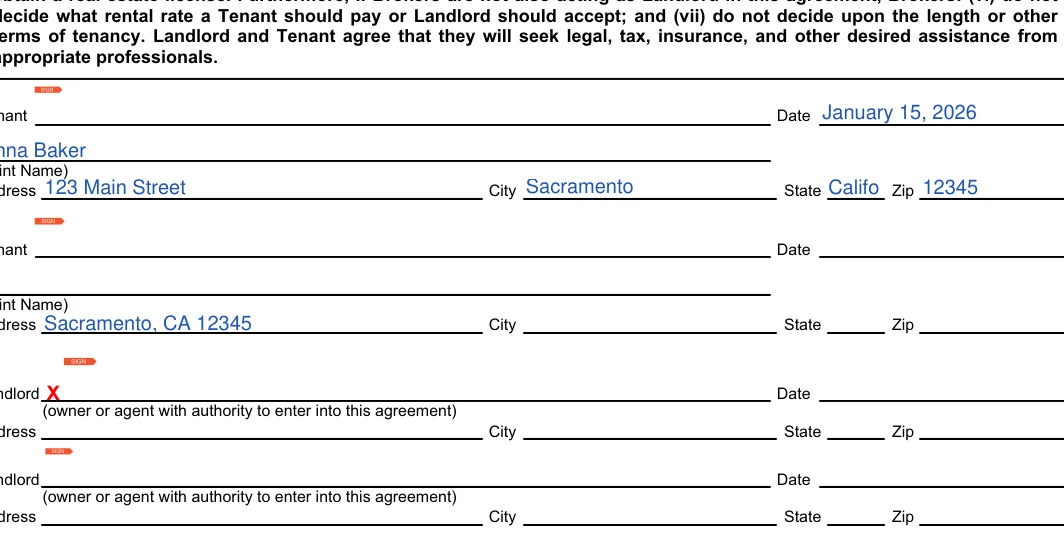
Tenant and Landlord signatures (page 6). Each Tenant and each Landlord signs, prints a name and enters the date, address, city, state and zip. Use the second block for a second Tenant or Landlord.Step 13: sample entries, not a real document.
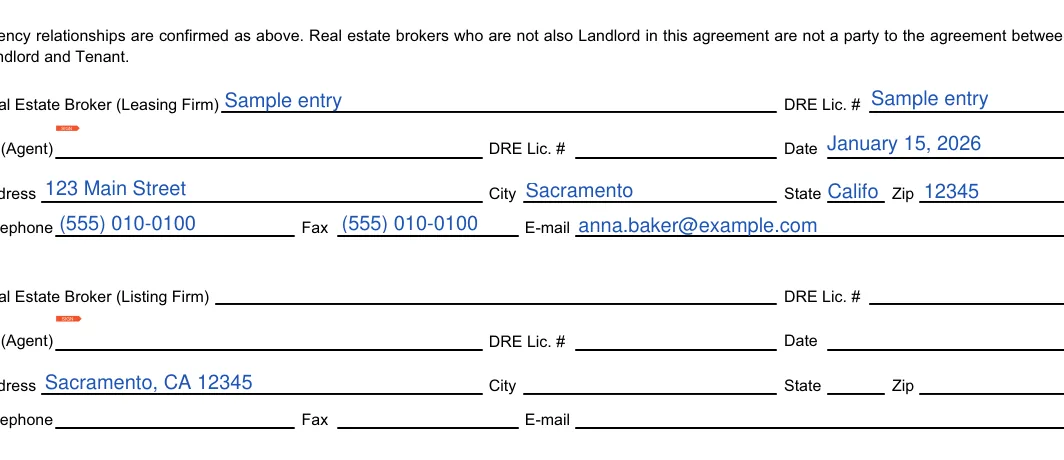
Broker and agent lines (page 6). If a broker is involved, each agent signs on the By line and enters the DRE license number, date, address, telephone, fax and e-mail. The firm names go on the broker lines. Leave these lines blank when no broker is used.Step 14: sample entries, not a real document.
Reviewed by and Date (page 6 footer) (page 6). Fill the Reviewed by and Date lines at the foot of page 6 when a broker or office reviews the form. The form does not say who must complete them.Step 15: sample entries, not a real document.
How to Sign and Use the Commercial Lease
Once every entry is complete, you finish the lease in four steps. Get the final copy, read the whole agreement, have the Landlord and each Tenant sign, and give everyone a signed copy. The steps below explain each one.
Get the template. Download the PDF and fill it in on screen with our online PDF editor, or print it and write the entries by hand. You can also answer a few questions in the document builder at the top of this page.
Read every paragraph, including those with no blanks. The printed text also covers alterations, entry, signs, damage to the premises, hazardous materials, condemnation, early termination and subletting.
Sign the lease. The Landlord and each Tenant sign, print their names and add the date on page 6.
Keep copies. Give the Landlord and each Tenant a signed copy, and store yours with your other business records.
Other California Forms
We provide a range of key California forms to anyone in quest of simplicity when handling various papers in the state.
With over 25 years of experience as a business and transactional attorney, Jennifer has mastered the craft of closing highly successful deals for her clients. Through her wide-ranging expertise in commercial contracts, real estate transactions, M&A and corporate law, Jennifer secures results that are second-to-none.