A California roommate agreement is a written document that sets the rules for people who share one home. It names the landlord and the tenant, states the rent and any utility split, and records the deposits paid. It also lists house rules such as cleaning, guests, quiet hours and pets, and you can fill out FormsPal's free three-page form online or as a PDF. Read every line with your housemate before anyone signs, because the form calls itself a legally binding agreement.
Last Updated: October 2026. This guide is reviewed and updated regularly to reflect current California law. If you notice an error or outdated information, please contact us.
Create a free high-quality California Room Rental Agreement online now!
Build Your Document
Answer a few simple questions to make your document in minutes
Save and Print
Save progress and finish on any device, download and print anytime
Sign and Use
Your valid, lawyer-approved document is ready
... or download your California Roommate (Room Rental) Agreement Form as a PDF file
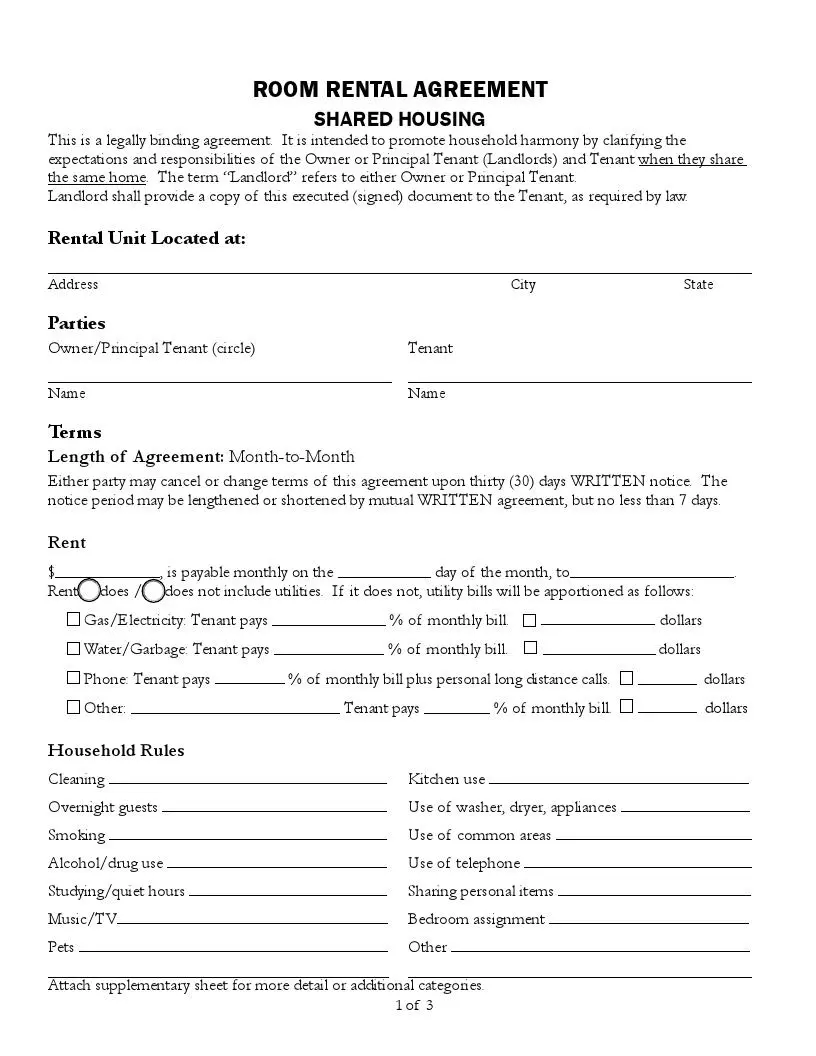
The FormsPal California roommate agreement is a three-page room rental form for shared housing. The Owner or Principal Tenant is the landlord side, and the tenant rents a room in the same home. The form runs from the rental address and the parties through rent, house rules, deposits and signatures, so every housemate sees the same terms in writing.
Rental unit and parties: the address, the Owner or Principal Tenant and the Tenant.
Terms: a month-to-month term that either party can end with written notice.
Rent and utilities: the monthly rent, the due day and each tenant share of the bills.
Household rules: 14 lines, from cleaning and overnight guests to pets and bedroom assignment.
Conflict resolution: how the housemates settle disputes that continue.
Deposits: last month's rent, the security deposit and any other refundable deposit.
Other agreements: a condition checklist, plus printed notices on Megan's Law and lead-based paint.
A house rule works best when it is specific. Write the agreed quiet hours or the cleaning day on the line instead of leaving a general promise. Leave a line blank when the housemates have nothing to agree on.
California Roommate Agreement Form Details
Document Name
California Roommate Agreement Form
Other Names
CA Roommate Agreement, California Room Rental Agreement
Relevant Laws
California Civil Code, Sections 827, 1946.1, 1950.5 and 1954
Avg. Time to Fill Out
14 minutes
# of Fillable Fields
75
Available Formats
Adobe PDF
Create a free high-quality California Room Rental Agreement online now!
California Security Deposit Rules for a Room Rental
California limits how much security a landlord may demand or receive, and when it must come back. Civil Code section 1950.5 sets the rules below. The form's Deposits section on page 2 has lines for last month's rent, the security deposit and any other refundable deposit. Check these rules before you fill it in.
A landlord may not demand or receive security of more than one month's rent, in addition to any rent for the first month paid on or before initial occupancy.[3]
A landlord who meets the statutory small landlord requirements may collect up to two months' rent, in addition to any rent for the first month paid on or before initial occupancy.[3]
Where state law allows an additional amount of security, that amount must be returned after no more than six months of residency if the tenant is not in arrears for any rent due during that period.[3]
A lease or rental agreement may not contain a provision characterizing any security as nonrefundable.[3]
The landlord must return the deposit no later than 21 calendar days after the tenant has vacated the premises, with an itemized statement of the basis for and the amount of any deduction.[3]
These rules are written for landlords and tenants. If your landlord is a principal tenant, ask which rules apply to your arrangement before you rely on them.
Before the deposit comes back, the law adds photographs and an optional inspection. Together they give both sides a record of the condition of the room at move-in and at move-out.
For tenancies that begin on or after July 1, 2025, the landlord must take photographs of the unit immediately before, or at the inception of, the tenancy.[3]
At the tenant's request, the landlord must make an initial inspection before any final inspection, at a reasonable time and no earlier than two weeks before the termination or end-of-lease date.[3]
The landlord must give at least 48 hours' prior written notice of the date and time of the inspection.[3]
Beginning April 1, 2025, the landlord must take photographs within a reasonable time after possession is returned and before any repair or cleaning for which the landlord will make a deduction, and again after those repairs or cleanings are completed.[3]
If the deductions for repairs and cleaning together do not exceed $125, the landlord is excused from requirements the statute otherwise imposes on such deductions.[3]
Once the landlord completes the repair or receives the documentation, the landlord has 14 calendar days to complete the further steps the statute requires.[3]
A landlord who in bad faith claims or keeps the security or any part of it may be subject to statutory damages of up to twice the amount of the security, in addition to actual damages.[3]
Take your own photographs on move-in day and keep them with your copy of the agreement. Date each one so the housemates can compare the room later.
Notice, Entry and Rent Increase Rules
Three notice rules matter most in a shared home: ending the tenancy, entering the room and raising the rent. Each has its own period in the Civil Code, summarized below. Compare them with the notice terms printed on the form before you sign.
Ending the Tenancy
An owner's notice to a tenant who has lived in the dwelling one year or more must be given at least 60 days before the proposed date of termination.[2.2]
An owner's notice to a tenant who has lived in the dwelling less than one year must be given at least 30 days before the proposed date of termination.[2.3]
A tenant giving notice must give notice for a period at least as long as the term of the periodic tenancy before the proposed date of termination.[2.1]
Where the landlord gives reasonable written notice and enters during normal business hours, 24 hours is presumed to be reasonable notice in the absence of evidence to the contrary. No notice of entry is required to respond to an emergency, and in an emergency the landlord may enter without the tenant's consent or advance notice.[2.4]
Rent Increase Notice
Suppose the proposed increase is 10 percent or less of the rent charged at any time in the 12 months before the effective date. The test counts the increase alone or combined with other increases in those 12 months. The notice must then be delivered at least 30 days before the effective date.[1]
The form prints its own terms. Page 1 says either party may cancel or change the agreement on 30 days of written notice, and that the notice period can be lengthened or shortened by mutual written agreement, but no less than 7 days. Page 2 repeats the 24 hours of written notice for entry. Compare the printed 30 days with the periods above before you sign.
How to Fill Out the California Roommate Agreement
To fill out the agreement, work through the form in the order it prints, from the rental address on page 1 to the signatures on page 3. The nine steps below follow the form's own parts. You can build the document online or fill the PDF with our online PDF editor.
The screenshots under each step show the FormsPal California roommate agreement template filled with sample entries in blue, so you can see where each answer goes. The names, addresses, dates and amounts are examples only.
Print Form control (page 1). Find the Print Form control above the Room Rental Agreement heading on page 1. Fill in the rest of the form first, then use it to print.Step 1: sample entries, not a real document.
Rental Unit Located at (page 1). Enter the street address, city and state of the home where the room is rented.Step 2: sample entries, not a real document.
Parties (page 1). Circle Owner or Principal Tenant for the landlord side, then print that person's name and the tenant's name in the two Name fields. The Terms line below is preprinted as Month-to-Month, so there is nothing to fill in there.Step 3: sample entries, not a real document.
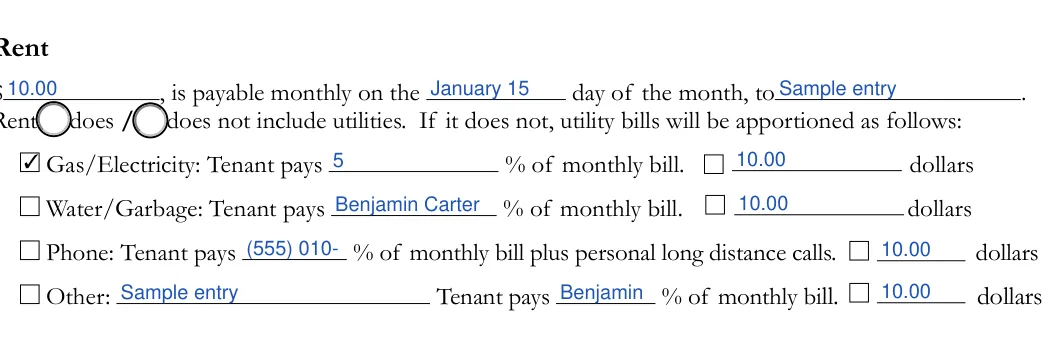
Rent and utility bills (page 1). Enter the monthly rent, the day of the month it is due and who it is paid to. Mark whether rent does or does not include utilities. If it does not, give the tenant's share of each bill as a percent or a dollar amount. The bills listed are gas and electricity, water and garbage, phone, and other.Step 4: sample entries, not a real document.
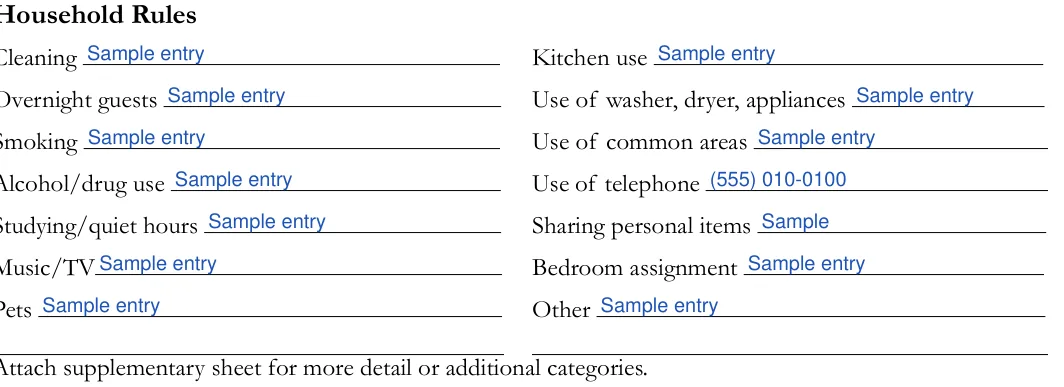
Household Rules (page 1). Write the rule agreed for each line, such as cleaning, kitchen use, overnight guests, smoking, quiet hours, music or TV, pets and bedroom assignment. Leave a line blank if there is nothing to add, and attach a sheet for more detail.Step 5: sample entries, not a real document.
Conflict Resolution (page 2). Mark the box or boxes for how the housemates will settle disputes that continue. The choices are decision by household consensus, decision by household majority vote, binding mediation by an impartial third party, decision by the Principal Tenant and decision by the Owner.Step 6: sample entries, not a real document.
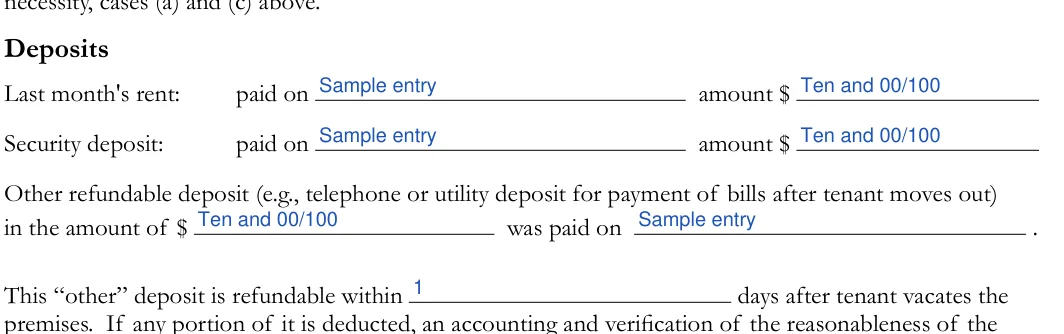
Deposits (page 2). Fill in the date paid and the amount for last month's rent and for the security deposit, and check the amount against the deposit rules above. If there is another refundable deposit, add its amount, the date paid and the number of days for its refund. A printed note on this page applies only to homes in Santa Cruz County.Step 7: sample entries, not a real document.
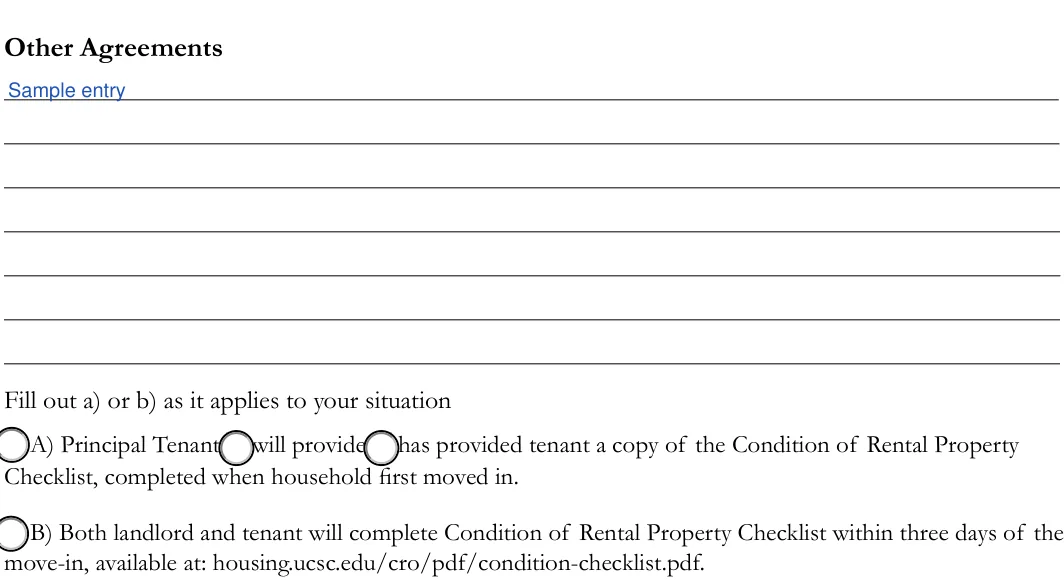
Other Agreements (page 3). Fill out option A or B for the Condition of Rental Property Checklist. Option A says the Principal Tenant will provide or has provided a copy of the checklist completed at move-in. Option B says both sides will complete it within three days of move-in. Then use the Other Agreements lines for anything else agreed. The Megan's Law and lead-based paint paragraphs are printed text, and the two lead-paint lines are blank lines to mark by hand.Step 8: sample entries, not a real document.
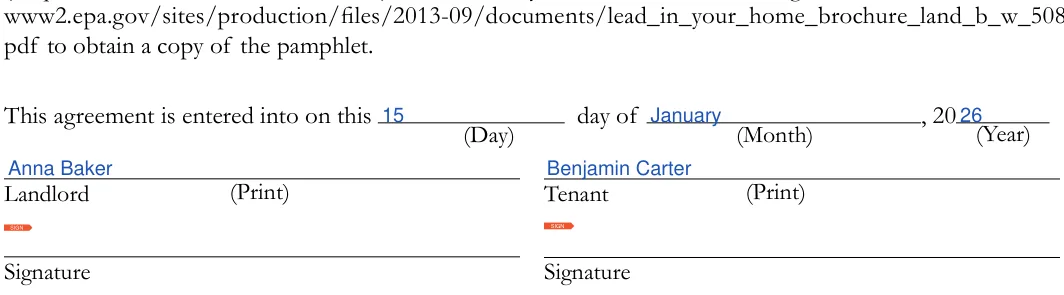
Date, names and signatures (page 3). Enter the day, month and year the agreement is entered into. Print the Landlord and Tenant names, and have each sign on the Signature lines at the bottom of page 3.Step 9: sample entries, not a real document.
How to Sign and Use the California Roommate Agreement
Once every part is complete, the housemates finish the agreement in five steps. Get the final copy, read the whole document, sign it, share copies and keep your own. The steps below are common practice for any signed rental document.
Get the template. Download the PDF, or answer a few questions in the document builder at the top of this page to create the agreement online.
Read every printed paragraph, including those with no blanks. The privacy, Megan's Law and lead-based paint text is part of what you sign.
Sign the agreement. The Landlord and the Tenant sign, print their names and date the form on page 3.
Share copies. The first page of the form says the Landlord provides the Tenant a copy of the signed document, so make a complete copy of all three pages for each person.
Keep your copy with the move-in photographs, the deposit receipt and any attached sheet of house rules.
Frequently Asked Questions
Can you charge a 2 month security deposit in California?
Yes, but only a landlord who meets the statutory small landlord requirements. That landlord may collect up to two months' rent, in addition to any rent for the first month paid on or before initial occupancy. Every other landlord is limited to an amount equal to one month's rent.[3]
Do landlords have to give 24 hours notice in California?
Where the landlord gives reasonable written notice and enters during normal business hours, 24 hours is presumed to be reasonable notice unless there is evidence to the contrary. No notice of entry is required to respond to an emergency.[2.4]
How much notice is required to terminate a lease in California?
The answer depends on who gives notice and how long the tenant has lived in the dwelling.
An owner gives at least 60 days of notice to a tenant who has lived in the dwelling one year or more.[2.2]
An owner gives at least 30 days of notice to a tenant who has lived there less than one year.[2.3]
A tenant gives notice for a period at least as long as the term of the periodic tenancy.[2.1]
Does California require a written notice of termination?
For an owner's notice to a tenant who has lived in the dwelling one year or more, the rule calls for at least 60 days of written notice.[2.2] For a tenant who has lived there less than one year, an owner gives at least 30 days.[2.3] The form also asks for written notice, so put any notice in writing and keep a copy.
Can a California rental agreement call the security deposit nonrefundable?
No. A lease or rental agreement may not contain a provision characterizing any security as nonrefundable.[3]
Other California Forms
Take a look at some other California documents completed by FormsPal users. Try our powerful builder to personalize any of these forms to your preferences.
With over 25 years of experience as a business and transactional attorney, Jennifer has mastered the craft of closing highly successful deals for her clients. Through her wide-ranging expertise in commercial contracts, real estate transactions, M&A and corporate law, Jennifer secures results that are second-to-none.