
Updated:
A California sublease agreement is a tenant's contract with a subtenant. The agreement sets out the premises, the term, the rent, the deposits and the landlord's consent. The form suits tenants renting out a spare room or moving out early.
Key facts
This sublease is one of several types of rental agreements.

Build Your Document
Answer a few simple questions to make your document in minutes
Save and Print
Save progress and finish on any device, download and print anytime
Sign and Use
Your valid, lawyer-approved document is ready
A California sublease agreement is a written contract between a tenant and a new occupant for all or part of a rented home. The tenant, called the sublessor, passes the space to the subtenant for an agreed period. The original lease between the landlord and the tenant stays in place beside it.
The sublease names its parties in its first section. The landlord is the lessor, the tenant is the sublessor, and the new occupant is the subtenant or sublessee. The form gives each of them a signature line.
"Sublease" and "sublet" name the same deal in everyday use: a tenant rents out the place they rent. A search for a sublet form, a sublet agreement or a subtenant agreement leads to this document.
A sublease agreement fits a tenant who wants someone else to live in the rental while the tenant's own lease runs on. The usual cases are a spare room rented to a housemate and a tenant who moves out before the lease ends.
The original lease sets terms the sublease should match. Read its clause on subletting and its rent and deposit terms before filling in the form.
A sublease starts from a tenant; an owner who rents a room in the home they live in is renting to a lodger. The lodger notice rule of Cal. Civ. Code § 1946.5 applies only to owner-occupied dwellings where a single lodger resides. Under Cal. Civ. Code § 1946.5, either party may end a periodic room hiring by written notice given at least as long before the end of the term as Section 1946 specifies.
A new tenant who signs directly with the landlord needs a lease of their own: see the California rental lease agreement forms.
A California sublease agreement covers the parties, the premises, the term, the rent and the deposits, then the extras that set this home apart. The form's sections follow this order:
The sublease form carries a consent section for the landlord, set out as statements to choose from. The landlord picks the statement that fits and signs the form beside the two tenants.
The original lease is the place to check whether the landlord's consent is needed and how to ask for it. A copy of that lease goes with the sublease as an attachment.
The sublease's deposits table lists each deposit, who paid it, who received it and who will refund it: last month's rent, the security deposit and any other deposit. Cal. Civ. Code § 1950.5 words the rules below for a landlord and a tenant; this page does not say how they apply when the Principal Tenant, not the landlord, holds the subtenant's deposit. The one month's rent limit of Cal. Civ. Code § 1950.5 covers security "however denominated", whatever name the deposits table gives the sum.
| Deposit rule | What the section says | Source |
|---|---|---|
| Limit | A landlord may not demand security above one month's rent, in addition to the first month's rent paid on or before initial occupancy. | Cal. Civ. Code § 1950.5 |
| Higher limit | Two months' rent, in addition to the first month's rent, only if the landlord meets both of the section's requirements. | Cal. Civ. Code § 1950.5 |
| Wording | A lease or rental agreement shall not call any security "nonrefundable". | Cal. Civ. Code § 1950.5 |
| Return | No later than 21 calendar days after the tenant has vacated, the landlord shall send an itemized statement and return any remaining portion of the security. | Cal. Civ. Code § 1950.5 |
The Condition of Rental Property Checklist is the sublease's attachment for the state of the home at move-in. For tenancies that begin on or after July 1, 2025, Cal. Civ. Code § 1950.5 has the landlord take photographs of the unit immediately before, or at the inception of, the tenancy. Beginning April 1, 2025, Cal. Civ. Code § 1950.5 also has the landlord take photographs within a reasonable time after the unit is returned, before any repairs or cleanings the landlord will deduct from the security deposit.
A dated checklist signed by the Principal Tenant and the Subtenant gives both sides the same picture of the home at move-in.
The California sublease form's details table sums up its names, the section it ties to, the fill-out time and the format.
| Document Name | California Sublease Agreement Form |
| Other Name | CA Sublease Agreement |
| Related Sections | Cal. Civ. Code § 1950.5 (security deposits) |
| Avg. Time to Fill Out | 12 minutes |
| # of Fillable Fields | 59 |
| Available Formats | Adobe PDF |
The steps below follow the sections of the California sublease form in order, from the parties to the signatures. The screenshots under each step show the form filled with sample entries in blue, so you can see where each answer goes. The names, addresses, dates and amounts are examples only.
Have these details ready before you start:
Name the parties. Enter the Landlord, the Principal Tenant and the Subtenant on the three lines in the first section. The Principal Tenant is the tenant who signed the original rental agreement.


Describe the premises (2a). Fill in the Street, Apt. #, City, State and Zip of the property being sublet.


List the furniture and appliances (2b). List each piece of furniture or appliance that comes with the property on the two lines provided. Leave the lines blank if nothing is included.

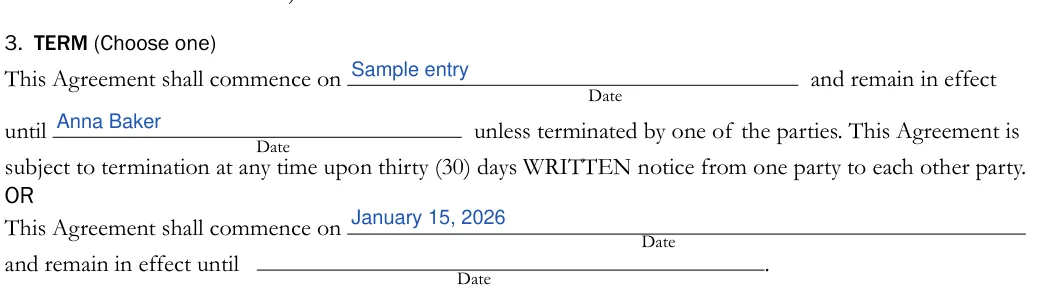
Pick the term. Choose one of the two term options and leave the other blank. Enter the start date and the end date for the option you pick.
Set the rent. Enter the monthly rent, the day of the month it is due, the name of the person it is paid to and the address where it is paid. To record how the rent is paid, such as cash or bank card, use the writing lines in step 8.


Check the utilities. Check each service the rent includes: Electricity, Gas, Water or Garbage. Write any other included service on the Other line.

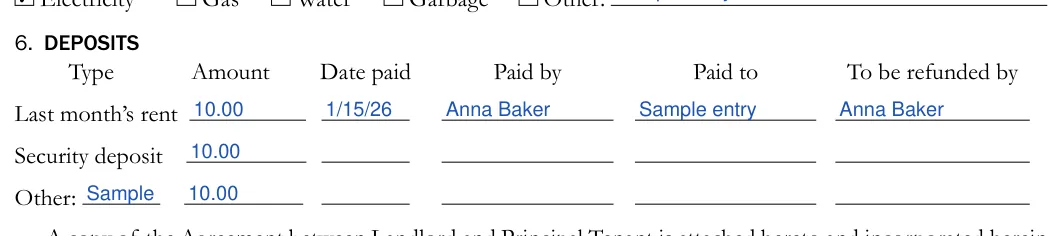
Fill in the deposits table. For last month's rent, the security deposit and any other deposit, enter the amount, the date paid, who paid, who received it and who will refund it. Leave a row blank when no such deposit is paid.

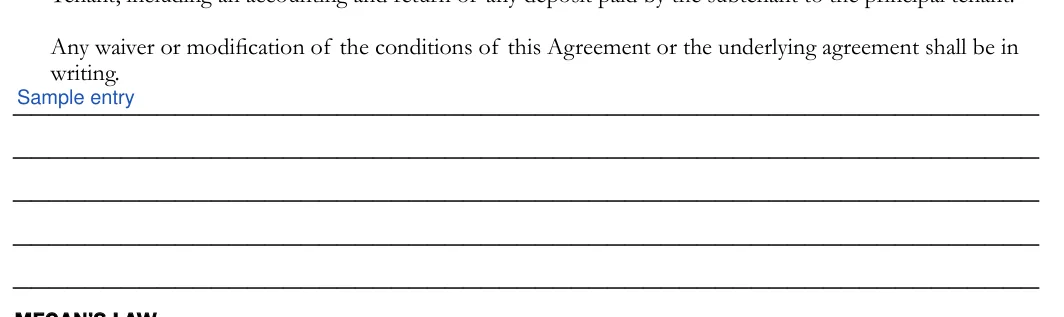
Write the added terms. Use these lines to write down anything the parties add or change, in plain words. The parties may add other terms and conditions that were not described before. For a smoking policy, say whether smoking is allowed and, if so, where.

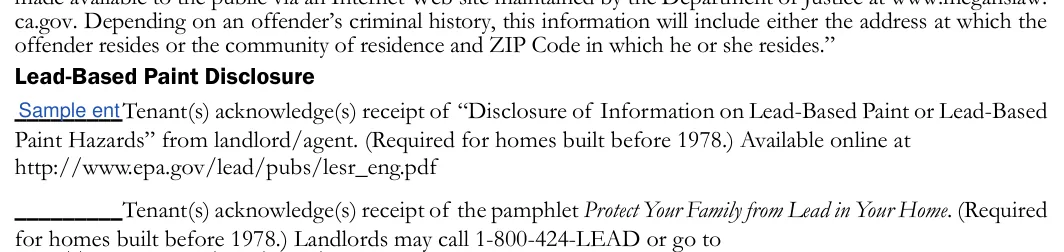
Complete the lead-based paint lines. If the subject property was constructed before 1978, you must give the sublessee a lead-based paint disclosure. The template has two blanks for acknowledging the lead-based paint disclosure and the pamphlet, so fill in both.

Mark the attachments. Check Original Lease Agreement and Condition of Rental Property Checklist for each document you attach. If the parties made an itemized move-in checklist, attach it here, along with a copy of the original lease agreement.

Print the signers' names. Print the names of the Subtenant, the Principal Tenant and the Landlord, then add each signature and date on the lines below.

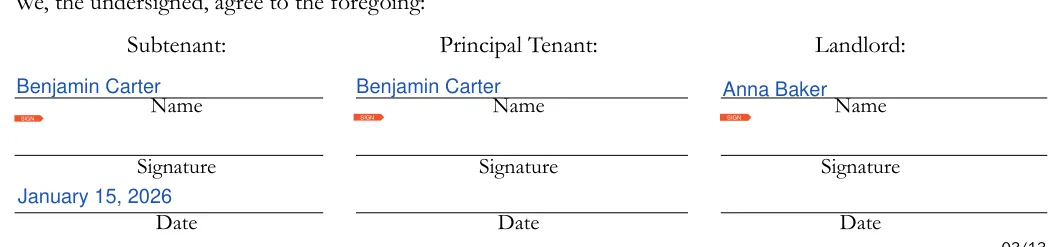
The signing stage of the sublease gathers the landlord's consent and all signatures. Work through the list in order and keep every signed copy together with the original lease agreement.
The template has a signature and date line for the Subtenant, the Principal Tenant and the Landlord. Each person prints a name, signs and dates their own line, so the finished page carries three names and three dates.
The template calls them the Principal Tenant and the Subtenant. The Principal Tenant is the tenant who signed the original rental agreement, and the Subtenant is the person moving in.
A month-to-month residential lease allows a rent increase on written notice from the landlord, under Cal. Civ. Code § 827(b)(1), only where the lease runs from week to week, month to month or another period less than a month. For an increase of 10 percent or less of the rent charged at any time in the 12 months before its effective date, alone or combined with other increases in those 12 months, the notice is delivered at least 30 days before the effective date, under Cal. Civ. Code 827(b)(2). For an increase greater than 10 percent of the rent charged at any time in the 12 months before its effective date, alone or combined with other increases in those 12 months, the notice is delivered at least 90 days before the effective date, under Cal. Civ. Code 827(b)(3)(A). Cal. Civ. Code § 827 sets only the notice for an increase, not how much the rent may rise; another California statute or a local rent ordinance may limit the increase itself.
The bad faith retention of security may subject the landlord to statutory damages of up to twice the amount of the security, in addition to actual damages, under Cal. Civ. Code § 1950.5.
A sublet agreement and a sublease agreement are the same document under two names. Both let a tenant rent all or part of the home to a subtenant while the original lease stays in place.
This form is a residential sublease: its sections cover a home, its furniture, its utilities and a lead-based paint acknowledgment. A sublease of an office or shop calls for terms written for that use.

General information, not legal or tax advice.
