
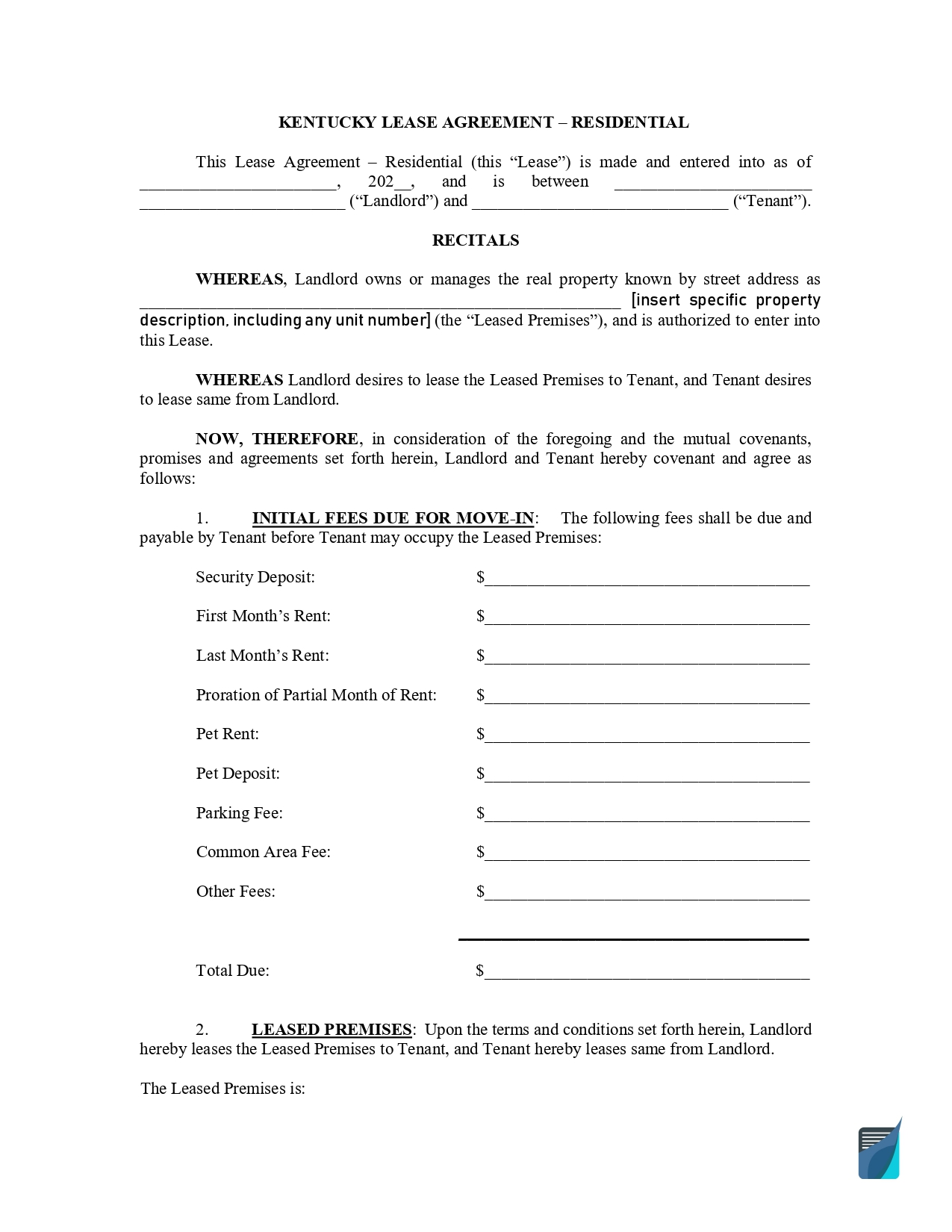
A Kentucky lease agreement is a legally binding document between a landlord and a tenant that outlines the terms and conditions of renting property. This agreement specifies the lease duration, rent amount, payment schedules, and required deposits. It also covers rules regarding pets, noise levels, and maintenance responsibilities.
Last Updated: September 2026. This guide is reviewed and updated regularly to reflect current Kentucky law. If you notice an error or outdated information, please contact us.
Build Your Document
Answer a few simple questions to make your document in minutes
Save and Print
Save progress and finish on any device, download and print anytime
Sign and Use
Your valid, lawyer-approved document is ready
All Kentucky lease agreements protect the landlord’s property and the tenant’s rights. For both parties, having a clear, comprehensive lease agreement form is essential to ensure a smooth rental experience.
Landlords renting out a house, apartment, or single room in Kentucky use this agreement, as do tenants who want the lease terms in writing before they move in. A property manager acting on a landlord’s behalf can also use it to formalize the rental terms for each unit under management.
A Kentucky lease agreement must comply with the Kentucky Revised Statutes, Chapter 383 (Uniform Residential Landlord and Tenant Act). This chapter outlines rules concerning security deposits, lease terminations, and the respective rights and obligations of the parties.
In practice, Kentucky landlords set the security deposit amount based on the monthly rent and local market conditions. The amount should be written clearly into the lease agreement.
Kentucky requires a landlord who collects a deposit to place it in a separate account used only for that purpose. The account must be at a bank or other institution regulated by Kentucky or the federal government, and the tenant must be told where it is held and given the account number.[1]
If a tenant leaves owing no rent and a refund is due, the landlord must notify the tenant of the refund amount at the tenant’s last known address. If the tenant does not respond within sixty (60) days, the landlord may keep the deposit free of any claim.[1]
A different rule covers unpaid rent. If a tenant moves out still owing the last month’s rent and does not ask for the deposit back, the landlord may wait thirty days, then apply the deposit to that debt.[1]
“No landlord shall be entitled to retain any portion of a security deposit if the security deposit was not deposited in a separate account as required by subsection (1) of this section and if the initial and final damage listings required by subsections (2) and (3) of this section are not provided.”
Every Kentucky lease agreement should include a move-in condition checklist covering items such as the walls, floors, appliances, and fixtures. Before accepting a deposit, the landlord must give the tenant a written list of existing damage, with its estimated repair cost. The tenant can inspect the unit to check that list before moving in.[1]
Once the tenant agrees, both sides sign the list. Their signatures serve as evidence that it is accurate, though not as to hidden defects. A tenant who disagrees must instead write down the disputed items and sign that statement of dissent.[1]
For example, a move-in listing might note a cracked window pane with an estimated repair cost of $150, or a scuffed wall that would cost $75 to repaint. Recording specific items and dollar estimates up front gives both sides a clear baseline to compare against when the tenant moves out.
At the end of the tenancy, the landlord must inspect the unit and make a similar listing, with its estimated repair cost. The tenant then has the right to inspect the unit again to check that listing.[1]
Kentucky landlords and tenants can use the lease to set clear expectations about entry notice. For example, the lease can state how much advance notice the landlord will give before entering for repairs or inspections. Putting this in writing helps both sides avoid disputes.
In cities and counties that have adopted Kentucky's Uniform Residential Landlord and Tenant Act (KRS 383.500), Section 383.615 requires the landlord to give the tenant at least two days' notice before entering and to enter only at reasonable times, except in an emergency or where notice is impracticable.[3]
Kentucky landlords must comply with several mandatory disclosure requirements:
These regulations are designed to safeguard tenants by providing them with necessary information about their rights and the condition of their living environment.
| Document Name | Kentucky Rental Lease Agreement Form |
| Other Names | Kentucky Lease Agreement, KY Rental Lease, Kentucky Residential Lease Agreement |
| Relevant Laws | Kentucky Revised Statutes, Chapter 383 |
| Security Deposit Amount | Set by the lease agreement |
| Security Deposit Return | No statutory deadline |
| Avg. Time to Fill Out | 18 minutes |
| # of Fillable Fields | 119 |
| Available Formats | Adobe PDF |
Kentucky sets the notice period for ending a periodic tenancy based on how often rent is paid. Either the landlord or the tenant can end the tenancy by giving the other party written notice[2]:
If the tenant fails to pay rent within ten (10) days after it becomes due, the landlord may end the tenancy at any time without further notice.[2] Either side can count the exact notice date with FormsPal’s deadline calculator.
For example, Anna Baker rents month-to-month and her rent is due on the first of each month. Her landlord must deliver written notice at least thirty days before that date. That gives Anna until the following rental due date to move out.
Under Kentucky law, a landlord who collects a security deposit cannot skip any of the following steps without losing rights over that money later. Doing so forfeits the landlord’s right to withhold any part of the deposit once the tenancy ends[1]:
Kentucky tenants have the right to inspect the rental unit before move-in and again after move-out to check the accuracy of the landlord’s damage listing. A tenant who disagrees with that listing can write down the disputed items and sign a statement of dissent. Tenants are also entitled to know which account holds their security deposit.[1]
No. Kentucky law says a landlord who skipped the required separate account is not entitled to keep any part of the deposit. The same is true for a landlord who did not provide the initial and final damage listings the law requires.[1]

Other Rental Lease Agreement Forms by State
General information, not legal or tax advice.
