
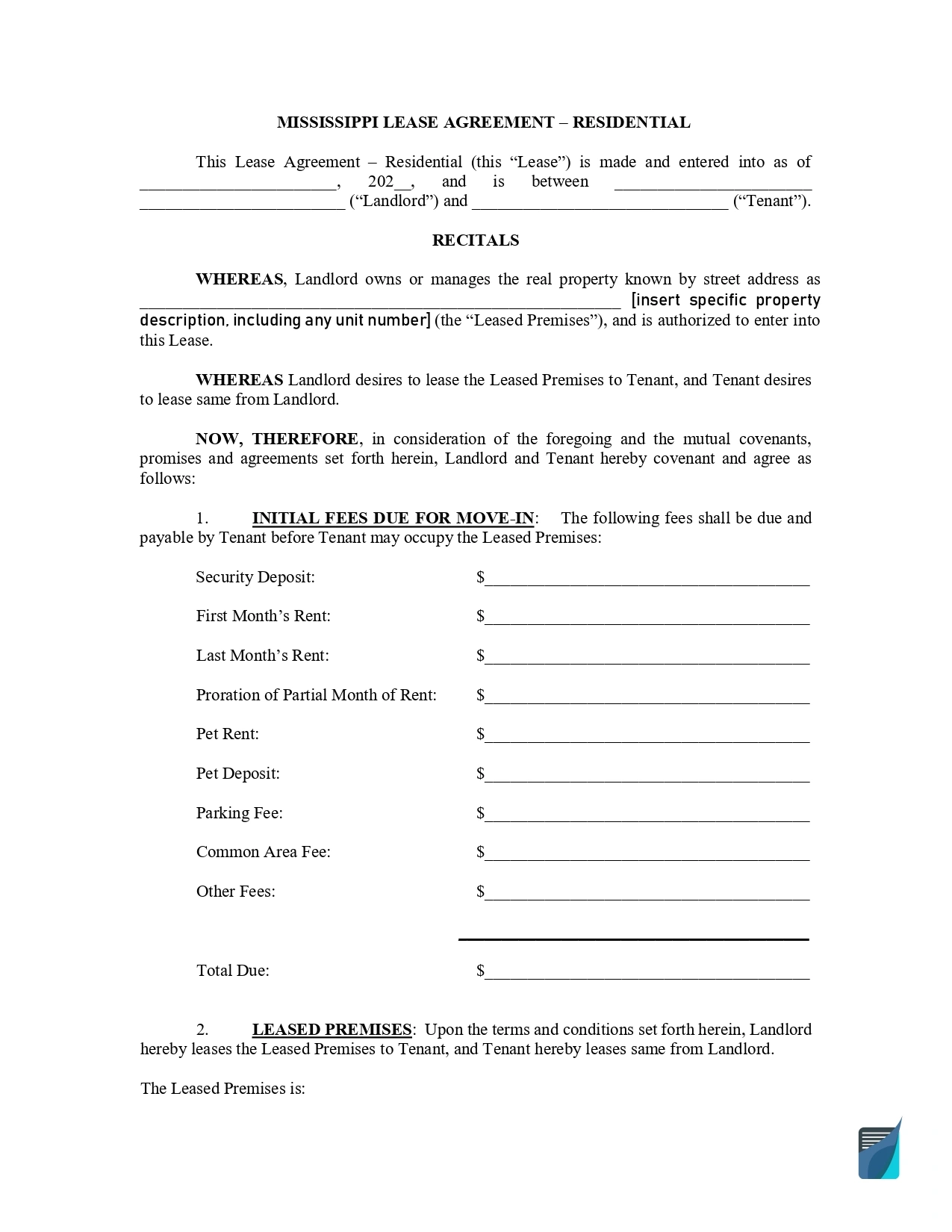
A Mississippi lease agreement is a written contract between a landlord and a tenant. It sets the rent amount, the security deposit, and the rules for renting residential property in Mississippi. The document names both parties, describes the property, and lists the duties each side agrees to follow. Mississippi law, mainly Title 89, Chapter 8 of the Mississippi Code, sets rules for the security deposit and for ending a periodic tenancy. Read every clause and understand your rights before signing.
Last Updated: September 2026. This guide is reviewed and updated regularly to reflect current Mississippi law. If you notice an error or outdated information, please contact us.
Build Your Document
Answer a few simple questions to make your document in minutes
Save and Print
Save progress and finish on any device, download and print anytime
Sign and Use
Your valid, lawyer-approved document is ready
Mississippi landlords and tenants can choose from several types of rental agreements, depending on the property and the length of the tenancy. A month-to-month agreement renews on its own each month until either side gives the required notice to end it. A standard one-year lease instead runs for its full term and ends on the date stated in the lease, unless both sides agree to renew it.
To get acquainted with the specific terms of each form, or to create one of them, you are welcome to use our form-building software above. It also helps make the downloading process quicker.
The Mississippi lease agreement is also known as an MS rental lease or a Mississippi residential lease agreement. All three names describe the same document.
Mississippi's landlord-tenant rules for a written lease come mainly from Title 89, Chapter 8 of the Mississippi Code, which covers residential leases with a term of one year or less. The chapter sets out how a security deposit is handled, when a landlord or tenant may end a periodic tenancy, and what a lease may not require of either side.
In Mississippi, there is no set maximum for a security deposit. Because there is no cap, landlords set their own deposit amount, usually based on the property and the rental terms.
Together, these rules protect both sides. The tenant knows the deposit comes back within 45 days, in writing, with a clear list of any deductions. A landlord who follows the rules can keep money for real repairs or unpaid rent. If you want help understanding any clause in your lease before you sign it, our chat-with-pdf tool can answer questions about the document. A landlord who skips the deposit rules faces a real penalty under Mississippi law:
The retention by a landlord or transferee of a payment or deposit or any portion thereof, in violation of this section and with absence of good faith, may subject the landlord or his transferee to damages not to exceed two hundred dollars ($200.00) in addition to any actual damages.
In practice, this means a landlord who keeps a deposit in bad faith, without sending the required written itemization, can owe the tenant up to $200.00. That amount is on top of whatever actual damages the tenant can show.
Before entering a rented home for repairs or inspection, most landlords give the tenant advance notice, often in person, by text, or by mail. Giving notice helps both sides avoid disputes and confirms the visit has a legitimate purpose.
A lease agreement can set its own notice period and list the entry rules both landlord and tenant agree to follow. A typical entry clause names how notice is given, how many hours ahead it is given, and the reasons entry is allowed, such as repairs, inspections, or showing the unit to a new tenant.
How much notice ends a Mississippi tenancy depends on how the rental period is set up. A month-to-month tenancy and a week-to-week tenancy each carry their own statutory notice period, and either the landlord or the tenant may give that notice.
Whichever type of tenancy you have, put the notice in writing and keep a copy. A written record avoids disputes about when notice was given and when the tenancy actually ends. These notice periods are counted in calendar days, and they run from the date the notice is delivered, not the date it is written. Our deadline calculator can help you count the days correctly before you send or act on a notice.
For housing built before 1978, it is standard practice for a Mississippi lease to include a lead-based paint disclosure. This is part of a nationwide rule, not something specific to Mississippi, so it shows up in leases for older housing in every state.
In practice, the disclosure names any lead-based paint or lead-based paint hazards the landlord knows about. It also comes with a copy of the pamphlet "Protect Your Family from Lead in Your Home," and is attached to the lease before the tenant signs.
| Document Name | Mississippi Rental Lease Agreement Form |
| Other Names | MS Rental Lease, Mississippi Residential Lease Agreement |
| Relevant Laws | Mississippi Code, Title 89, Chapter 8 |
| Security Deposit Amount | Not specified |
| Security Deposit Return | Forty-five (45) days after the termination of the tenancy |
| Avg. Time to Fill Out | 18 minutes |
| # of Fillable Fields | 119 |
| Available Formats | Adobe PDF |
A landlord who withholds a security deposit in violation of Mississippi law, without good faith, may be liable for damages of up to $200.00. That amount is in addition to any actual damages the tenant can show. The same statute requires the landlord to send that written, itemized notice before keeping any part of the deposit.[1.3]
General information, not legal or tax advice.

Other Rental Lease Agreement Forms by State
