
Updated:
A resignation letter is written notice that you are leaving your job. It tells your employer your last day of work, thanks them and offers help with the handover. Employees use one when they quit, especially to leave on good terms.
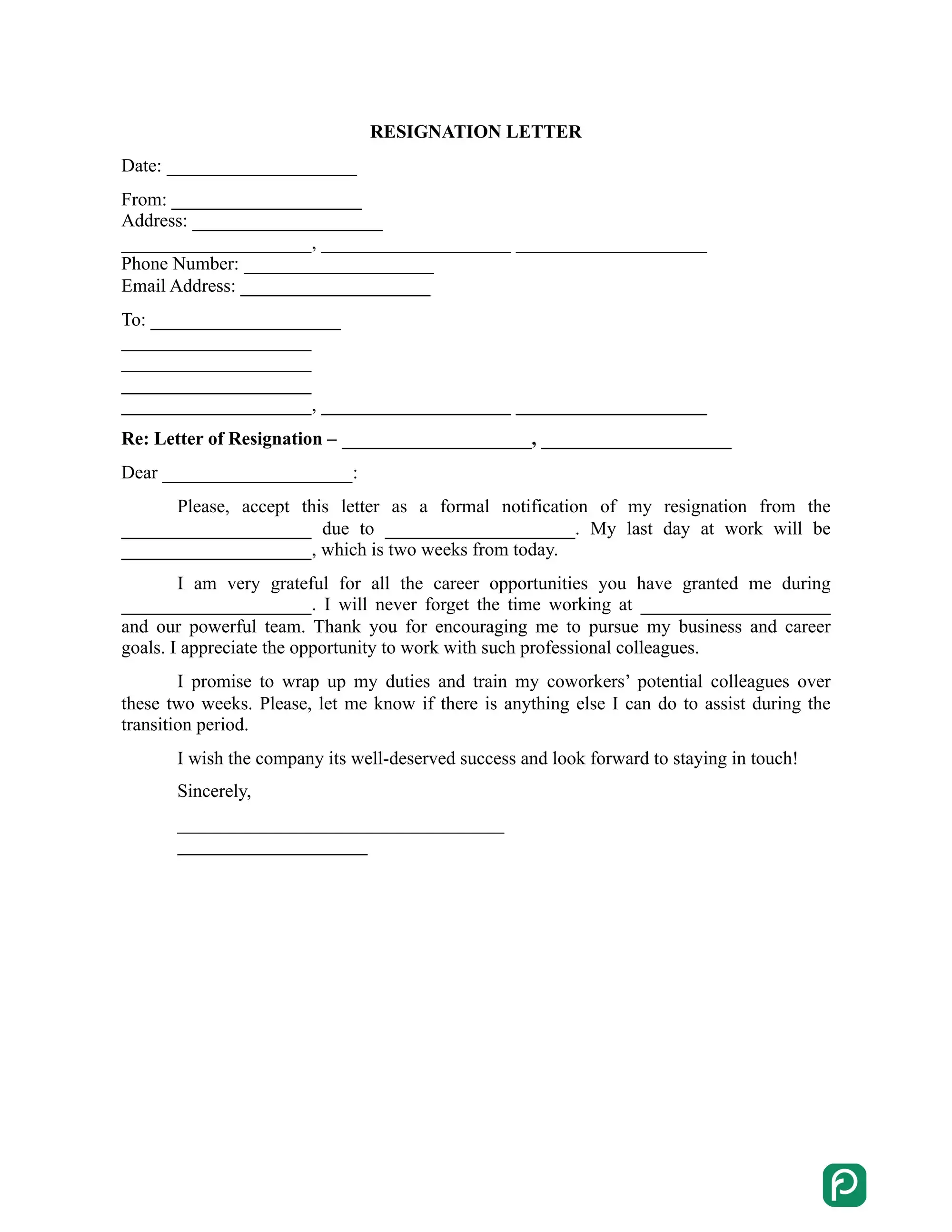
This official document is not required when you leave your job (unless your employer obliges you to write it), but it helps keep friendly relationships with your former team. Below you will find our free resignation letter template, a step-by-step writing guide, a list of what to include and avoid, and three sample letters you can copy.
Build Your Document
Answer a few simple questions to make your document in minutes
Save and Print
Save progress and finish on any device, download and print anytime
Sign and Use
Your valid, lawyer-approved document is ready
A resignation letter is a short, formal letter or email in which an employee tells the employer that they are leaving the job and names the last working day. People also call it a notice letter, a leaving notice or a notice of intent to leave.
The letter does three jobs. It puts your decision in writing, so nobody has to remember a conversation. It fixes the date of your last day, so your manager and HR can plan. It closes your time at the company on a polite note, which helps when you later ask for a reference.
You write one when you have decided to leave a job and want the decision on file. Common reasons are a new job offer, a move, health, family, study, retirement or a career change.
Write it after you have told your manager in person or by phone, and hand it in the same day. Some employers ask for written notice in the employee handbook or the employment agreement, so read those first.
This letter is only for leaving a job by your own choice. If your employer says you abandoned your post after an absence, you need an explanation letter instead: it says why you were away, when you could not report, and whether you want to keep the job. If you are leaving a board seat, a church role or a volunteer position, use a letter written for that role, such as a board resignation letter.
These letters differ mainly in how much notice they give before your last day at work. Pick the type that fits your situation:
A two weeks notice letter gives your supervisor time to find or train someone to take over your duties before you go. It’s a common and recommended practice to hand in a resignation letter with at least two weeks’ notice.
A short notice letter sets a last day earlier than the usual notice period, and it works best when you explain the reason briefly and offer to help. If your employment agreement or employee handbook doesn’t provide otherwise, you can define a shorter period after which you will be leaving, for example, a week or five days. It’s useful to check whether the employment documents have special requirements on the issue.
An immediate resignation letter tells your employer you are leaving at once, and it should apologize for the short notice and give a brief reason. Circumstances beyond your control, such as health problems or a family emergency, are the usual cause. If you have to quit today, call your supervisor first, then send the letter so the date is in writing.
A resignation letter includes the date, the names of you and your manager, your job title, a statement that you are resigning, your last day, a thank you and an offer to help. Most letters keep these parts in this order:
The letter stays in your employee file, so leave out anything you would not want a future employer to read:
To write a resignation letter, start with a formal heading, say that you are resigning and give your last day, thank your employer, offer to help with the handover and end with your signature. Use our resignation letter template or the samples below, and follow these steps:
A resignation email works the same way as a printed letter: it states that you are resigning, names your last day and thanks your employer. Use a clear subject line, such as “Resignation, [Your Name]”, put the letter in the body of the email, and copy HR if your workplace asks you to.
To quit a job professionally, tell your manager in person first, hand in your letter, finish or hand over your work, and leave a clear record of where each task stands. These four steps protect your reputation and keep you on good terms:
After you hand in your letter, keep a copy, ask HR how your final paycheck and benefits will be handled, and return company property before your last day. A short checklist helps:
These samples show the same structure in three situations: a standard notice, a new job and an immediate resignation. Replace the names, dates and details with your own, and keep the letter short and polite. Each sample follows this order:
11/16/2026
Company A
Sales Manager
Mary Smith
Dear Mr. Andersen
With deep regret, I am writing to inform you that I am resigning from my position as sales manager for personal reasons. My last day at work will be 11/30/2026.
I want to thank you for your encouragement and support for my career growth. I really appreciate you being my mentor and such a great leader. I am also grateful for the opportunity to work with such a powerful team. I have had a wonderful and fruitful time working at Company A.
I am determined to finish all my projects and complete all the current tasks. I understand that it can be hard to find a specialist in this position, so I can train the person who will take over my duties. Please, let me know if there is anything else I can do to assist during the transition period.
I wish the company its well-deserved success and look forward to staying in touch!
Sincerely,
Mary Smith
(signature)
11/16/2026
Company C
Graphic Designer
Alex Brown
Dear Ms. Lee
Please accept this letter as notice that I am resigning from my position as graphic designer. I have accepted a new role that will help me grow my career, and my last day at work will be 11/30/2026.
Thank you for the trust you have placed in me and for everything I have learned on the design team. Working on the spring campaign with you has been a highlight of my time at Company C.
Before I leave, I will finish the current projects and prepare handover notes for the team. I am glad to help train my replacement.
I hope we stay in touch.
Kind regards,
Alex Brown
(signature)
11/16/2026
Company B
Assistant Manager
John Smith
Dear Mrs. Perkins
Please, accept this letter as a formal notification of my immediate resignation from the assistant manager position. I sincerely apologize for not providing notice. But due to the sudden deterioration in my health, I won’t be able to perform the work properly. My last day at work will be tomorrow, November 17, 2026.
I am very grateful for all the career opportunities you have granted me during these several years. I will never forget the time working at Company B and our support team. Thank you for encouraging me to pursue my business and career goals. I appreciate the opportunity to work with such professional colleagues.
Unfortunately, under the current circumstances, I cannot assist in the transition and hand my current tasks over to the next employee. However, please let me know if you have any questions. I will do everything in my power to help you.
I hope to stay in touch!
Kind regards,
John Smith
(signature)
For other situations, see our letters for personal reasons and retirement.
Either works: pick the format your workplace uses most. A printed letter feels formal, while an email gives you a dated copy that is easy to forward to HR. Keep the text short and polite either way.
Keep it to one page. A few short paragraphs are enough:
Address it to your direct manager. You can also send a copy to HR so your last day is on file.
A short, general reason is enough, such as a new opportunity or personal reasons. Skip details about conflicts or your next job, and keep the tone positive.
You can, but read your employment agreement and employee handbook first, because they may ask for notice or tie some benefits to it. If you must leave at once, tell your manager directly, apologize for the short notice and send an immediate resignation letter.
You can ask, and how the request is handled depends on who employs you. A federal agency may decline a request to withdraw a resignation before its effective date only when it has a valid reason and explains that reason to the employee (5 CFR 715.202(b)). For other jobs, check your employment agreement, handbook or union agreement, which may set their own terms. Talk to your manager as soon as possible, and confirm any agreement in writing.
Select Create My Document at the top of this page and answer a few simple questions. FormsPal saves your progress, so you can finish on any device, then download and print the letter.
General information, not legal or tax advice.
