
What Happens If You Violate a Non-Compete Agreement?
Written by FormsPal Editorial Team
- Time to read
- 6 min
Breaking a non-compete can cause problems faster than most people expect. These agreements usually limit where you can work, what kind of work you can do, and sometimes even which former clients you can talk to after you leave.
Trouble usually starts when a former employer believes those limits were crossed. Violating non-compete agreements does not automatically lead to a lawsuit, but it can lead to warning letters, pressure on your new employer, or claims that your move caused financial damage. This guide explains what happens if you break a non-compete agreement and what options you might have.
What Is Considered a Non-Compete Violation?
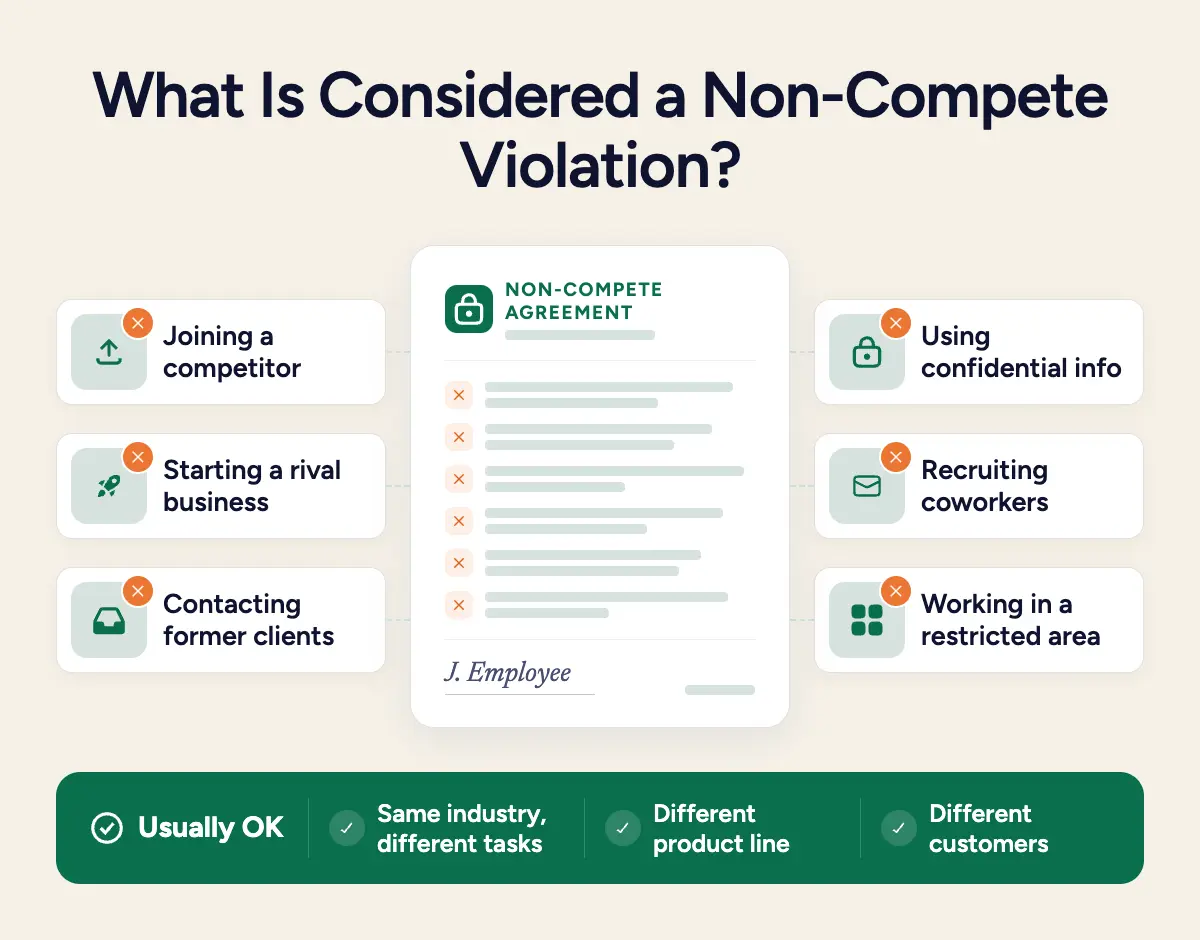
A non-compete violation occurs when a former employee does something their agreement prohibits after leaving a job. Most often, this means working for a competitor, starting a similar business, or contacting former clients before the restriction period ends.
A breach of non compete agreement depends on what the contract actually says. Some agreements only restrict direct competitors, while others also limit the type of work, the location, or even the clients a person can work with, which can create problems even when the new job looks different at first glance.
Here are some common situations that might count as a non-compete violation.
| Possible Violation | Why It May Be a Problem |
|---|---|
| Working for a direct competitor | The new role may fall within a restricted industry or duties. |
| Starting a competing business | The agreement may prohibit similar commercial activity. |
| Contacting former clients | Non-solicitation terms may block outreach. |
| Using confidential information | Trade secrets and internal data remain protected. |
| Recruiting former coworkers | Some agreements restrict team solicitation. |
| Working in a restricted location | Geographic limits may prohibit certain markets. |
Changing jobs does not necessarily mean breaking a non-compete agreement. For instance, an employee may remain in the same industry but perform different tasks. This makes it more difficult to prove real competition, especially if the new job involves a different product line or serves different customers.
What Happens If You Violate a Non-Compete?
Breaking a non-compete agreement leads to several outcomes. It depends on how strict the contract is and how the former employer responds. Some situations end with a warning, others turn into disputes that affect your job, income, or future work plans.
Cease and Desist Letter
One of the most common first steps is a cease and desist letter. This is a formal notice where the former employer claims a non-compete violation and demands that the restricted activity stop.
The letter may ask you to leave your new job, stop contacting certain clients, or confirm in writing that you will follow the agreement. Ignoring it pushes the situation toward more serious action.
Pressure on Your New Employer
A former employer may also contact your new company. This usually happens when they believe the new role directly conflicts with the agreement or creates unfair competition.
In some cases, the new employer may:
- Change your responsibilities
- Move you to another department
- Pause your employment
- End your employment to avoid risk
Companies rarely want to step into a contract dispute, so they may act cautiously even if they believe your position is acceptable.
Financial Claims and Damages
A breach of a non-compete agreement may also be a reason for financial demands. An employer may claim that your actions caused lost revenue, damaged client relationships, or gave a competitor an unfair advantage.
Some agreements also contain clauses that set a fixed amount a person must pay if they break the contract. These clauses don't always hold up, but they raise the financial stakes and make the situation feel heavier than expected.
Court Orders to Stop Certain Work
If the dispute escalates, an employer may ask a court for an injunction. This is a legal order that can temporarily or permanently stop someone from continuing the disputed work.
These requests often move quickly because employers argue that business harm cannot wait. A judge may review the agreement, the job duties, and the actual risk of competition before deciding whether to enforce the restriction.
Lawsuits for Breach of Non-Compete Agreement
If the issue cannot be resolved, the employer may file a lawsuit. This typically focuses on whether the contract was valid, whether a real non-compete violation happened, and whether the company suffered measurable harm.
Not every dispute reaches this stage. Many conflicts settle earlier through negotiation, role changes, or written agreements that limit certain activities instead of forcing someone to completely leave a new job.
Related Forms:
Can You Go to Jail for Breaking a Non-Compete?
In most situations, breaking a non-compete agreement does not lead to jail time. A breach of a non-compete agreement usually falls under civil law, which means the dispute involves financial claims or court orders rather than criminal penalties. Employers usually try to stop the competing activity or recover damages rather than pursue criminal charges.
Jail only becomes a possibility if the situation involves separate illegal conduct. For example, criminal risk may appear if someone steals trade secrets, takes protected data, commits fraud, or transfers confidential files without permission. These situations fall under laws such as the Economic Espionage Act enforced by the U.S. Department of Justice, and trade secret protections explained by the Federal Trade Commission (FTC).
The FTC also explains how non-competes function as employment contract restrictions rather than criminal violations, and many state laws treat them the same way. For example, California law under the Business and Professions Code, Section 16600, generally restricts the enforcement of non-competes instead of criminalizing violations.
The main risk usually involves money, employment problems, or court orders. A person may face demands to stop certain work, pay damages, or follow the contract terms, but jail remains highly unusual unless the case involves theft or fraud. That changes the legal situation very quickly.
What To Do If You Already Violated a Non-Compete?
Realizing you may have violated a non-compete is stressful, but quick and practical steps reduce the risk of a bigger dispute.
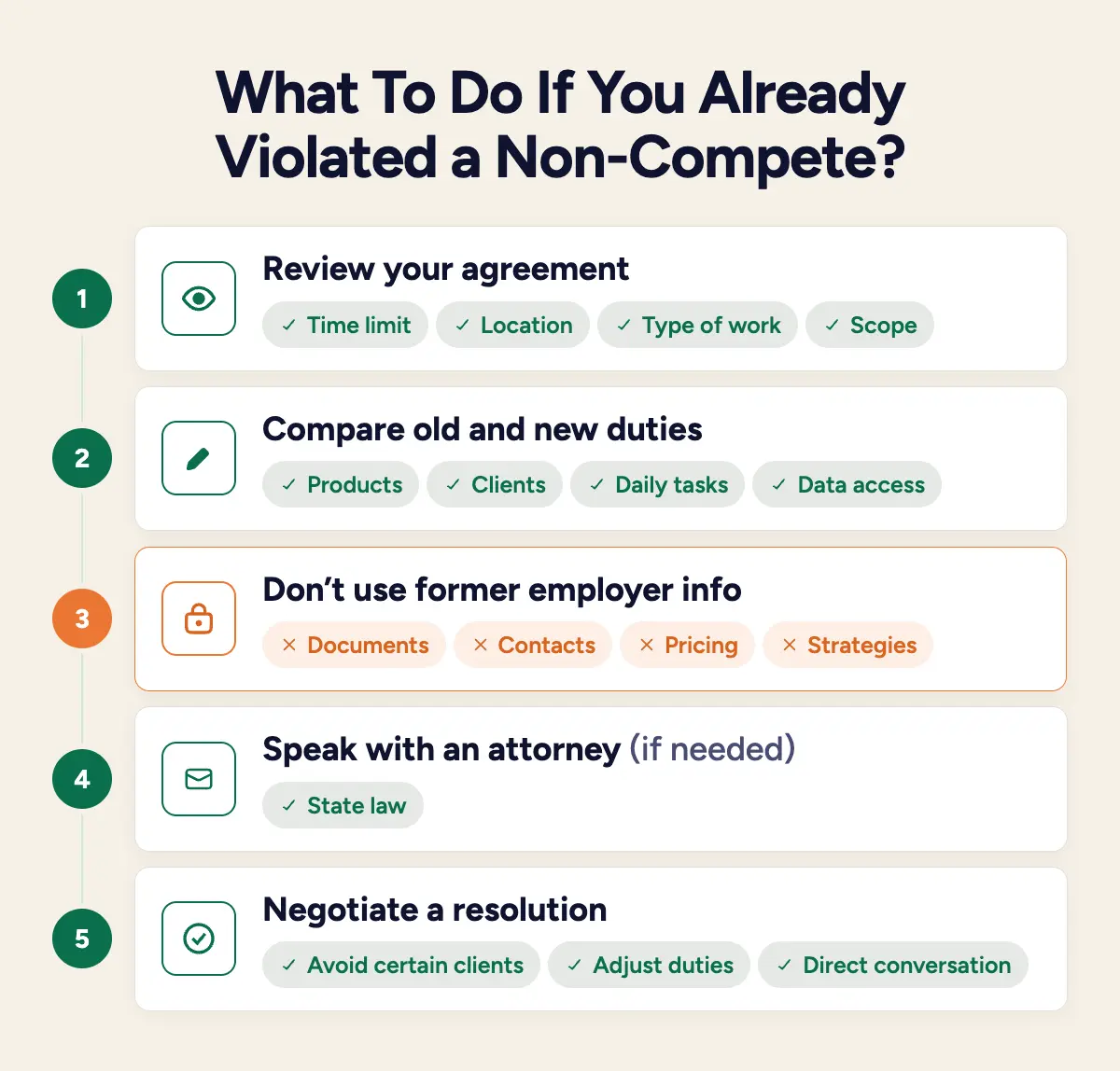
Step 1. Review Your Agreement Carefully
First of all, read the non-compete agreement you’ve signed again. You must pay close attention to the time limit, restricted locations, and the type of work the contract actually prohibits.
Sometimes the restriction may be narrower than it first appears, and a new role may fall outside the prohibited activities. That changes how serious the situation really is.
Step 2. Compare Your Old and New Job Duties
Write down the differences between the roles, especially:
- Products or services involved
- Type of clients
- Daily responsibilities
- Access to sensitive information
- Decision-making authority
Look at what you actually did before and what you do now. In such cases, job titles alone do not decide whether a breach of non-compete agreement terms occurred; real duties matter more.
Step 3. Don’t Use Any Former Employer Information
Do not use documents, contact lists, pricing data, or internal strategies from your previous job. Even accidental use of this information makes a non-compete violation look more serious and harder to defend. That’s why keeping your past and current work separate lowers your legal risk.
Step 4. Speak With an Attorney
If the situation looks serious, a lawyer can deeply analyze the contract and explain how state law may apply. In some cases, agreements have limits that courts will not enforce, especially if they are too broad.
Step 5. Consider Negotiation or a Resolution
Sometimes, a direct conversation is the fastest way to solve the problem. A former employer may agree to minor adjustments instead of pushing the issue, especially if the new role doesn't directly threaten their business.
Such negotiations could entail avoiding certain clients or making minor changes to your duties. And this happens pretty often. Most companies prefer a practical solution to a long dispute that wastes time and money without achieving a real win for anyone.