
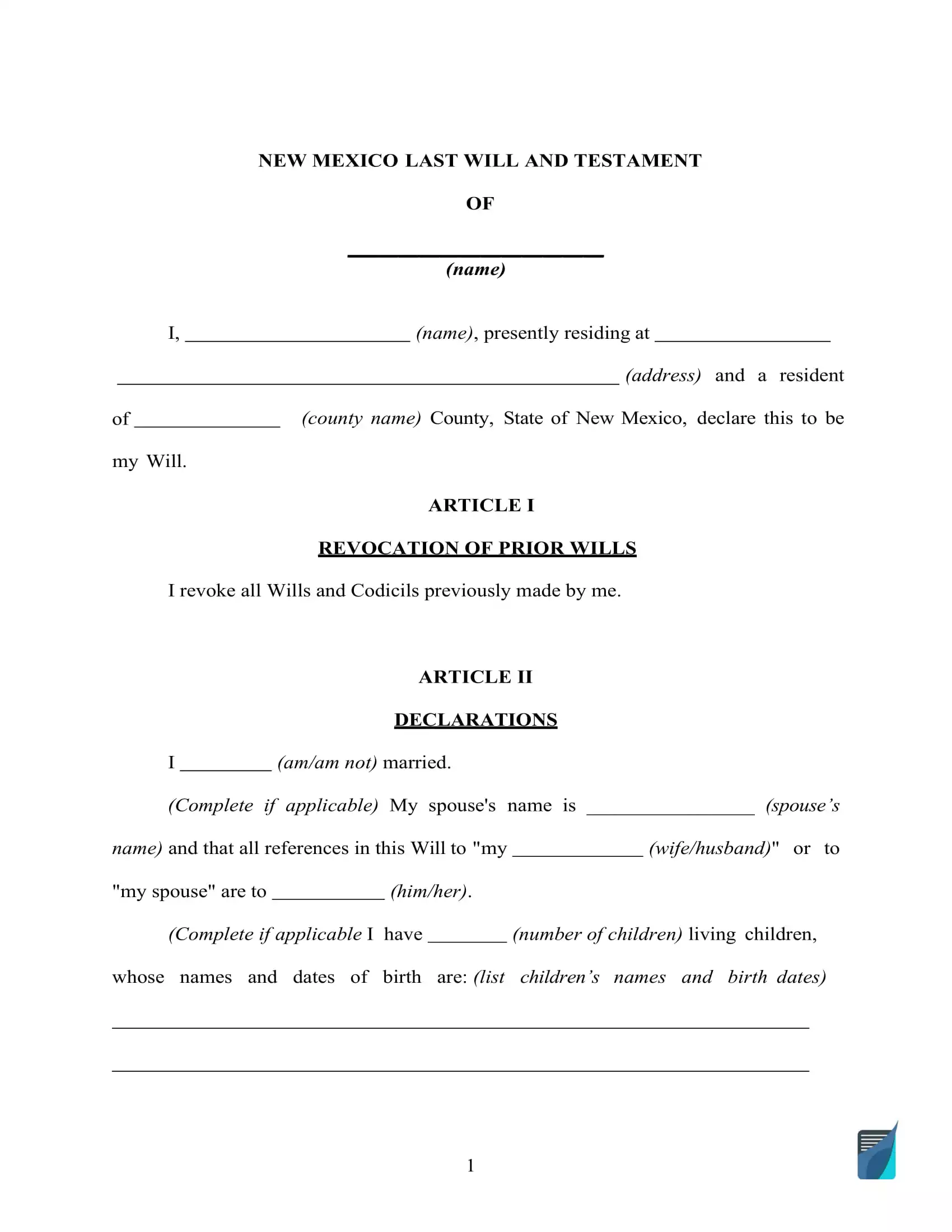
A New Mexico last will and testament is a written document that lets a person, known as the testator, name who receives their property after death and who will serve as executor to carry out those wishes. Under New Mexico law, it must be in writing, signed by the testator, and signed by at least two witnesses.[2]
A last will also lets you name a guardian for minor children and choose the specific people who receive your property. Many people create one even with a modest estate, since it puts these decisions in writing instead of leaving them unresolved.
Build Your Document
Answer a few simple questions to make your document in minutes
Save and Print
Save progress and finish on any device, download and print anytime
Sign and Use
Your valid, lawyer-approved document is ready
Last Updated: September 2026. This guide is reviewed and updated regularly to reflect current New Mexico law. If you notice an error or outdated information, please contact us.
A New Mexico last will and testament is sometimes confused with a living will. A last will and testament decides who receives your property and who serves as executor after you die. A living will is a different document that states your wishes for end-of-life health care while you are alive.
New Mexico law sets specific rules for a will to be valid, covering who can make one, how it must be signed, and how many witnesses are required. The table below summarizes these requirements, with the full text of each rule explained in the sections that follow.
| Requirements | State law | |
| Statutes | Chapter 45 – Uniform Probate Code; Article 2 – Intestate Succession and Wills | |
| Who can make a will | 18 or older (or an emancipated minor) and of sound mind | § 45-2-501 |
| Signing and witnessing | In writing, signed by the testator, and signed by at least two witnesses | § 45-2-502 |
| Interested witnesses | A witness who is also a beneficiary does not invalidate the will | § 45-2-505(B) |
| Out-of-state wills | Recognized if validly executed under the law of the place where signed | § 45-2-506 |
| Revoking a will | By a later will, a signed revocation document, or a revocatory act such as destroying it | § 45-2-507(A) |
A New Mexico will is valid when it is in writing, signed by the testator, and signed by at least two witnesses who each sign in the presence of the testator and of each other after watching the testator sign.[2] The testator must also be 18 or older, or an emancipated minor, and of sound mind at the time of signing.[1.1]
New Mexico requires at least two witnesses to sign a will.[2] Each witness must sign in the presence of the testator and of the other witness, after watching the testator sign the will.[2]
"Signed by at least two individuals, each of whom signed in the presence of the testator and of each other after each witnessed the signing of the will as described in Subsection B of this section."
Some people believe a witness cannot also be a beneficiary of the will. New Mexico law says otherwise: the signing of a will by an interested witness does not invalidate the will or any of its provisions.[1.2] Many people still choose witnesses who are not beneficiaries, since it can help avoid disputes later, but the law does not require it.
Yes. New Mexico's requirements for a valid will do not include hiring a lawyer. A will is valid if it is in writing, signed by the testator, and signed by at least two witnesses who meet the state's signing requirements.[2] Many people still consult an attorney for a large or complex estate. A basic will does not call for one.
1. Think about your options. Make a decision if you would like to hire an attorney or prepare your last will and testament yourself (either by using a template or our document builder). Consulting a law firm might be recommended if you have a large estate that would be too complex to plan out yourself.
2. Specify your information. The first step is establishing the testator by providing their full name, together with the residential information (city, county, and state). Go over the information you entered as well as the rest of the passage to check if there are no mistakes or typos.

3. Indicate the executor. Appoint the executor of your property by entering their specifics: full legal name and place of residence. This should typically be in the same state as the testator, since it is easier for someone in the same state to handle the required duties.
Although it isn’t required, it’s a good idea to appoint an additional person to perform the duty of your executor in the event the first one is unwilling or not capable of carrying out your last will and testament.

4. Choose the guardian (optional). It is possible to choose a trusted person as a guardian if you have minor or dependent children that must be taken care of. If there are no directions pertaining to exactly who should take care of your kids, the guardian will be selected by the court.

5. Establish your beneficiaries. This is where you establish those who will receive your assets. Enter their full names, places of residence, and your relationship with them (spouse, child, friend, etc.).
6. Allocate the property. You can indicate which of the beneficiaries gets this or that piece of property. Otherwise, the assets will be distributed equally among the inheritors. Property could include cash, shares, real estate, company control, money for unresolved debts, and any tangible things of monetary worth that count among your possessions. But, shared and living trust property and assets, as well as your life insurance, can’t be put into your last will.

7. Sign and ask witnesses to finalize the document. New Mexico law requires at least two witnesses to sign the will in the presence of the testator and of each other, after watching the testator sign.[2] If the testator cannot sign personally, another person may sign the will in the testator's name, in the testator's conscious presence and at the testator's direction.[2] A witness who is also a beneficiary does not make the will invalid, though many people still choose witnesses who are not beneficiaries to help avoid disputes later.[1.2]
Note: Consider picking witnesses younger than you to ensure that they will still be around if the will is contested in court or if any other problem occurs.
Now, you (as well as your two competent witnesses) have to sign the paper after writing your full legal addresses and names. Make sure you check each paragraph carefully beforehand.


Yes. A will is valid in New Mexico if it meets the state's own signing requirements. It is also valid if it was properly executed under the law of the place where it was signed. The same is true if it meets the law of the state where the testator lived, had a home, or was a citizen, at signing or at death.[1.3]
Yes. If the testator cannot sign personally, another person may sign the will in the testator's name, as long as it is done in the testator's conscious presence and at the testator's direction.[2]
Testamentary capacity means having the legal and mental ability to make or change a will. New Mexico's statute requires the testator to be of sound mind, and 18 or older or an emancipated minor, at the time of signing.[1.1] In practice, this generally means understanding:
No, disinheriting a spouse completely through a simple will clause is difficult in most states, since spousal inheritance protections often apply regardless of what the will says.
If you want to limit what your spouse receives, a prenuptial or postnuptial agreement in which the spouse agrees to receive none of your property is one option. Divorce is another way to end a spouse's inheritance rights, if that is the outcome you and your spouse choose.
Yes. You may modify or revoke your will unless you are bound by a legal contract not to. New Mexico law allows a will to be revoked in three ways: by executing a later will that revokes it, by signing another document that expressly revokes it, or by a revocatory act. A revocatory act means burning, tearing, or destroying the will with the intent to revoke it.[1.4]
For a small change, write your update in a codicil and attach it to your will. If you have many changes, it is usually better to create a new will instead.
Yes. After the testator dies and the will is filed, a copy generally becomes a public record that can be requested through your local court.
| Related documents | Cases when you might want to make one |
| Codicil | Your last will requires one or a number of small modifications. |
| Self-proving affidavit | You wish the probate to be quicker when the time comes. |
| Living will | You would like to express your wishes concerning end-of-life health care and life-prolonging measures. |
| Living trust | You want to avoid probate by putting your property in a trust. See how a living trust compares to a will. |
General information, not legal or tax advice.
Unless noted otherwise, the sources below are from the New Mexico Statutes Annotated, published by the New Mexico Compilation Commission.
