
A Connecticut living will is a written document that states your wishes about life-sustaining medical treatment for a time when illness or incapacity keeps you from speaking for yourself. Connecticut law requires the document to be signed and dated by the declarant, with at least two witnesses.[1.1]
Last Updated: September 2026. This guide is reviewed and updated regularly to reflect current Connecticut law. If you notice an error or outdated information, please contact us.
Build Your Document
Answer a few simple questions to make your document in minutes
Save and Print
Save progress and finish on any device, download and print anytime
Sign and Use
Your valid, lawyer-approved document is ready
The same living will template also lets you appoint a health care representative in Connecticut, the person who can make medical decisions for you once you can no longer make them yourself. You can change or revoke the document at any time while you remain mentally competent.
Give a signed copy of your living will to your health care agent, your primary doctor, and a close family member so it is on hand when it is needed.
Connecticut's living will laws set out how a living will must be executed. The declarant must sign and date the document, and at least two witnesses must sign it as well.[1.1] The witnesses sign in the declarant's presence, and by signing they attest that the declarant appeared to be at least 18 years old, of sound mind, and able to understand the nature and consequences of the document.[1.2]
"Such document shall be signed and dated by the maker with at least two witnesses and may be in substantially the following form."
In practice, many people also choose witnesses who are not related to them and who do not stand to inherit from them, since an interested witness can raise questions later about whether the document reflects the declarant's own wishes. Connecticut law does not set that rule for declarants generally, but it does set special witness rules for people living in certain state-licensed facilities, covered below.
The person you appoint as your health care representative may not serve as a witness to that appointment (Conn. Gen. Stat. § 19a-576(a)).[1.4]
| Document Name | Connecticut Living Will Form |
| State Form Name | Connecticut Advance Health Care Directive |
| Signing Requirements | Two Witnesses |
| Validity Requirements | Section 19a-575a |
| Powers Limitation | Section 19a-575 |
| State Laws: Connecticut General Statutes, Sections 19a-575 to 19a-580a | |
Connecticut's statute includes suggested wording a living will "may be in substantially" for stating wishes about life support, pregnancy, and related decisions.[1.1] That wording opens with, "I wish this statement to stand as a testament of my wishes." You do not have to copy it word for word. FormsPal's builder walks you through the same decisions in plain questions and produces a document that follows the statute.
A few avoidable errors can leave a Connecticut living will incomplete, hard to use in an emergency, or open to challenge later. Watch for these common problems before you sign the document and before you hand out copies to your agent, doctor, and family.
Here is a sample situation that shows how the witness rules work in practice. Anna Baker of Hartford names her sister as her health care agent on her living will. Connecticut requires two witnesses to sign the document alongside Anna. In practice, Anna should not also ask that same sister to serve as one of those two witnesses, and should instead pick two neighbors or coworkers who are not named anywhere else in the document.
Keeping her witnesses separate from the people named in the document helps avoid any later question about whether Anna signed the living will freely and on her own terms.
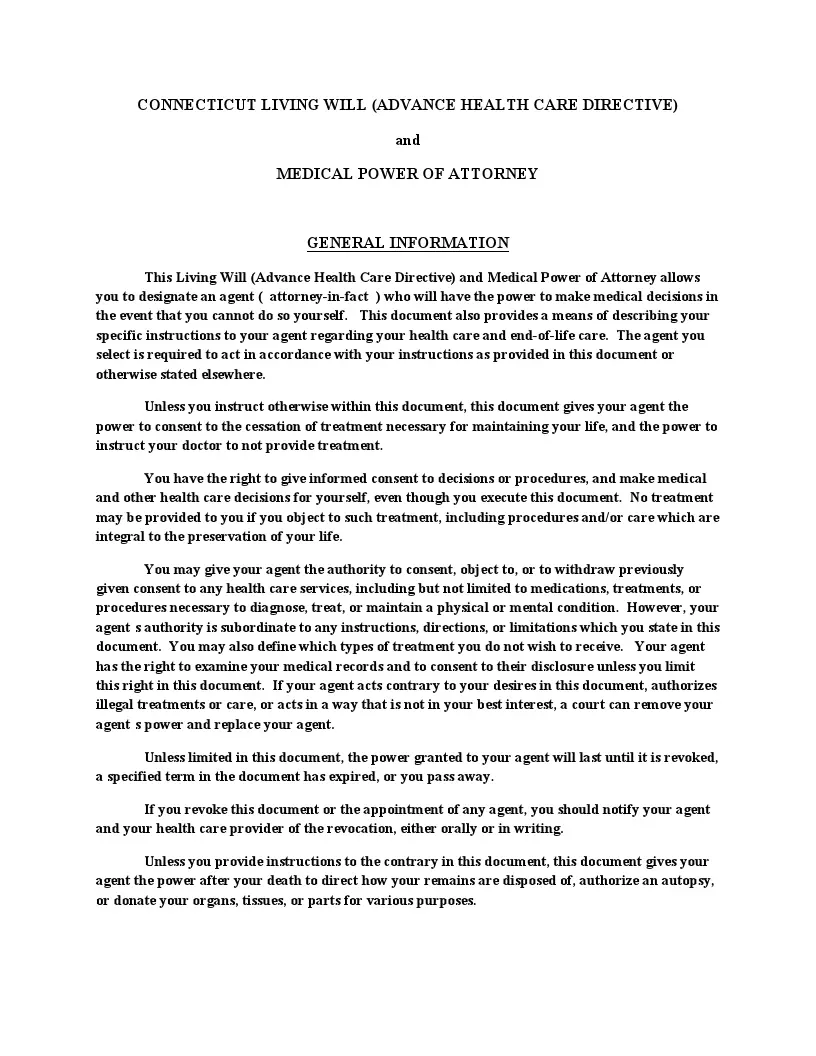
FormsPal's Connecticut living will form combines a living will declaration with a medical power of attorney. Work through the form in the order below, from the opening explanation on page 1 through the witness acknowledgment on page 8, and read each part before you write anything in it.

Connecticut law adds special witness rules for declarants who live in certain state-licensed facilities. If you live in a facility operated or licensed by the Department of Mental Health and Addiction Services, at least one witness must not be affiliated with that facility. At least one witness must also be a physician, advanced practice registered nurse, or licensed clinical psychologist with specialized training in treating mental illness.[1.3]
Facility residents, take note. The same rule applies if you live in a facility operated or licensed by the Department of Developmental Services. At least one witness must not be affiliated with the facility, and at least one witness must be a physician, advanced practice registered nurse, or licensed clinical psychologist with specialized training in developmental disabilities.[1.3] Connecticut medical facility staff can usually point you to these additional witness rules if you are unsure whether they apply to you.
If you live in a facility run by the Department of Mental Health and Addiction Services or the Department of Developmental Services, at least one witness must be unaffiliated with the facility and one must be a physician, advanced practice registered nurse or licensed clinical psychologist (Conn. Gen. Stat. § 19a-576(b) and (c)).[1.5]
A Connecticut living will needs at least two witnesses in addition to the declarant's own signature. The statute states that the document "shall be signed and dated by the maker with at least two witnesses."[1.1]
Yes. Connecticut law requires the declarant to sign and date the living will for it to be valid, in addition to the signatures of the two required witnesses.[1.1] Without the declarant's own signature and date, the document does not meet the state's execution requirements, whatever the witnesses signed.
General information, not legal or tax advice.
