

DD Form 2216 at a glance
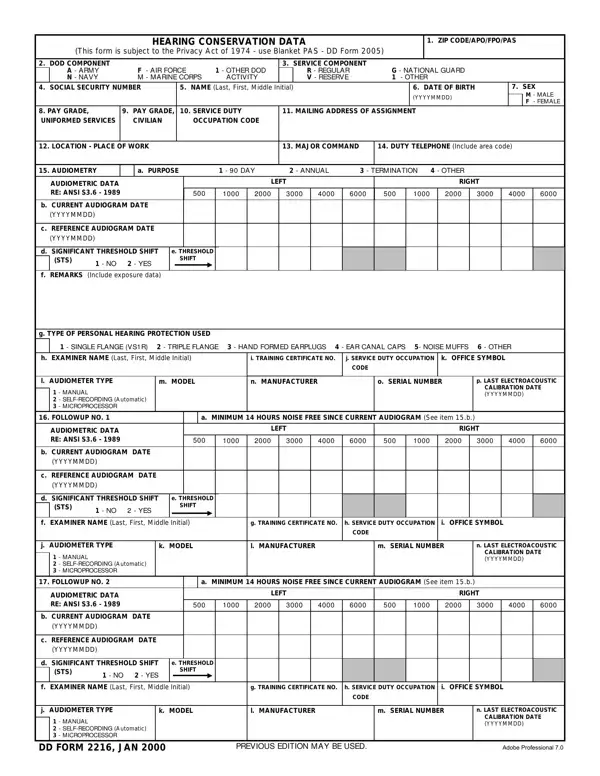
What it is: Hearing Conservation Data, DD Form 2216, is used to record the results of periodic and followup audiometry for individuals routinely exposed to hazardous noise.
Where and when to file: Before this form is used, a DD Form 2215, "Reference Audiogram," must already be filed in the individual's health record.
What to bring and attach to DD Form 2216
Before this form is used, a DD Form 2215, "Reference Audiogram," must already be filed in the individual's health record.
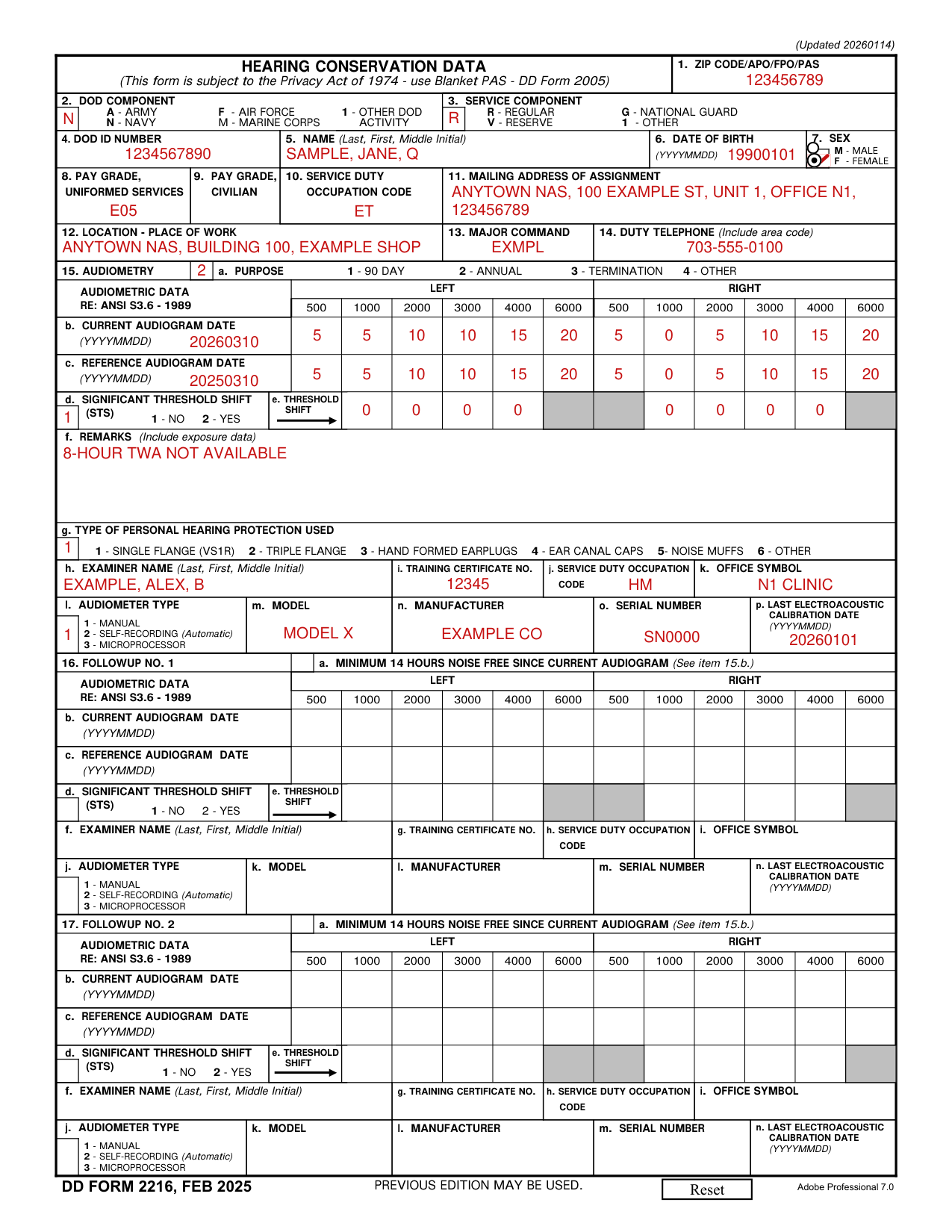
A filled-in DD Form 2216 example: an annual hearing test recorded
How to fill out DD Form 2216, box by box
ZIP Code, DoD Component and Service Component

Enter nine digit ZIP Code/APO/FPO/PAS of where audiometric test is conducted.
Enter letter in box of major organizational subdivision of DOD to which military or civilian individual is assigned. Enter "1" if DOD component is not listed.
Enter letter in box corresponding to primary subdivision of separate military service in which military is assigned (e.g., Regular (R) - standing military component of armed forces in peace and war; Reserve (V) - component of ready trained personnel for military service when needed, etc.; National Guard (G) - component of National Guard personnel in full-time or part-time status). Enter "1" for all others not listed.
DoD ID Number, Name, Date of Birth and Sex

Enter ten digit DoD ID number.
Enter surname, given name and middle initial of individual being tested.
Enter year, month, day (YYYYMMDD).
Enter "M" if male, "F" if female.
Pay Grade and Service Duty Occupation Code

In Pay Grade, Uniformed Services, for military personnel only, enter military personnel class and pay level serial number.
In Pay Grade, Civilian, enter two letters and two numbers of Federal civilian employee rank (e.g., WG05, GS11, etc). Letter entries will be WG, WL, WS, WN, WD or GS. Number entries will be 01 to 18. Enter "1111" if other (e.g., foreign national, contractor, etc.).
Enter code to which military member's duty occupation is assigned (e.g., MOS, SSI, NEC/Rating, NOBC or AFSC in which individual is actually working). Enter number code of civilian job series in which civilian member is actually working (e.g., for a carpenter enter "4607").
Mailing Address of Assignment, Location - Place of Work, Major Command and Duty Telephone

Enter installation name (and street address for Navy and Marines), unit, office symbol, and ZIP Code/APO/FPO/PAS of individual's current duty assignment.
Enter specific location where individual is routinely exposed to hazardous noise including building number (e.g., Corpus Christi, NAS, Building 1571, Carpenter Shop).
For Air Force personnel, enter 12-digit Workplace Identifier Code per AFOSH Std. 161-17.
Enter authorized abbreviation of military major command to which individual is assigned.
Enter individual's duty telephone number.
Audiometry: Purpose, Current Audiogram and Reference Audiogram

In Purpose, enter number in box for reason to complete audiogram. "1" - First periodic test given 90 days after beginning duties in noise-hazardous area or operation; "2" - Periodic test given at yearly intervals; "3" - Last test given, regardless of noise exposure history, before termination of active duty or employment; "4" - Test at interval for reason not listed in 1, 2 or 3.
Enter year, month, day (e.g., if January 31, 2000, enter 20000131) that audiometric test is given and current threshold levels determined for this individual at six frequencies in each ear. Results are entered in 5 dB increments (e.g., 0, 5, 10, 15, etc.). If responses exceed maximum limits of audiometer, enter that limit with plus sign (e.g., 110+).
Enter year, month, and day reference test results were obtained. See DD Form 2215, "Reference Audiogram," or other appropriate source. Enter threshold levels in 5 dB increments from reference audiogram.
Significant Threshold Shift, Threshold Shift and Remarks
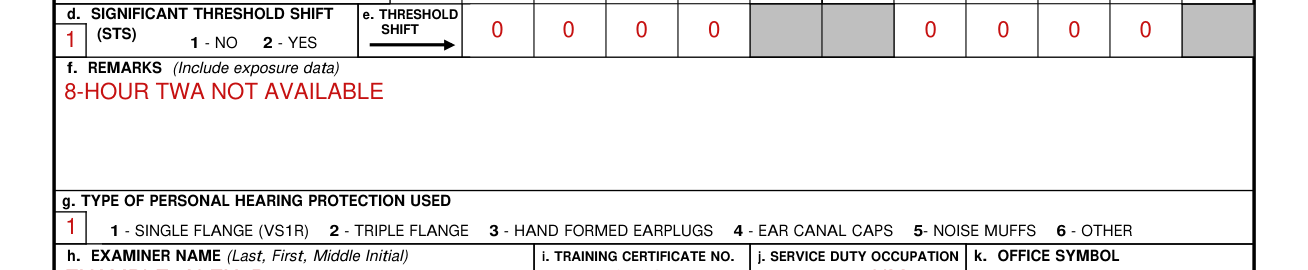
Enter "1" if no STS is present; enter "2" if STS is present.
STS-YES: Outlines procedures required when a significant threshold shift present: "Notify Supervisor" - Notify individual's supervisor that significant threshold shift has been found and followup audiogram must be done. "Followup No. 1 After Minimum 14 Hours Noise Free" - Schedule individual for first followup audiogram.
Enter difference between current and most recent reference audiogram for 1000, 2000, 3000 and 4000 Hz. Refer to DoD component manuals for established criteria. Enter "+" to indicate positive shift (poorer hearing) or "-" to indicate negative shift (better hearing) on current audiogram.
In Remarks, print any information considered pertinent. Include the individual's 8-hour TWA noise exposure, when available.
For Type of Personal Hearing Protection Used, enter number for type of hearing protection that is routinely used by individual: 1 - SINGLE FLANGE (VS1R) 2 - TRIPLE FLANGE 3 - HAND FORMED EARPLUGS 4 - EAR CANAL CAPS 5- NOISE MUFFS 6 - OTHER
Examiner Name, Training Certificate Number, Service Duty Occupation Code and Office Symbol

Enter surname, given name and middle initial of individual operating audiometer.
Enter audiometric technician training certificate number.
Enter examiner's service duty occupation code (see Item 10).
Enter complete office symbol where examiner is performing the test.
Audiometer Type, Model, Manufacturer, Serial Number and Last Electroacoustic Calibration Date

Enter number for type of audiometer used (e.g., "1" for manual type, etc.): 1 - MANUAL 2 - SELF-RECORDING (Automatic) 3 - MICROPROCESSOR
In Model, enter manufacturer's designation of audiometer.
Enter name of company that produced audiometer.
Enter manufacturer's serial number of audiometer.
Enter year, month and day (see Item 15.b.) of last electroacoustic determination of this audiometer's performance specifications.
Followup No. 1
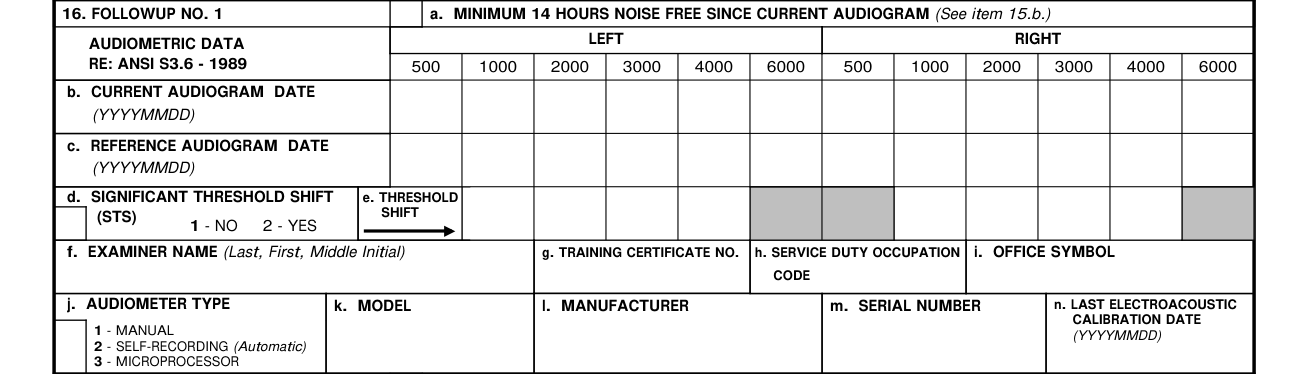
If significant threshold shift determined on periodic test, record results of first followup audiogram in this section.
Mark (X) box to certify "Minimum 14 Hours Noise Free Since Current Audiogram (see Item 15.b.)".
Hearing threshold levels entered in 16.c. are the same values as those used in 15.c.
"STS - NO" - If no STS noted, enter "1" in box and follow steps in "STS - NO" section.
"STS - YES" - If STS remains following this examination (Followup No. 1), follow service component instructions (e.g., supervisor is notified for the second time, individual is scheduled for Followup No. 2 audiogram, and individual is instructed to stay in a noise free environment (not to exceed 75 dBA or 120 dBP) for a minimum of 14 hours of auditory rest since current audiogram (Item 15.b.)).
Enter the required information according to guidelines for entries on periodic audiogram.
Followup No. 2
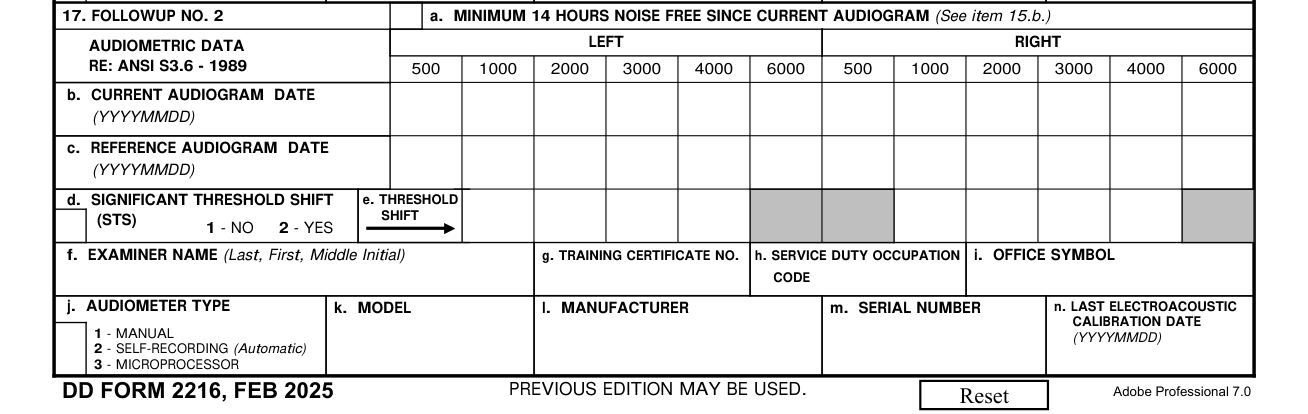
If significant threshold shift determined on Followup No. 1, record results of Followup No. 2 in this section.
Hearing threshold levels entered in 17.c. are the same values as those used in 15.c.
In Followup No. 2, for "STS - YES": if STS remains following this examination, enter "2" in box. Refer to DoD component instructions for appropriate patient disposition.
Sources
[1] DD Form 2216 (FEB 2025), Hearing Conservation Data, Department of Defense (the Official source link on this page).