Free Ohio Medical Power of Attorney PDF Form

An Ohio medical power of attorney is a written document in which you, the principal, name an agent to make health care decisions on your behalf. Ohio law sets rules for how it is signed and who may witness it or serve as your agent. The free Ohio medical power of attorney PDF below combines the appointment with an advance directive and has 21 fillable fields.

Last Updated: October 2026. This guide is reviewed and updated regularly to reflect current Ohio law. If you notice an error or outdated information, please contact us.
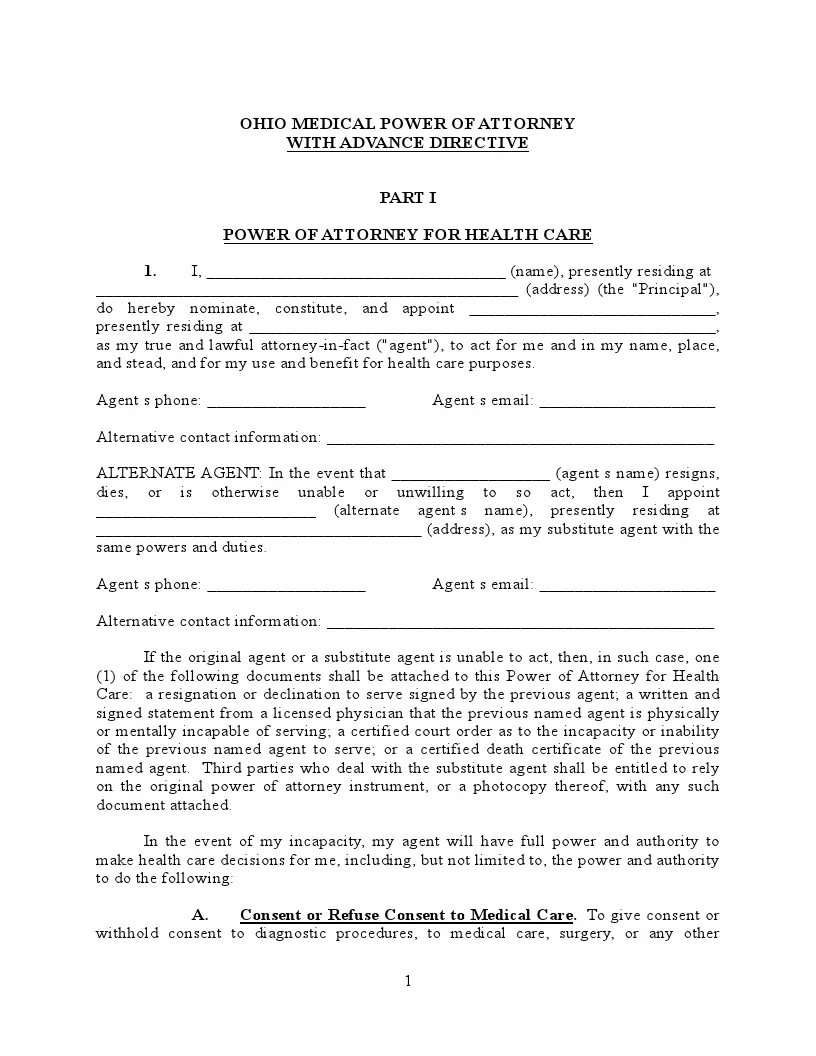
Ohio medical power of attorney form preview

Create a free high-quality Ohio Medical Power of Attorney online now!

Build Your Document

Answer a few simple questions to make your document in minutes

Save and Print

Save progress and finish on any device, download and print anytime

Sign and Use

Your valid, lawyer-approved document is ready

... or download your Ohio Medical Power of Attorney (POA) Form as a  PDF file

What Is an Ohio Medical Power of Attorney?

An Ohio medical power of attorney lets you appoint a person you trust, called your agent, to make health care decisions for you. It is also known as an Ohio healthcare power of attorney, a health care power of attorney or a medical POA. The agent deals with doctors and hospitals on your behalf, and the powers are the ones written in the form you sign.

The FormsPal template is titled Ohio Medical Power of Attorney with Advance Directive. Part I names your agent and an alternate agent, Part II states end-of-life wishes, and Part III holds general provisions. For other documents, browse our Ohio power of attorney forms, or read how the medical power of attorney form works in general. For financial decisions rather than medical ones, see our Ohio general power of attorney or Ohio durable power of attorney form.

This guide covers the following topics, in the order of the page:

  • The Ohio rules for witnesses and notaries, and who is ineligible to serve.
  • What each of the seven pages of the FormsPal template says.
  • How to fill out the form step by step, with screenshots of sample entries.
  • Common mistakes, a sample of a completed form, and answers to frequent questions.

Ohio Laws and Requirements

Ohio’s rules for a medical power of attorney sit in section 1337.12 of the Ohio Revised Code. They cover how it is signed, who may witness it, and who may serve as your agent. The sections below put each rule in plain words.[1]

Signing Requirements

It must be signed at the end by you, the principal, and it must state the date you signed it.[1]

… it shall be signed at the end of the instrument by the principal and shall state the date of its execution.

Ohio Rev. Code Ann. § 1337.12

Ohio then gives two routes. You can have it witnessed by at least two adults, or you can sign it and have it acknowledged before a notary public.[1]

A notary must make the certification the statute describes. The notary must also attest that you appear to be of sound mind and not under or subject to duress, fraud, or undue influence.[1] FormsPal also has a separate notary acknowledgment template for Ohio.

Choose how you will sign before you print the form. The FormsPal template has a notary acknowledgment on page 7 and no lines for witnesses.

Witness and Agent Eligibility

Ohio limits who can witness it. The following people are ineligible to be your witnesses:

  • Anyone related to you by blood, marriage, or adoption.[1]
  • Anyone named in it as your agent or alternate agent.[1]
  • Your attending physician.[1]
  • The administrator of any nursing home in which you are receiving care.[1]

The same law limits who can be your agent. Your attending physician and an administrator of any nursing home in which you are receiving care cannot be named as your agent and cannot act as one.[1]

Pick an agent you trust and talk with that person before you name them. That is common practice, not an Ohio rule. Before you fill in the form, it helps to talk through a few points.

  • Your wishes about medical treatment and the end of your life.
  • Whether the person is willing to serve and can be reached by phone or email.
  • Who should be your alternate agent if the first person cannot serve.
  • Where you will keep the signed original and who will get copies.

Ohio Medical Power of Attorney Form Details

Document NameOhio Medical Power of Attorney Form
FormsPal TemplateOhio Medical Power of Attorney with Advance Directive, seven pages
State LawsOhio Revised Code, Section 1337.12[1]
Signing RequirementsTwo adult witnesses, or acknowledgment before a notary public[1]
Who Can’t Be the Agent?Your attending physician or a nursing home administrator[1]
Who Can’t Be the Witness?Relatives, a named agent, your attending physician or a nursing home administrator[1]
Avg. Time to Fill Out8 minutes
# of Fillable Fields21
Available FormatsAdobe PDF

Popular Local Medical POA Forms

Health care power of attorney forms are used in every state. Have a look at other samples of Medical POA forms regularly filled out by people.

What the Ohio Medical Power of Attorney Form Covers

The FormsPal template has three parts, a signature page and a notary acknowledgment. What each part says comes from the printed text of the form, not from the statute. Read all seven pages before you sign.

  • Part I, Power of Attorney for Health Care. You name your agent and an alternate agent. The listed powers include consenting to or refusing medical care, hiring health care personnel, getting your medical records, arranging pain relief, decisions on blood transfusions and organ donation, funeral and burial or cremation arrangements, and personal care decisions.
  • Sections 2 to 7 of Part I. These carry printed terms with no blanks. They include a HIPAA release in Section 3 so your agent can receive your medical records, the standard your agent follows in Section 4, and a clause on photocopies in Section 7.
  • Part II, Advance Health Care Directive. This part states your end-of-life wishes in fixed wording, with no blanks to fill in.
  • Part III, General Provisions. These are closing clauses, also with no blanks.
  • Signature and acknowledgment. The date, signature and printed name sit on page 6. Page 7 is an acknowledgment that a notary public completes.

If neither the agent nor the alternate agent can act, the form says one document must be attached. It can be a signed resignation, a physician’s written statement, a certified court order or a certified death certificate.

The advance directive is a serious statement about end-of-life care. If it does not match what you want, talk to a lawyer or your doctor before you sign. You can also compare it with our Ohio living will form. If you also want a do not resuscitate order, FormsPal has a separate Ohio DNR form.

Filling Out the Ohio Medical Power of Attorney Form

The form has 21 fillable fields, all on pages 1, 6 and 7. The five steps below follow the form in order. Pages 2 to 5 are printed text with no blanks, so read them before you sign.

The screenshots under each step show the FormsPal Ohio medical power of attorney template filled with sample entries in blue, so you can see where each answer goes. The names, addresses, dates and amounts are examples only.
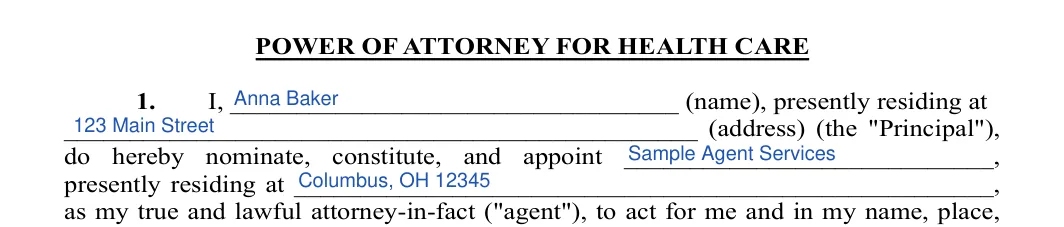
  1. Part I: principal and agent. On page 1, write your full name and home address as the principal. Then write the full name and address of the person you appoint as your agent.
    Ohio medical power of attorney: POWER OF ATTORNEY FOR HEALTH CARE, filled with sample entries
    Step 1: sample entries, not a real document.
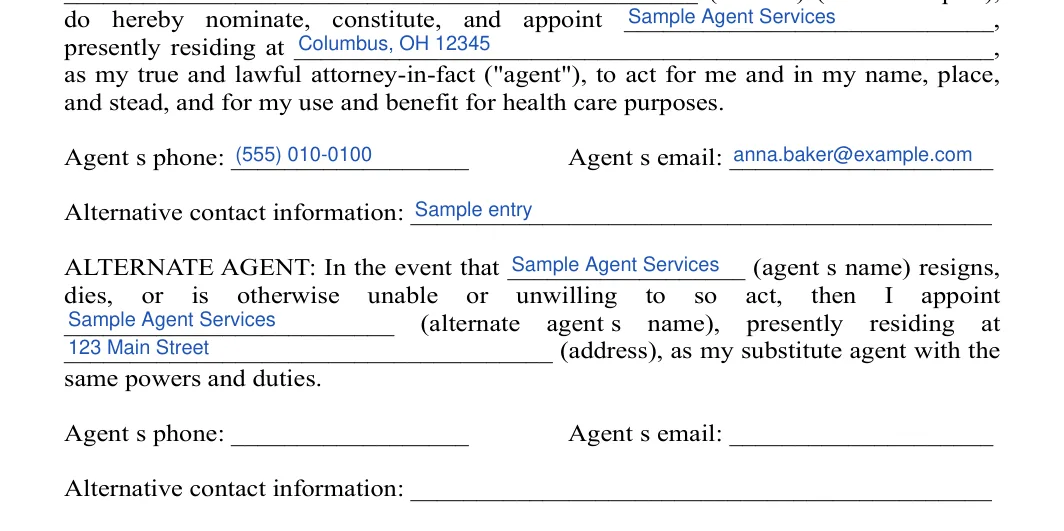
  2. Agent contact details and alternate agent. Still on page 1, add the agent’s phone number, email and any alternative contact information. In the Alternate Agent paragraph, repeat the agent’s name, then enter the alternate agent’s name and address, followed by the alternate agent’s phone, email and alternative contact.
    Ohio medical power of attorney: Agent's phone, Agent's email and more, filled with sample entries
    Step 2: sample entries, not a real document.
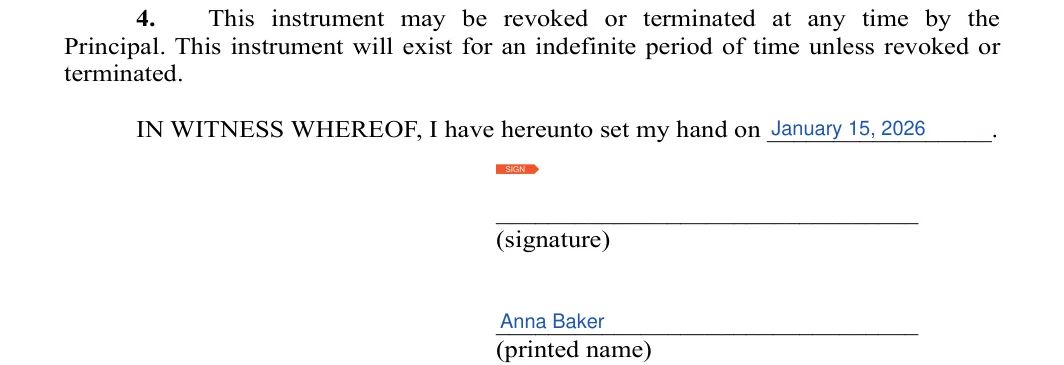
  3. Date, signature and printed name. On page 6, enter the date after the words “I have hereunto set my hand on,” sign on the signature line and print your name.
    Ohio medical power of attorney: Date, Signature and more, filled with sample entries
    Step 3: sample entries, not a real document.
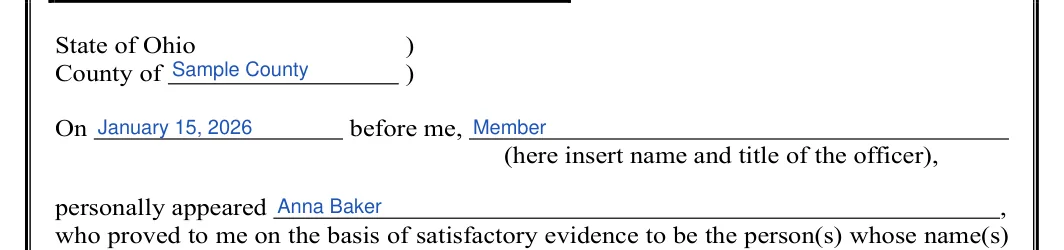
  4. Notary acknowledgment: county, date and officer. Page 7 holds the notary acknowledgment. The county, the date, the officer’s name and title, and your name as the person who appeared are completed when you appear before the notary.
    Ohio medical power of attorney: County, Date and more, filled with sample entries
    Step 4: sample entries, not a real document.
  5. Notary signature and seal. The notary signs on the Signature (Seal) line at the bottom of page 7 and adds the official seal.
    Ohio medical power of attorney: Signature, filled with sample entries
    Step 5: sample entries, not a real document.

How to Sign and Use the Ohio Medical Power of Attorney

Filling in the blanks is only part of the job. The steps below cover what happens around the form, from getting the template to sharing copies. Ohio allows two routes, witnesses or a notary, so settle that before you print.

  1. Get the template. Build your power of attorney with our online form builder, or download the PDF.
  2. Read pages 2 to 5 and Part II. They are fixed text, so check that they match your wishes.
  3. Choose between witnesses and a notary. Ohio requires either at least two adult witnesses or an acknowledgment before a notary public.[1]
  4. If you use witnesses, check that none of them is on the ineligible list, which includes relatives, your agent, your attending physician and a nursing home administrator.[1]
  5. Sign and date at the end of the form. The notary completes the acknowledgment on page 7 and adds a seal. The template has no witness lines, so if you choose witnesses, ask a lawyer how to record their signatures.[1]
  6. Keep and share copies. It is common practice to keep the original in a safe place and to give copies to your agent and your doctor.

Common Mistakes on an Ohio Medical Power of Attorney

Most problems come from a few avoidable errors. Check this list against your finished form before you take it to a notary or ask anyone to witness it, because each item below comes straight from the Ohio rules or from the printed form.

  • Choosing a witness who is ineligible, such as a relative, your agent, your attending physician or a nursing home administrator.[1]
  • Naming your attending physician or a nursing home administrator as your agent.[1]
  • Leaving the date off. It must state the date it was signed.[1]
  • Putting your signature anywhere but the end. Ohio requires the principal’s signature at the end.[1]
  • Looking for witness lines on the FormsPal template. It has none, only the notary page.
  • Skipping pages 2 to 5. They hold the powers and the advance directive, and you cannot edit them.

Example of a Completed Ohio Medical Power of Attorney

The screenshots above use made-up entries so you can see where each answer goes. Nothing in the example below is a real person, address or date. Replace every entry with your own details before you sign.

  • Principal on page 1: Anna Baker, 123 Main Street (sample entry).
  • Agent on page 1: Sample Agent Services, Columbus, OH 12345 (sample entry).
  • Agent phone and email: (555) 010-0100 and anna.baker@example.com (sample entries).
  • Date on page 6: January 15, 2026 (sample entry).

Frequently Asked Questions

These answers cover the witness and eligibility questions people ask most about the Ohio medical power of attorney. Each answer comes from section 1337.12 of the Ohio Revised Code, which sets the rules.

Does a medical power of attorney need to be notarized in Ohio?

Not always. Ohio gives two routes. It may be witnessed by at least two adults, or it may be acknowledged before a notary public.[1] The FormsPal template includes a notary acknowledgment on page 7.

Does Ohio require witnesses for a medical power of attorney?

Yes, unless you use a notary. It must be witnessed by at least two individuals who are adults and who are not ineligible to be witnesses.[1]

Who cannot be a witness to an Ohio medical power of attorney?

Four groups of people are ineligible to be witnesses:

  • Anyone related to you by blood, marriage, or adoption.
  • Anyone named as your agent or alternate agent.
  • Your attending physician.
  • The administrator of any nursing home in which you are receiving care.[1]

Who cannot be my agent under an Ohio medical power of attorney?

Your attending physician and a nursing home administrator cannot be named as your agent and cannot act as one.[1]

What does the notary attest on an Ohio medical power of attorney?

The notary makes the certification the statute describes. The notary also attests that you appear to be of sound mind and not under or subject to duress, fraud, or undue influence.[1]

seal of ohio state
Other Ohio Forms
Listed below are some other Ohio templates completed by our users. Consider our simple builder to personalize these documents to your requirements.

Download a Free Ohio Medical Power of Attorney Form

You can download the Ohio medical power of attorney as a PDF with 21 fillable fields, or build it online and print it. Either way, complete it in one of the two ways Ohio allows, with at least two adult witnesses or with an acknowledgment before a notary public.[1]

Here is what the download gives you:

  • An Adobe PDF of the seven-page Ohio medical power of attorney with advance directive.
  • 21 fillable fields on pages 1, 6 and 7, so you can type your answers before you print.
  • A page 7 notary acknowledgment, and no lines for witnesses.
  • The option to build the same power of attorney online with our form builder instead of editing the PDF.
Template Preview
Create a free high-quality Ohio Medical Power of Attorney online now!

General information, not legal or tax advice.

Sources

  1. Ohio Rev. Code Ann. § 1337.12.
Published: Jul 10, 2022
Mara Erlach
Mara Erlach
Writer & Attorney
Mara has been practicing estate planning and trust law in California since 2003, taking pride in helping clients of all backgrounds and asset profiles form a complete and customized estate plan. Her specialties are: estate planning, wills and trusts, trust and probate administration.