
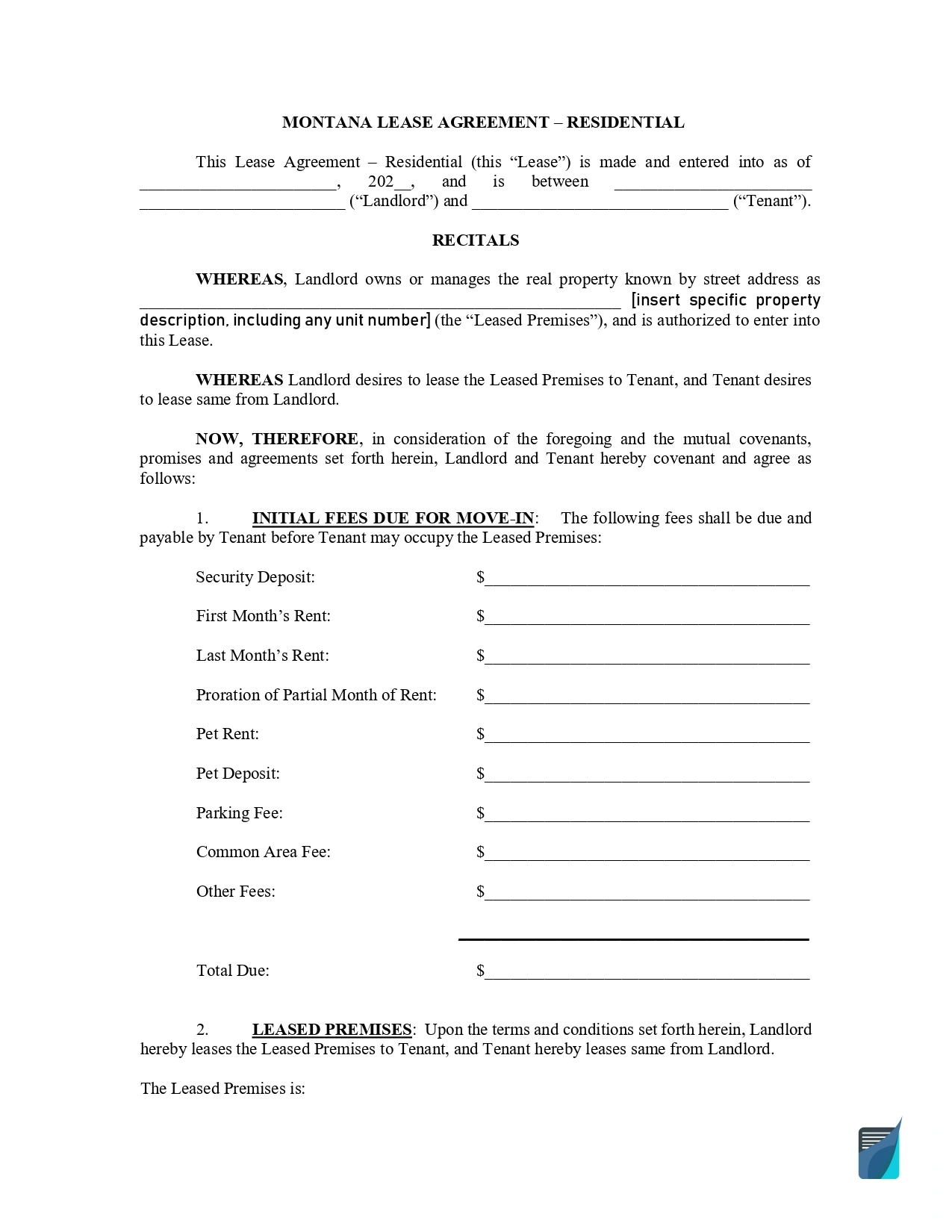
A Montana lease agreement, also called a rental lease agreement, is a legally binding document between a landlord and a tenant that outlines the terms for renting residential or commercial property. It states the length of the lease, the rent amount, the security deposit, and the obligations and rights of both the landlord and the tenant.
Last Updated: September 2026. This guide is reviewed and updated regularly to reflect current Montana law. If you notice an error or outdated information, please contact us.
Build Your Document
Answer a few simple questions to make your document in minutes
Save and Print
Save progress and finish on any device, download and print anytime
Sign and Use
Your valid, lawyer-approved document is ready
Montana regulates residential leases mainly through the Residential Landlord and Tenant Act of 1977 (Chapter 24) and the security deposit rules in Chapter 25 of the Montana Code Annotated. The sections below cover the security deposit deadlines and the notice periods for ending a Montana lease agreement, and link to a rental agreement you can build online.
A written lease protects both sides by fixing the rent, the deposit, and each party’s duties before move-in, which helps prevent later disputes.
Except in an emergency or where it is impracticable, the landlord must give the tenant at least 24 hours' notice of the intent to enter and may enter only at reasonable times. Posting the notice conspicuously on the main entry door counts as notice (Section 70-24-312).[3]
At or before the start of the tenancy, the landlord must disclose to the tenant in writing the name and address of the person authorized to manage the premises and of the owner, or of the person authorized to act for the owner for service of process and notices (Section 70-24-301).[4]
A landlord who knows mold is present, or that the building was tested for mold, must disclose it before or when the lease is signed. Landlords may also give the statutory mold disclosure statement, which the tenant signs to acknowledge receipt (Section 70-16-703).[5]
An owner who knows the property was used as a methamphetamine or fentanyl lab, or was contaminated by methamphetamine or fentanyl use, must notify any later occupant in writing before the lease is agreed, unless the property was remediated to state standards by a certified contractor (Section 75-10-1305).[6]
Federal law also requires disclosure of known lead-based paint hazards for housing built before 1978. The landlord must give the tenant the EPA lead pamphlet and a signed disclosure (42 U.S.C. § 4852d).[7]
Under Section 70-25-202 of the Mont. Code Ann., a landlord must give the departing tenant a written list of any rent due and any damage or cleaning charges within 30 days after the tenancy ends. That 30-day clock also starts at surrender and acceptance of the unit, whichever happens first.[2]
If the landlord's inspection finds no damage, no cleaning charges, and no unpaid rent, and the tenant can show that no utilities are unpaid, the deposit must be returned within 10 days instead. The landlord must send this list together with payment of the difference, if any, between the deposit and the charges the law allows.[2]
Montana calls this document a rental agreement or a lease. Both names refer to the same paperwork, for a month-to-month tenancy or a week-to-week one.
The refund can be paid by electronic funds transfer, cash, check, or another form of payment, or mailed to the address the tenant provided after moving out. If the tenant does not give a new address, the landlord may mail it to the tenant's last-known address instead. Doing so is not a wrongful withholding, though the landlord still owes the tenant the amount due.[2]
These deposit-return rules do not apply if the lease was ended under the separate eviction provisions of Montana law (Section 70-24-427 or 70-33-427) and the landlord already has a claim pending in court.[2]
If the landlord takes a security deposit, the landlord must give the tenant a separate written statement of the property's condition, signed by the landlord or the landlord's agent, when the lease is signed (Section 70-25-206).[8]
Under Section 70-24-441 of the Mont. Code Ann. (Residential Landlord and Tenant Act of 1977), either the landlord or the tenant may end a month-to-month tenancy by giving the other at least 30 days' written notice before the termination date named in the notice. For a week-to-week tenancy, either party may end it with at least 7 days' written notice before the termination date stated in the notice.[1]
Count the notice period accurately with FormsPal’s deadline calculator.
Key facts about the Montana lease agreement form:
| Document Name | Montana Rental Lease Agreement Form |
| Other Names | MT Rental Lease, Montana Residential Lease Agreement |
| Relevant Laws | Montana Code Annotated, Title 70, Chapter 24 |
| Security Deposit Return | Up to 30 days after the tenancy ends (10 days if there is no damage, no cleaning charges, and no unpaid rent)[2] |
| Avg. Time to Fill Out | 18 minutes |
| # of Fillable Fields | 119 |
| Available Formats | Adobe PDF |

A Montana landlord must return the security deposit within 30 days after the tenancy ends, or within 30 days after the tenant surrenders the unit, whichever comes first. If there is no damage, no cleaning charges, and no unpaid rent or utilities, the deadline shortens to 10 days.[2]
Yes. To end a month-to-month tenancy, Montana law requires the landlord or the tenant to give the other written notice at least 30 days before the termination date. A week-to-week tenancy needs at least 7 days of written notice instead.[1]
Montana sets two written notice periods, each ending on the date the notice states.[1]
For a month-to-month or week-to-week tenancy, either party ends it by giving the other written notice, 30 days for a month-to-month tenancy or 7 days for a week-to-week tenancy.[1] A fixed-term lease normally ends on the date written in the agreement, without extra notice, unless the lease itself says otherwise.

Other Rental Lease Agreement Forms by State
General information, not legal or tax advice.
Unless noted otherwise, the sources below are from the Mont. Code Ann..
