
Indiana bill of sale is a document used in private transactions within the state where the parties, a buyer and a seller, agree to transfer ownership to a particular personal property (motor vehicle, animal, equipment, etc.). The bill of sale form is used to prove ownership transfer and to protect both the buyer and seller.
Last Updated: September 2026. This guide is reviewed and updated regularly to reflect current Indiana law. If you notice an error or outdated information, please contact us.
Build Your Document
Answer a few simple questions to make your document in minutes
Save and Print
Save progress and finish on any device, download and print anytime
Sign and Use
Your valid, lawyer-approved document is ready
As well as the necessary information on different bills of sale, you will find the State Form 44237 provided by the Indiana Bureau of Motor Vehicles, used in transactions involving vehicles and vessels. With our builder, you can get a completed form in no time.
| Document Name | Indiana Vehicle Bill of Sale Form |
| Other Names | Indiana Car Bill of Sale, Indiana Automobile Bill of Sale |
| DMV | Indiana Bureau of Motor Vehicles |
| Bill of Sale Required? | No |
| Avg. Time to Fill Out | 7 minutes |
| # of Fillable Fields | 26 |
As we have mentioned, bills of sale differ depending on the type of sale. This is why it is prudent to look through the forms that fit your needs before filling out any documents. There are various bills of sale, such as those used when selling cars, watercraft, and weapons. Indiana does not require any of them to be signed before a notary public.[1.1]
A vehicle's certificate of title is normally what transfers ownership in Indiana. A signed bill of sale only takes the title's place when the vehicle is not required to be titled under Indiana law.[1.2]
Indiana vehicle bill of sale form is used in the vehicle titling and registration process. In practice, the buyer titles and registers the vehicle with the BMV soon after the purchase and pays the registration fee and any sales tax at that point.
| Alternative Name | Car Bill of Sale |
| Seller’s Signature | Required |
| Buyer’s Signature | Required |
| Notarization | Optional |
| Download | ⇒ PDF Template ⇒ Form 44237 |

Indiana boat bill of sale helps record the state’s sale and purchase of watercraft. In practice, motorized boats are registered with the state after the sale, and the registration is renewed periodically.
| Alternative Name | Vessel Bill of Sale |
| Seller’s Signature | Required |
| Buyer’s Signature | Required |
| Notarization | Optional |
| Download | ⇒ PDF Template ⇒ Form 44237 |

A firearm bill of sale records the purchase or sale of a firearm in Indiana. In practice, both parties keep a copy as their record of the transfer.
| Alternative Name | Gun Bill of Sale |
| Seller’s Signature | Required |
| Buyer’s Signature | Optional |
| Notarization | Optional |
| Download | PDF Template |

A general bill of sale in Indiana can be used for all types of personal property that can be sold and purchased. This template contains sections for the parties’ contact information, property description, selling price, and signatures. However, transactions involving vehicles and boats are better to be detailed in a specialized form.
| Alternative Name | Generic Bill of Sale |
| Seller’s Signature | Required |
| Buyer’s Signature | Optional |
| Notarization | Optional |
| Download | PDF Template |
An Indiana motor vehicle bill of sale records the sale in writing so both sides have proof of what was agreed. How binding a bill of sale is in Indiana depends on what it includes, so check what makes a bill of sale enforceable before you rely on it alone. Notarizing it is not required under Indiana law, though many people choose to for extra assurance.[1.1]
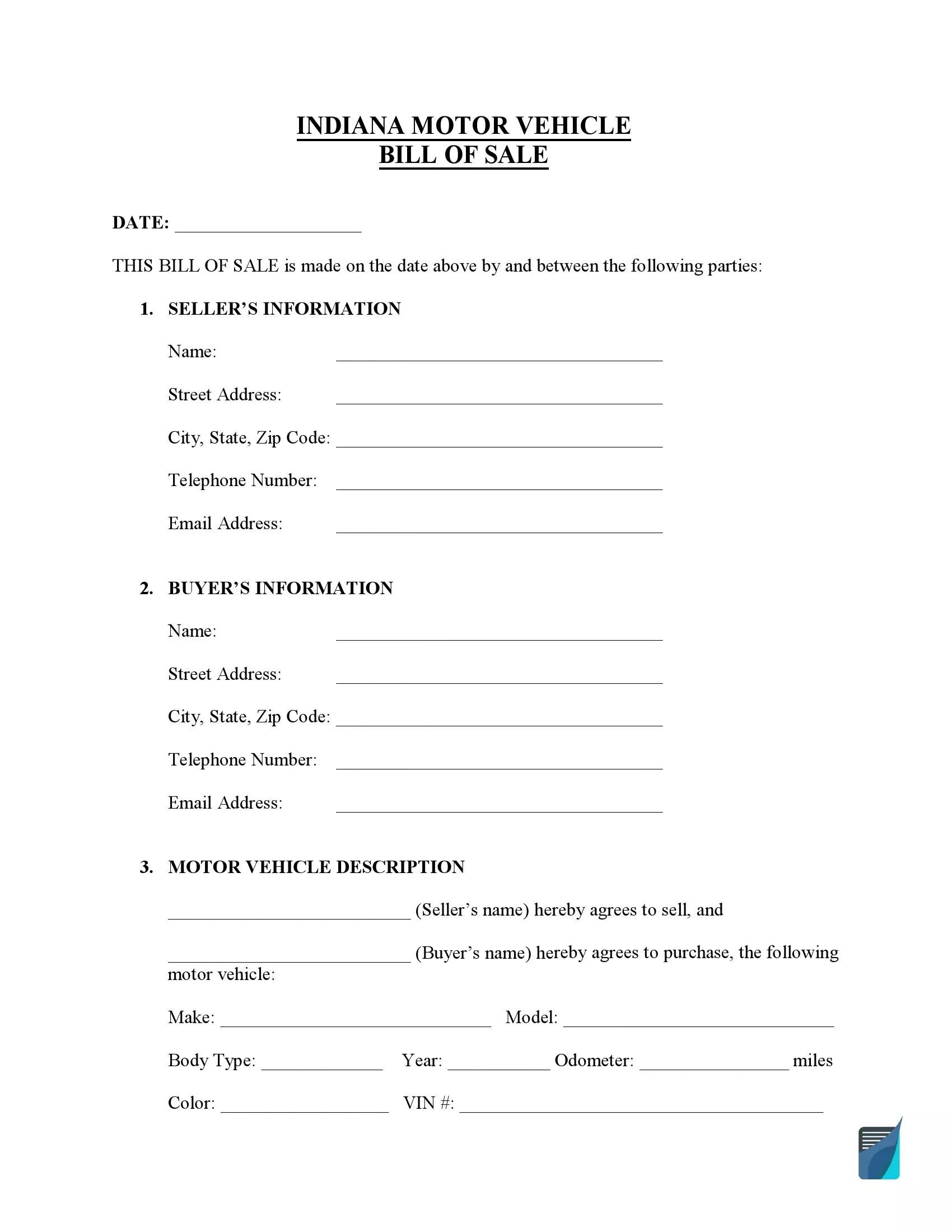
Form 44237 is the official bill of sale form authorized in Indiana for vehicle and vessel title transfers. You can use either a customizable template or a uniform one. Here is a step-by-step guide to help you fill it out within minutes.
Step 1: Seller's Information
Start with the date, then enter the seller's name, address, phone number, and email. Indiana's bill of sale form specifically asks for the seller's address.[1.1]

Step 2: Buyer's Information
Enter the purchaser's name, address, phone number, and email. Indiana's form requires the purchaser's name.[1.1]

Step 3: Motor Vehicle Description
Re-enter the seller's and buyer's names, then describe the vehicle, including its year, make, model, body type, odometer reading, and color. Indiana's form also asks for the vehicle identification number (VIN).[1.1]

Step 4: Purchase Date, Price and Method
Enter the purchase date and the total price. Then check how the vehicle was paid for (all at once, trade-in, deposit, or gift), the payment method (cash, check, cashier's check, or money order), and whether taxes are included.

Step 5: Miscellaneous Provisions
Read the ownership, as-is, and entire-agreement statements on the form. No entries are needed here, but both parties should read this section before signing.
Step 6: Signatures
The seller signs, prints their name, and dates the form.[1.2] Many buyers sign as well, though Indiana's form only requires the seller's signature. If a witness is used, they sign, print their name, and date it too.
Step 7: Acknowledgment
If you want extra assurance it is credible, you can have it notarized. The acknowledgment section on the last page is where a notary fills in the county, date, and their name.
Once the bill of sale is signed, the buyer typically brings it to the Indiana BMV along with the vehicle's signed title to complete registration. For most vehicles, Indiana's certificate of title is what transfers ownership. A signed bill of sale only takes the title's place when the vehicle is not required to be titled under Indiana law.[1.2]
In practice, buyers bring their driver's license, proof of insurance, and the paperwork the BMV requests to the registration appointment. Requirements and deadlines can change, so confirm the current list and any time limits with the Indiana BMV before you go.
Use this form along with the bill of sale form 44237 to ensure there are no odometer discrepancies.


Short Indiana Bill of Sale Video Guide

Other Indiana Forms
A bill of sale is not the same as a vehicle title. Keep the signed bill of sale together with the title until registration is complete.
No. Indiana does not require a bill of sale to be notarized or signed under penalty of perjury before it is valid.[1.1] Many buyers and sellers choose to do it anyway. A notary's signature can make the document easier to rely on if a question about the sale ever comes up.
"The bill of sale is not required to be notarized or signed under penalties for perjury."
Indiana does not require the prior owner to have obtained a certificate of title before the bill of sale is written, and notarization is optional.[1.2] A complete one names the seller and buyer, describes the vehicle by VIN, year, make, and model, and states the price and date. The seller signs it before the sale is final.
An Indiana bill of sale must include the purchaser's name, the seller's name and address, and the vehicle's identification number (VIN), along with the seller's signature. Notarization is optional, so keep a copy for both the buyer and the seller.[1.1]
Nothing changes. Indiana law does not require a bill of sale to be notarized or signed under penalty of perjury, so an unnotarized bill of sale is still valid.[1.1] Keep it together with the vehicle's title and any registration paperwork, since either party may need to show it later to confirm the sale took place.
General information, not legal or tax advice.


