
New Mexico Quitclaim Deed Form

A New Mexico quitclaim deed is a written document that transfers whatever interest the grantor (the person signing) owns in a property to the grantee (the person receiving it). It implies no warranty of title, and a deed that follows the statutory form has the force of a fee simple deed for that interest.[2.1] Build it online or download the free New Mexico quit claim deed form.

Last Updated: October 2026. This guide is reviewed and updated regularly to reflect current New Mexico law. If you notice an error or outdated information, please contact us.
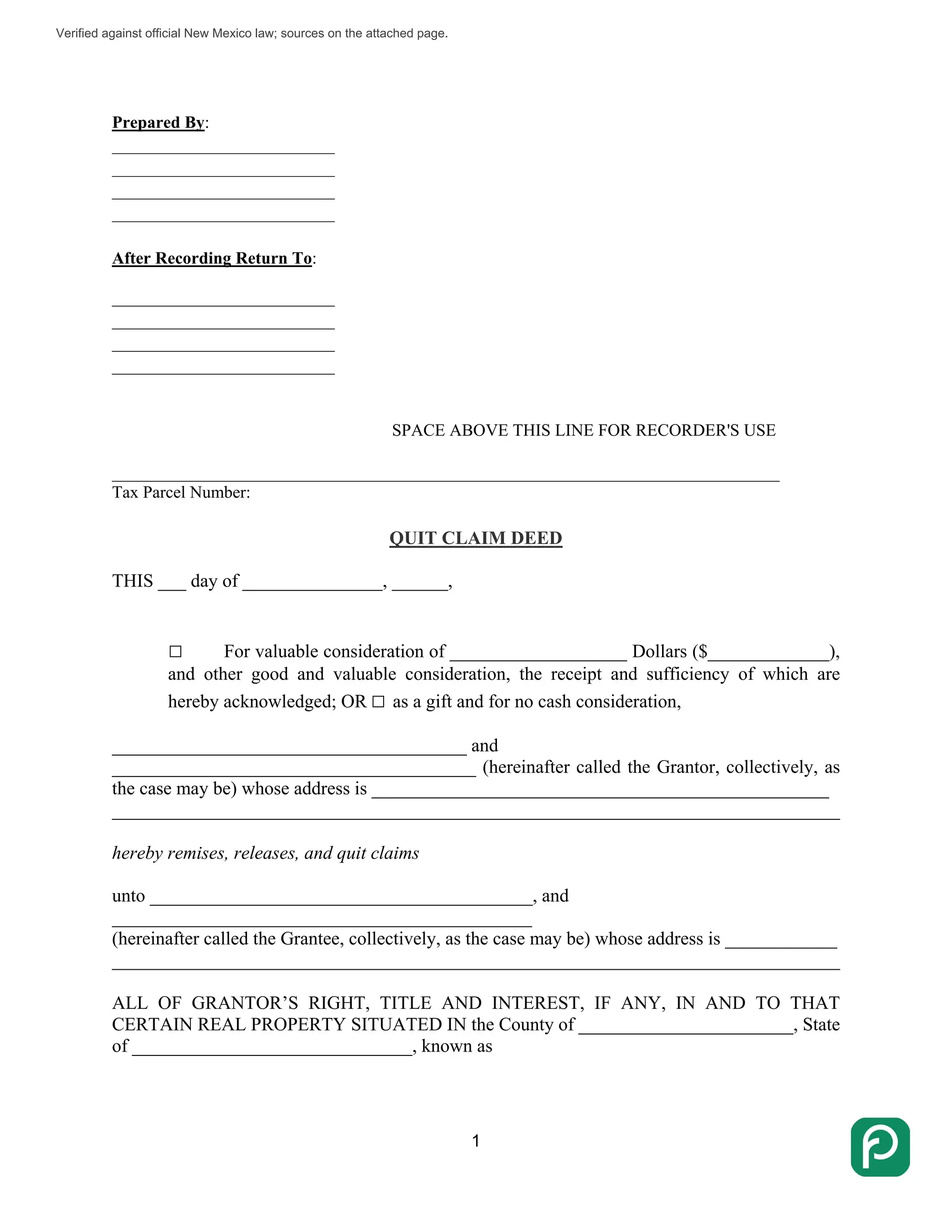
New Mexico quitclaim deed form preview

Create a free high quality New Mexico Quitclaim Deed Form online now!

Build Your Document

Answer a few simple questions to make your document in minutes

Save and Print

Save progress and finish on any device, download and print anytime

Sign and Use

Your valid, lawyer-approved document is ready

Download the New Mexico Quitclaim Deed: PDF or Word (.docx) or OpenDocument (.odt)

Quitclaim Deed Laws and Requirements in New Mexico

In New Mexico, a quitclaim deed passes only the interest the grantor owns, and it carries no warranty. The deed must be notarized. Deeds that affect the title to real estate must be recorded with the county clerk.[2.5][1]

These rules sit in sections 47-1-30 to 47-1-44 and 14-9-1 of the New Mexico Statutes Annotated. The sections below explain each rule in plain words and show where it comes from.

Laws

Under Section 47-1-30 of the New Mexico Statutes Annotated, a deed that follows the statutory form entitled "quitclaim deed" has this effect once it is duly signed:

A deed in substance following the form entitled "quitclaim deed" shall, when duly executed, have the force and effect of a deed in fee simple to the grantee, his heirs and assigns, to his and their own use of any interest the grantor owns in the premises, without warranty.

N.M. Stat. Ann. § 47-1-30

In plain words, the grantee receives whatever interest the grantor owns, and nothing more. The deed implies no warranty or covenant of title. A deed that follows the statutory form is enough to convey the grantor's interest. An equivalent instrument that makes the parties' transaction plain is not invalid for lacking the statutory wording.[2.1]

New Mexico law also sets default rules for what a deed passes:

  • A deed or reservation of real estate is construed to convey or reserve a fee simple estate, unless a different intention clearly appears in the deed. The words "heirs," "assigns" or other technical words of inheritance are not necessary to convey or reserve an estate in fee.[2.2]
  • In a conveyance of real estate, all rights, easements, privileges and appurtenances belonging to the granted estate are included unless the deed states the contrary. The deed does not need to list them.[2.3]
  • If a deed names two or more grantees "as joint tenants," the conveyance is to them as joint tenants, not as tenants in common, and to the survivor of them and the heirs and assigns of the survivor.[2.4]

If the property is in another state, use that state's quitclaim deed form instead.

Because a quitclaim deed makes no promise about the title, a title search can show what the grantor actually owns. That interest is all the deed can pass.

Signing Requirements

Under Section 47-1-44 of the New Mexico Statutes Annotated, a New Mexico quitclaim deed must be notarized, and the statutory form ends with a line to add the acknowledgment.[2.5] The form on this page has an acknowledgment page with lines for a notary public.

Only the grantor signs the deed. Under NMSA 47-1-5, a conveyance of real estate is subscribed by the person transferring the title or interest, or by that person's agent or attorney, and no section requires the grantee to sign.[2.6]

The grantor must appear before the notary, in person or by approved remote notarization, to acknowledge the signature (NMSA 14-14A-5).[1.1]

Recording Requirements

Under Section 14-9-1 of the New Mexico Statutes Annotated, these must be recorded in the office of the county clerk of the county where the real estate is situated:

  • all deeds and mortgages,
  • leases of an initial term plus option terms longer than five years, and memoranda of their material terms,
  • assignments or amendments to such leases, and leasehold mortgages,
  • United States patents and other writings affecting the title to real estate.[1]

In practice, people take the signed and notarized deed to that office.

An unrecorded deed is still a deed between the parties. Under NMSA 14-9-3, though, a deed that is not recorded does not affect the title or rights of a purchaser, mortgagee in good faith or judgment lien creditor who has no knowledge of it.[1.2]

The county clerk collects the recording fee before accepting the deed for filing or recording (NMSA 14-8-15).[1.3]


How to Fill Out and File a Quitclaim Deed in New Mexico

You can build the deed with our online form builder, or download the New Mexico quitclaim deed form and fill it in yourself. The steps below follow the form from page 1 to page 5, so you can complete it in the order its parts appear. To type your entries into the downloaded file, open the PDF in our online PDF editor. FormsPal also has a general deed form page.

  1. Prepared By, After Recording Return To and Tax Parcel Number (page 1). Write the name and address of the person who prepared the deed, where the recorded deed should be sent, and the tax parcel number.
  2. Date and consideration (page 1). Enter the day, month and year. Then check the box for valuable consideration and write the amount in words and figures, or check the box for a gift with no cash consideration.
  3. Grantor (page 1). Write the grantor's name on the first line, and a second grantor's name on the next line if there is one. Add the grantor's address after "whose address is".
  4. Grantee (page 1). Write the grantee's name after "unto" and the grantee's address after "whose address is".
  5. Property: County of, State of and Parcel Id (pages 1 and 2). Enter the county and state on page 1 and the Parcel Id on page 2. The form says the legal description is set forth on Exhibit A, so attach an Exhibit A with the full description.
  6. No-warranty and SUBJECT TO paragraphs (page 2). There is nothing to fill in below the Parcel Id. Read both paragraphs, because they are part of what the grantor signs. Page 3 is intentionally blank.
  7. IN WITNESS WHEREOF (page 4). Each grantor signs on the Grantor line and prints the name under Printed Name. Fill in By and Title only when signing for an entity. The form also has two Witness lines under each grantor block.
  8. Acknowledgment (page 5). Fill in STATE OF, COUNTY, the day and month, and the grantor's name before "of Grantor". The notary signs as Notary Public, prints the name and adds the commission expiry date.

When the notary has completed page 5, take the deed to the county clerk of the county where the property is located for recording.[1]

Leave the Notary Public lines on page 5 blank. The notary fills them in, because the form says the deed is acknowledged before the notary.

Before you take the deed to the clerk, run through these checks. They are practice tips, not legal requirements, and they make the finished deed easier to review:

  • Read each name and address against your records, so it matches the way the grantor and grantee will sign.
  • Attach Exhibit A to the deed, with the full legal description of the property on it.
  • Check that every line you filled in is legible, and that nothing is left half-complete.
  • Keep a copy of the signed and notarized deed for your own records.

Frequently Asked Questions

These short answers cover what a New Mexico quitclaim deed passes and what the state requires for one. Each answer follows the New Mexico statutes cited above, so you can check the wording yourself.

Does a quitclaim deed in New Mexico imply any warranties or covenants on the part of the grantor?

No. A quitclaim deed in New Mexico passes any interest the grantor owns "without warranty." The deed implies no covenant or warranty of title.[2.1]

What does a New Mexico quitclaim deed convey?

It passes all of the grantor's right, title and interest in the property described, unless the deed itself limits the grant. It conveys nothing more than the interest the grantor holds at that time.[2.1]

Does a New Mexico quitclaim deed have to be recorded?

Yes. Deeds and other writings affecting the title to real estate must be recorded. They go in the office of the county clerk of the county where the property is located.[1]

Can I fill out the New Mexico quitclaim deed form online?

Yes. You can build the deed with our online form builder, or download the form and type your entries into it in a PDF editor. Either way, the signed deed still needs a notary.

How many pages is the New Mexico quitclaim deed form?

The form has five pages:

  • Page 1: the parties, the date and the consideration.
  • Page 2: the property and the no-warranty paragraphs.
  • Page 3: intentionally blank.
  • Pages 4 and 5: the signatures and the notary acknowledgment.

What information do I need before I start the New Mexico quitclaim deed form?

Gather the following details first, so that you can complete the entire form in a single sitting:

  • The full names and mailing addresses of every grantor and of the grantee.
  • The county and state where the property is located, and the Parcel Id.
  • The complete legal description of the property, which goes on Exhibit A.
  • The consideration, if any, expressed in words and in figures.
  • The name and address of the person preparing the deed, and the address for the recorded deed to be returned to.
seal of new mexico state
Other New Mexico Forms
We provide a variety of essential New Mexico templates to anybody in quest of simplicity when handling various agreements, contracts, and other paperwork.

General information, not legal or tax advice.

Sources

Unless noted otherwise, the sources below are from the New Mexico Statutes Annotated, published by the New Mexico Compilation Commission.

  1. New Mexico Compilation Commission. New Mexico Statutes Annotated N.M. Stat. Ann. 14-9-1.
    • 1.1 § 14-14A-5
    • 1.2 § 14-9-3
    • 1.3 § 14-8-15
  2. New Mexico Compilation Commission. New Mexico Statutes Annotated §§ 47-1-30 to 47-1-44.
    • 2.1 § 47-1-30
    • 2.2 § 47-1-33
    • 2.3 § 47-1-34
    • 2.4 § 47-1-35
    • 2.5 § 47-1-44
    • 2.6 § 47-1-5
Published: Apr 5, 2022
Mara Erlach
Mara Erlach
Writer & Attorney
Mara has been practicing estate planning and trust law in California since 2003, taking pride in helping clients of all backgrounds and asset profiles form a complete and customized estate plan. Her specialties are: estate planning, wills and trusts, trust and probate administration.