
A Montana eviction notice is a written notice a Montana landlord serves on a Montana tenant to end a tenancy for nonpayment of rent, a lease violation, or without cause. A landlord must serve this notice and let the notice period run before filing an eviction lawsuit, because the landlord's claim for possession arises only once the rental agreement has been terminated (Mont. Code Ann. § 70-24-427(1)).[4]
Last Updated: September 2026. This guide is reviewed and updated regularly to reflect current Montana law. If you notice an error or outdated information, please contact us.

Build Your Document
Answer a few simple questions to make your document in minutes
Save and Print
Save progress and finish on any device, download and print anytime
Sign and Use
Your valid, lawyer-approved document is ready
The notice must be in writing, state the reason for the eviction, and give the Montana tenant a set number of days to fix the problem or move out. Montana law sets that notice period by the reason for eviction, from 3 days for nonpayment of rent to 14 days for most other lease violations.
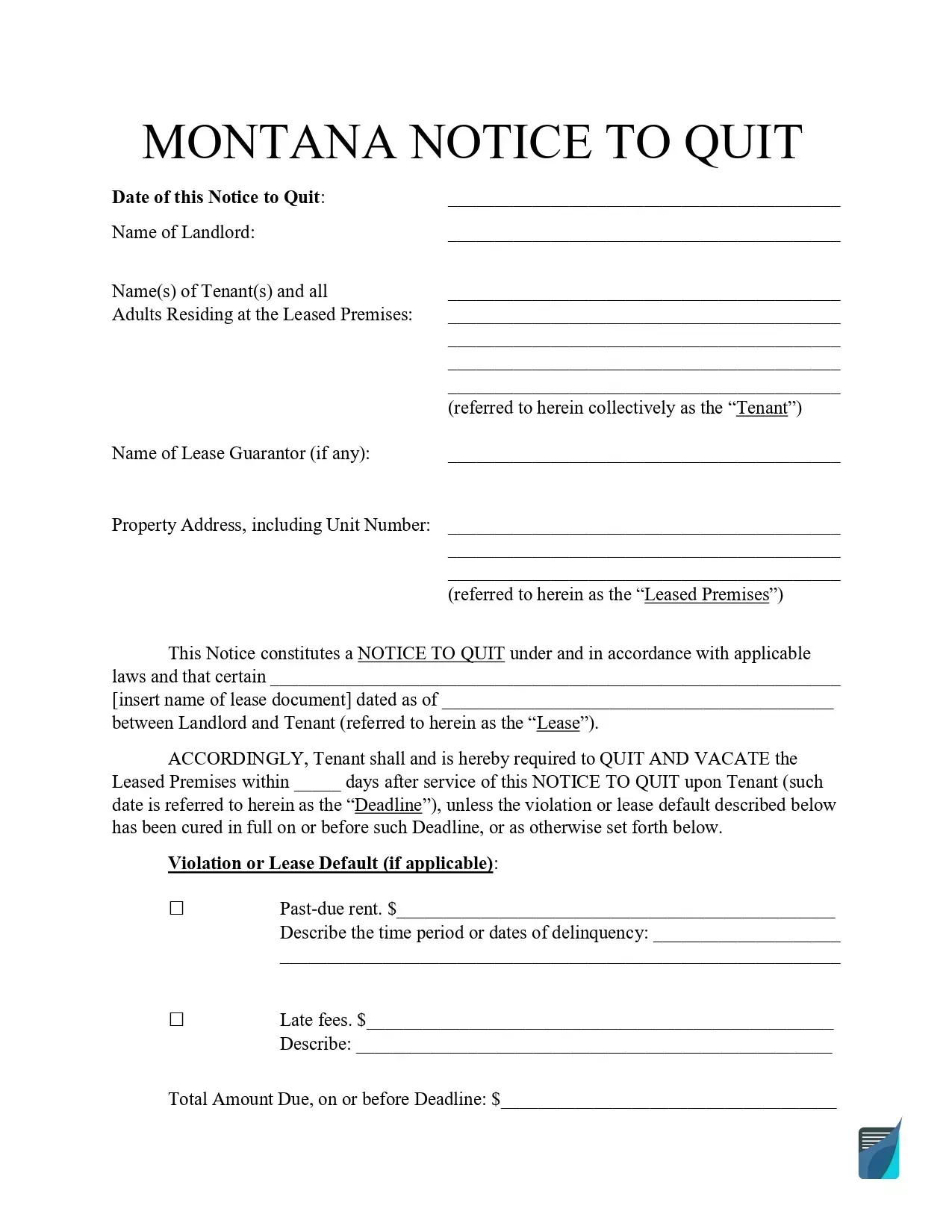
Some landlords and tenants call this document a notice to quit or a notice to vacate. Whatever the name, it starts the legal countdown before a Montana landlord can file an eviction case in court.
Montana eviction law sets the notice period a Montana landlord must give based on the reason for eviction. A Montana landlord must wait 3 days after written notice of nonpayment before terminating for unpaid rent, or give 14 days written notice for most other lease violations, under Mont. Code Ann. § 70-24-422.[2]
The notice period also depends on the type of violation:
If rent is unpaid when due and the tenant fails to pay rent within 3 days after written notice by the landlord of nonpayment and the landlord's intention to terminate the rental agreement if the rent is not paid within that period, the landlord may terminate the rental agreement, and the tenant shall vacate the premises if the landlord terminates the rental agreement.
If the Montana tenant breaks the rules on purpose, the landlord may recover treble damages, except where the statute says otherwise. This treble damages remedy does not apply to a tenant's early termination of the tenancy.[2]
You can count the exact deadline for any of these notice periods with FormsPal's deadline calculator.
| Notice for Nonpayment of Rent | 3 days |
| Notice for Most Lease Violations | 14 days |
| Notice for a Recurring Violation | 5 days |
| State Law | Mont. Code Ann. §§ 70-24-401 to 70-24-442 (Remedies), including §§ 70-24-411, 70-24-422, 70-24-441 |
Montana landlords use different eviction notices depending on why the tenancy is ending. A 3-day notice covers nonpayment of rent and certain serious violations. A 14-day notice covers most other lease violations, and a 5-day notice applies when the same violation happens again within six months.
3-Day Notice for Nonpayment or Serious Violations
A landlord may issue a 3-day notice for nonpayment of rent, verbal abuse toward the landlord, an unauthorized pet or person living in the unit, or property damage, under Mont. Code Ann. § 70-24-422.[2] The Montana tenant must pay the rent owed, fix the violation, or move out within three days of receiving the notice.
The section below on the 3-day notice to pay or vacate covers the nonpayment version of this notice in more detail.
3-Day Notice for an Unauthorized Pet or Occupant
If a Montana tenant keeps a pet the lease does not allow, or lets someone move in who is not on the lease, the landlord may issue a 3-day notice. The notice must name the violation, under Mont. Code Ann. § 70-24-422.[2] The tenant must remove the pet or the unauthorized occupant, or fix the problem, within those 3 days to keep the lease in place.
For example, if tenant Ben Carter brings home a dog his lease with landlord Anna Baker does not allow, Anna can serve Ben a 3-day notice. Ben can keep the lease in place by rehoming the dog within the 3 days.
3-Day Notice for Property Damage
If the tenant destroys, defaces, or damages any part of the rental property, the landlord may terminate the rental agreement on 3 days written notice specifying the damage, under Mont. Code Ann. § 70-24-422.[2] Landlords typically document the damage with photos and a written description before serving the notice, so there is a clear record of the condition of the property.
For example, if tenant Ben Carter breaks a window and does not fix it, landlord Anna Baker can serve Ben a 3-day notice describing the damage.
3-Day Notice for a Nuisance or Risk of Harm
If the tenant creates a real risk that the property could be damaged or destroyed, or that a neighboring tenant could be injured, the landlord may terminate the rental agreement. The landlord must give 3 days written notice naming the violation, under Mont. Code Ann. § 70-24-422.[2] This notice type covers conduct that puts the property or the people living in it at risk, not everyday wear and tear.
For example, if Ben Carter's actions create a fire hazard in the building, landlord Anna Baker can serve him a 3-day notice citing the danger.
3-Day Notice for Verbal Abuse
If the noncompliance is verbal abuse of the landlord by the tenant, the landlord may terminate the rental agreement on 3 days written notice, under Mont. Code Ann. § 70-24-422.[2] For example, if Ben Carter repeatedly verbally abuses landlord Anna Baker, Anna can serve Ben a 3-day notice ending the tenancy over that conduct.
5-Day Notice for a Recurring Violation
If a tenant repeats the same violation within six months of an earlier notice, the landlord may terminate the rental agreement. The notice period is at least 5 days, under Mont. Code Ann. § 70-24-422.[2] This shorter period reflects the tenant's repeated failure to correct the same problem.
For example, say Ben Carter receives a 3-day notice for an unauthorized occupant and lets the same person move back in within six months. Anna can then serve a 5-day notice instead of another 3-day notice.
14-Day Notice for Other Lease Violations
For a lease violation that is not covered by the 3-day or 5-day notice, Montana law requires a 14-day notice, under Mont. Code Ann. § 70-24-422.[2] If the violation can be fixed, the tenant may cure it before the date stated in the notice and avoid eviction.
For example, say landlord Anna Baker's tenant Ben Carter fails to keep the rental unit in the condition the lease requires. Anna can serve Ben a 14-day notice describing the problem. If Ben fixes the issue before the 14 days are up, the lease continues.
Week-to-Week and Month-to-Month Notice to End a Tenancy
When there is no lease violation, either the landlord or the tenant may end the tenancy without cause. A week-to-week tenancy needs at least 7 days written notice, and a month-to-month tenancy needs at least 30 days written notice, under Mont. Code Ann. § 70-24-441.[3] Neither side has to state a reason, and the tenancy ends on the date the notice specifies.
This type of notice does not depend on a lease violation. It works the same whether the landlord or the tenant is the one ending the arrangement.
For example, say landlord Anna Baker wants to end Ben Carter's month-to-month tenancy with no particular reason. She can give Ben a written 30-day notice, and Ben must move out by the date it states.
The landlord or the tenant may terminate a week-to-week tenancy by a written notice given to the other at least 7 days before the termination date specified in the notice. The landlord or the tenant may terminate a month-to-month tenancy by giving to the other at any time during the tenancy at least 30 days' notice in writing prior to the date designated in the notice for the termination of the tenancy.
Choosing the right notice matters, since serving the wrong one can slow the case down in court. Match the notice to the specific reason for eviction described above before serving it.
A 3-day notice to pay or vacate is the written notice a Montana landlord must give a tenant who has not paid rent when it was due. It tells the tenant to pay the rent owed within 3 days or move out.[2]
If the tenant pays the full amount owed within those 3 days, the landlord may not terminate the rental agreement over that missed payment. If the tenant does neither, the landlord may terminate the tenancy and the tenant must vacate the premises.[2]
The notice usually states:
Keeping a copy of the notice, along with proof of when it was delivered, helps both sides if a dispute reaches court.
A landlord who accepts a partial payment after serving the notice may need to start over with a new notice for the balance still owed. Keeping the conversation in writing helps avoid confusion about how much rent is left unpaid.
If the tenant moves out on their own before the deadline, the landlord does not need to go to court at all. The court process described below only becomes necessary once the notice period passes and the tenant is still in the unit.
For example, say tenant Ben Carter's rent to landlord Anna Baker is due on the 1st and goes unpaid. Anna can serve Ben a 3-day notice once the rent is late. If Ben pays what he owes within those 3 days, the tenancy continues. If he does not, Anna may terminate it.
Once the notice period ends and the tenant has not paid the rent owed, fixed the violation, or moved out, the landlord may file an eviction lawsuit in court. Montana law requires a court order before a landlord can remove a tenant, under Mont. Code Ann. § 70-24-411.[1]
No self-help evictions. A landlord may not lock the tenant out, remove the tenant's belongings, or shut off utilities such as heat, water, or electricity to force a move. A tenant harmed this way may recover possession of the unit or end the lease and collect damages.[1]
If a landlord unlawfully removes or excludes the tenant from the premises or purposefully diminishes services to the tenant by interrupting or causing the interruption of heat, running water, hot water, electricity, gas, or other essential services, the tenant may recover possession or terminate the rental agreement and, in either case, recover an amount not more than 3 months' periodic rent or treble damages, whichever is greater.
This rule exists so that only a court, not the landlord, decides whether the tenant must leave. It protects the tenant from being forced out without a chance to respond.
What a Tenant Should Do
A tenant who gets a notice should read it to see the reason given and the deadline to respond. Paying the rent owed or fixing the violation within the notice period keeps the lease in place.
A tenant who thinks the notice is wrong, or that the landlord did not follow the right steps, may want to talk to a local tenant rights group. An attorney can also help before the deadline passes. Some landlords and tenants settle the matter before it reaches a hearing. They might agree on a move-out date or a payment plan, and the landlord may then withdraw the lawsuit.
Follow these steps to complete the eviction process in court:
Following each step in order, and keeping careful records along the way, helps a Montana eviction case move smoothly for both sides.

Other Eviction Notice Forms by State
General information, not legal or tax advice.
Unless noted otherwise, the sources below are from the Mont. Code Ann..
