
W-9 vs. 1099 Explained
Written by FormsPal Editorial Team
- Time to read
- 8 min
Taxes get complicated in no time, and if you work with freelancers or earn income as an independent contractor, you have likely encountered Forms W-9 and 1099. Part of the problem is that taxpayers often end up mixing up these IRS forms. While both relate to tax reporting, they have different purposes. The W-9 collects taxpayer information before payments begin, while the 1099 reports payments made after the year ends.
This article explains what each form is for, when to use them, and how they work together, all in an easy-to-follow way.
What Is Form W-9?
Form W-9, officially titled the Request for Taxpayer Identification Number and Certification, is an IRS document businesses use to collect tax information from individuals and entities they intend to pay. It doesn't report income but serves as a reference to facilitate future tax reporting.
A business requests a W-9 before making any payments because it later uses that information to prepare forms such as the 1099. Without these details, payment reporting becomes uncertain and increases compliance risk, which all want to avoid.
A W-9 gathers several important details required for tax identification, such as:
- Legal name of the individual or business
- Business name or DBA (if different)
- Current mailing address
- Correct Taxpayer Identification Number (Social Security Number or Employer Identification Number)
- Federal tax classification (individual, LLC, corporation, partnership)
Only specific types of workers complete this form. Employees do not fill out W-9s. Instead, businesses use W-9s for non-employees who provide services on a contract basis rather than through payroll.
Examples of individuals or businesses required to complete a W-9 include independent contractors, freelancers, gig workers, vendors, self-employed professionals, and business entities such as LLCs, as well as partnerships. Businesses may also ask one-time service providers to submit a W-9 before approving payment.
Businesses usually request a W-9 before issuing the first payment, during contractor onboarding, or anytime they need to verify taxpayer information for reporting purposes. Waiting until tax season creates delays, missing details, or awkward follow-up emails nobody wants to send in January.
Collecting a completed W-9 early helps keep records organized. It also lowers the risk of backup withholding or reporting mistakes later, which make a simple contractor payment much more complicated.
What Is Form 1099?
Form 1099 is an IRS information return used to report specific types of income. Businesses use it to inform both the IRS and recipients of payments made during the tax year. Unlike a W-9, which collects information, a 1099 reports actual payments.
Form 1099 is commonly associated with freelance work because it often reports nonemployee compensation, or payments to independent contractors, rather than employees. If you hire someone outside your payroll, this form typically documents those payments at year-end.
Several types of 1099 forms exist, but a few are most frequent in business:
- 1099-NEC: For payments made in 2026, businesses use this form when they pay $2,000 or more in a calendar year to independent contractors or other non-employees for services.
- 1099-MISC, Miscellaneous Income: This version covers payments that aren't for contractor work, like rent, awards, or some legal settlements.
- 1099-INT: Banks and other financial institutions send this form to show how much interest someone earned during the year.
- 1099-DIV: This form reports dividends and other distributions paid to investors from stocks or funds.
Each type of 1099 form has its own purpose. Using the wrong form causes reporting problems or leads to IRS notices that may take time to resolve.
For payments made in 2026, businesses usually send Form 1099-NEC to independent contractors, freelancers, consultants, and service providers who get at least $2,000 in reportable payments over the year. This $2,000 limit is for the total paid in a year, not for each payment. Smaller amounts add up fast if someone works with the same client all year.
The IRS requires businesses to issue accurate forms and keep supporting records. Failing to send a required 1099 or providing incorrect information might cause penalties, especially if mistakes happen more than once.
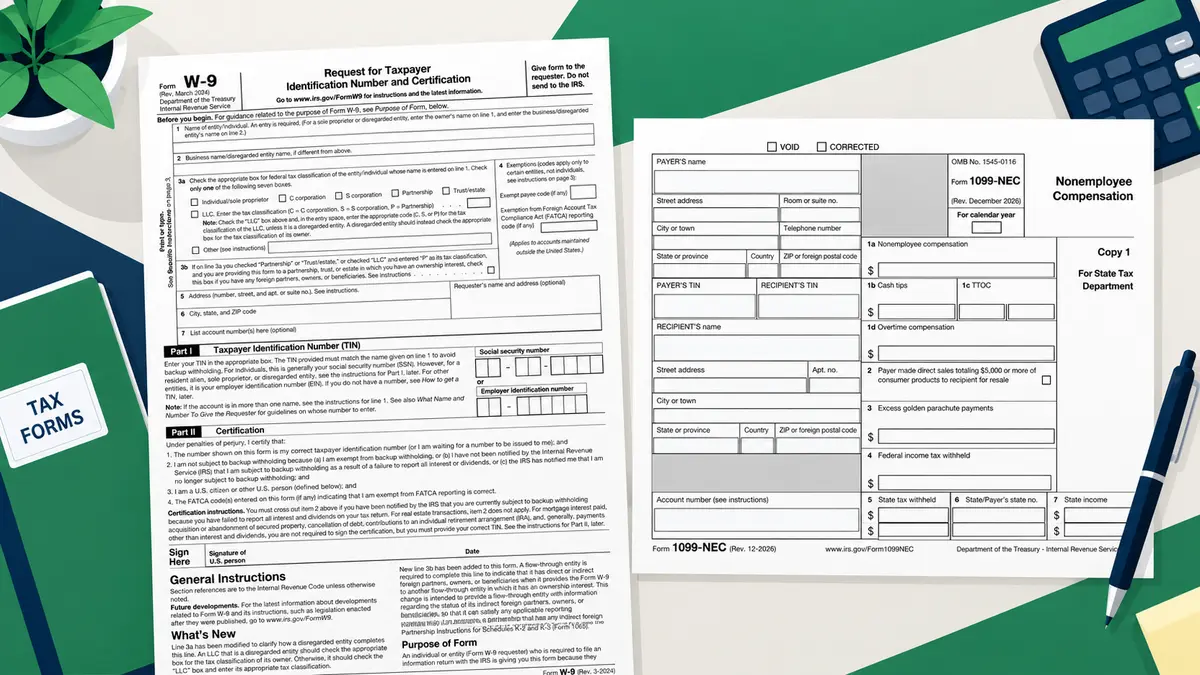
Side-by-Side Comparison: W9 vs. 1099 Tax Forms
W-9 and 1099 forms are both common in contractor paperwork, but they have different purposes. A W-9 gathers taxpayer details, while a 1099 reports what a business owner paid during the year. Contractors complete a W-9 at the start of a working relationship, and businesses issue 1099 forms after making payments.
The main difference is about taxes. A W-9 doesn't handle income tax reporting, tax withholding, or Federal Employment Taxes directly. Instead, it provides the information needed to prepare tax documents later. A 1099, on the other hand, shows how much someone earned so they can report that income and pay their own taxes.
This distinction also matters when determining whether someone is an employee or independent contractor. Contractors are generally considered self-employed. That means they handle their own taxes instead of having Medicare taxes and Social Security taxes withheld by an employer. Small business owners need to know this because how you classify workers affects your reporting and tax responsibilities.
Below is a side-by-side W9 vs. 1099 breakdown.
| W-9 Form | Form 1099 | |
|---|---|---|
| Main purpose | Collect taxpayer details | Report payments made |
| Who fills it out | Contractor or vendor | Business owner or payer |
| Tax function | Helps prepare reporting | Reports taxable income |
| Timing | Before payments | After payments |
| IRS submission | Usually kept on file | Filed with IRS |
| Tax withholding role | Helps verify backup withholding requirements | Shows income for tax reporting |
| Worker classification | Helps confirm employee or contractor status | Used only for non-employees |
Another key difference is backup withholding. If a contractor doesn't provide a W-9 or gives the wrong information, the business might have to hold back part of their payments for taxes. This doesn't happen often if the paperwork is done right, but the rule is there just in case.
To put it simply, the W-9 collects information, and the 1099 reports payments. Both are important. Using them together helps small business owners stay organized, report payments correctly, and avoid tax issues.
IRS Tax Deadlines for Forms W-9 and 1099
Form W-9 doesn't have a set IRS filing deadline, but Form 1099 does. When a contractor completes a W-9, the business should collect it before making the first payment and keep it on file for future use. The IRS recommends keeping the W-9 in your records instead of sending it to the agency, since it is used for tax compliance early on, not as a year-end filing.
Form 1099 has different rules:
- Form 1099-NEC: Businesses must send copies to contractors and file with the IRS by February 1, 2027. The usual January 31 deadline moves to Monday because it falls on a Sunday.
- Form 1099-MISC: Businesses generally need to send copies to recipients by February 1, 2027. The IRS filing deadline is March 1, 2027 for paper returns or March 31, 2027 for electronic filing.
Of course, both the employer and the contractor need accurate records to meet their tax obligations. Form 1099 shows how much the contractor was paid during the year, while Form W-9 provides the taxpayer information needed to prepare it correctly.
Detailed guidance from the IRS helps businesses avoid missed deadlines and filing errors.
What Are the Penalties for W-9 or 1099 IRS Forms?
Failing to handle Forms W-9 and 1099 properly can lead to IRS penalties, especially when mistakes affect income reporting. These penalties usually apply to businesses that fail to file required forms, submit incorrect information, or miss filing deadlines. Even small reporting errors can become expensive if they recur.
For Form 1099, penalties depend on how late the form is filed. For example, the IRS can charge:
- $60 per form if corrected within 30 days,
- $130 per form if corrected by August 1,
- $340 per form if filed after August 1 or not filed at all.
If the IRS decides the filer intentionally ignored the rules, the penalty jumps to at least $680 per form, with no annual cap.
W-9 problems usually come up when taxpayer information is missing or incorrect. If a contractor fills out a W-9 form with errors or refuses to provide a Taxpayer Identification Number, the payer may be required to withhold taxes at a 24% backup withholding rate.
If a business cannot determine whether a payee is a U.S. or foreign person, IRS presumption rules usually require treating that payee as a non-exempt U.S. taxpayer. In that situation, the payer may need to deduct backup withholding from the payment. This rule can apply whether the worker is a self employed individual, a sole proprietorship, or a registered business providing services.
How to Use the W-9 and 1099 Forms Together?
Businesses typically use Forms W-9 and 1099 as part of the same process to properly document contractor payments.
1. Collect the W-9 Before Making Payments
The process usually starts when a business asks a contractor to complete Form W-9 before any money changes hands. This form collects payment information, tax classification, and the taxpayer identification number needed for accurate reporting later.
This step applies whether the contractor is a sole proprietor, an LLC, or another type of service provider. Many other businesses make this part of their standard onboarding process because missing information can slow down accounting and tax reporting later.
2. Track Payments During the Year
After collecting the W-9, the next step is simple recordkeeping. Businesses should track how much they pay each contractor throughout the year, especially when payments may qualify as non-employee compensation. As mentioned earlier, good records make tax reporting easier and help prevent disputes over payment totals.
If a contractor fails to provide a W-9, businesses may need to delay payment or apply backup withholding rules.
Accurate payment records also help to confirm whether payments reach the $2,000 reporting threshold for payments made in 2026.
3. Prepare Form 1099 Using W-9 Information
At year-end, the information from the W-9 is extremely important. Without the right taxpayer details, it's much harder to prepare accurate forms, and filings may be rejected.
The 1099 shows how much the contractor earned so that they can include it on their tax return. And both the payer and contractor report the same information.
4. Send the 1099 and Keep Records
After completing Form 1099, the business must send it to the contractor and file it with the IRS. And it's also recommended to keep copies, as these documents may be needed later if questions arise about payments or reporting accuracy.
As you can see, using both forms together creates a simple system, and following it helps reduce errors and avoid compliance problems.