
A Connecticut last will and testament is a legal document comprising the official directions of a person (testator) relating to their property and assets usage in the event of death.
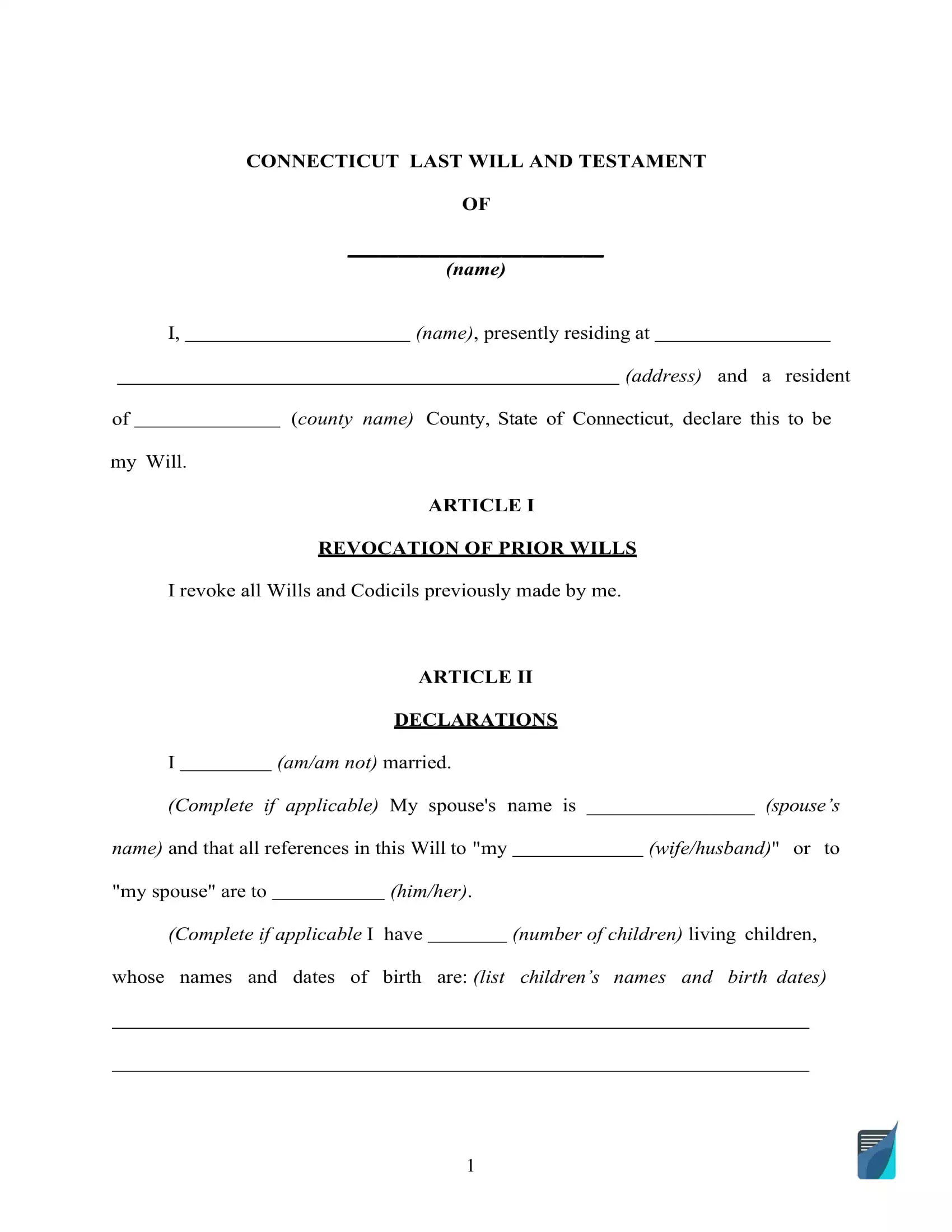
If you need a printable and fillable CT will template, you will find one on this page, along with tips on preparing your will, the state’s requirements, and answers to commonly asked questions.
Build Your Document
Answer a few simple questions to make your document in minutes
Save and Print
Save progress and finish on any device, download and print anytime
Sign and Use
Your valid, lawyer-approved document is ready
Last Updated: September 2026. This guide is reviewed and updated regularly to reflect current CT law. If you notice an error or outdated information, please contact us.
Some people search for a “CT will”, others for a “Connecticut will template”. Both terms refer to the same last will and testament form covered on this page.
A Connecticut last will and testament must meet a few legal requirements to be valid. State law requires the will to be in writing and signed by the testator, attested by two witnesses who each sign in the testator’s presence.[3] The testator must be eighteen years of age or older and of sound mind.[2.1] The table below breaks these CT will requirements down in more detail.
| Requirements | State laws | |
| Statutes | Chapter 802a – Wills: Execution and Construction | |
| Signing requirement | Two witnesses | Sec. 45a-251. Making and execution of wills |
| Age of testator | 18 and older | Sec. 45a-250. Who may make a will |
| Age of witnesses | Sec. 45a-251. Making and execution of wills | |
| Self-proving wills | Allowed | Sec. 45a-285. Proof of will out of court |
| Handwritten wills | Might be recognized if witnessed according to state law | Sec. 45a-251. Making and execution of wills |
| Oral wills | Not recognized | |
| Holographic wills | Not recognized | |
Writing a CT will involves naming an executor and beneficiaries, listing your assets, and signing the document in front of two witnesses.[3] The steps below walk through the FormsPal builder in order, from your first choice down to the final signatures. Follow them in sequence to avoid missing a required field.
1. Think about your possible choices. possible choices. One important thing to keep in mind, first of all, is whether you wish to write the entire thing by hand (holographic will) or work with a fillable last will and testament form available online.
2. Indicate your details. The first step is establishing the testator by filling out their full name, along with their residential details (city, county, and state). Go through the rest of the template, including the information you’ve entered and the “Expenses and Taxes” paragraph.

3. Choose the executor. In this particular passage, you choose who is going to carry out your will by entering their full name, together with their city, county, and state of residence. Most states have special policies for out-of-state representatives and executors, which usually means extra paperwork. It is best to name someone who lives in the same state as you. Although it is not mandatory, it’s a wise idea to appoint an additional person to act as an executor in case the first one is unwilling or incapable of executing your last will.

4. Determine the guardian (optional). You are able to choose a trusted person as a guardian if you’ve got underage or dependent children that need to be looked after. In case there are no instructions regarding exactly who should look after your kids, the guardian will be chosen by the court.

5. Establish your beneficiaries. This is where you name the beneficiaries who are going to receive your estate as the testator has directed. For every beneficiary, list their full name, address, and how they are related to you.
6. Allocate possessions. List your assets and describe precisely how you want to distribute them among your beneficiaries in case you’ve got something in mind other than dividing the property evenly. Cash, shares, realty, business ownership, money for unsettled debts, and any material items of financial worth you possess can be brought up in the last will. Some types of property may pass outside your will depending on how they are titled or on any beneficiary designations already in place. If you are not sure how a specific asset should be handled, talk with an attorney before finalizing your will.

7. Continue with the signatures. State law does not disqualify a witness just because they are also a named beneficiary of your will.[2.2] Even so, choosing witnesses who are not beneficiaries can help avoid disputes later. Consider selecting witnesses younger than you so they are more likely to be available if the will is ever contested in court. At this point, you (and your two witnesses) must sign the will after writing your full legal addresses and names. Don’t forget to review every sentence thoroughly before finalizing the matter.


Connecticut law affirms that a last will can be valid without having a notary public certify it. But if you need to add a self-proving affidavit to the will, you’ll need to notarize it, sworn before an officer authorized to administer oaths in or out of the state.[1] A self-proving last will makes probate quicker because the court can accept it without speaking to the witnesses who signed it.
It is not necessarily in Connecticut. Nevertheless, if you choose to attach a self-proving affidavit, it’ll be rather advantageous because this document functions as an alternative for in-court testimony of witnesses in the course of probate.[1]
Should you want to disinherit your marriage partner, you will be able to do it without any obstacles. State law places some restrictions on disinheriting a spouse, so if this applies to your situation, talk with an attorney before you finalize your will.
Besides your spouse, Connecticut law lets you disinherit any other family members. Your adult children or other relatives can be lawfully disinherited completely in your last will. To do that, include corresponding paragraphs to your last will and testament.
Yes, it is possible.
As outlined by Connecticut law, you can change or repeal your last will if you are not obligated by a legal agreement saying the opposite.
It’s recommended to modify your will if a significant event happens in your life. Those include but aren’t limited to:
If the last will and testament is lost or destroyed, according to the Connecticut law, the court will recognize it. But, the probate court will not be likely to accept anything other than the original of the last will and testament to probate.
If your last will cannot be located, talk with a probate attorney as soon as possible. What happens next depends on the specific facts of your case, and an attorney can walk you through your options.
Solely per your directive and in your presence is another person allowed to sign your will (See Connecticut Estate Code). You can give a particular directive using a number of means, including verbal communication, a positive answer to a query, or gestures.
A notary public is allowed to sign the name of the testator if the latter is unable to do so due to a physical incapacity. The notary has to be directed to do it in the presence of a witness. They are not allowed to have an interest (equitable or legal) in any of the assets affected by the will.
| Related documents | When to create it |
| Codicil | There are a number of minor modifications you want to make to your will. |
| Self-proving affidavit | You would like the probate to be faster in due time. |
| Living will | You want to make sure your end-of-life treatment is done as outlined by your wishes. |
| Living trust | You want extra safety and confidentiality once the time to distribute your possessions comes. |
This page is general information about CT last wills, not legal advice. For advice on your situation, talk to a licensed attorney.
