
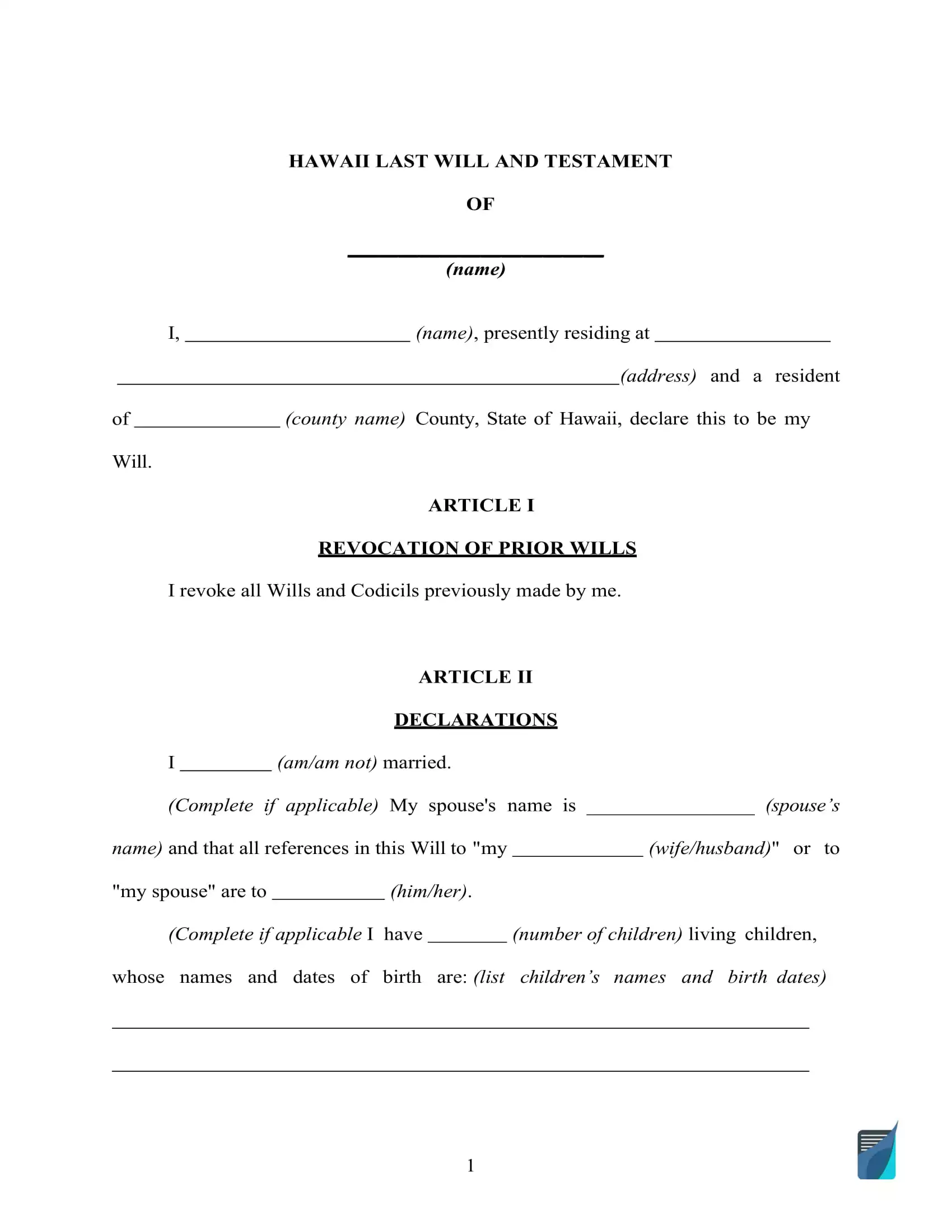
A Hawaii last will and testament template is a written legal document that lets you name who receives your property, choose an executor, and appoint a guardian for minor children. It becomes valid under Hawaii Revised Statutes Chapter 560 once you sign it and it is properly witnessed.
Most adults benefit from having one, even with modest assets, because it gives your family clear instructions instead of leaving the outcome to Hawaii’s default rules for people who pass away without a will. A last will is not the same document as a living will or a living trust.
The sections below cover Hawaii’s signing and witness requirements, the self-proving affidavit option, and a step-by-step guide to the free FormsPal template.
Build Your Document
Answer a few simple questions to make your document in minutes
Save and Print
Save progress and finish on any device, download and print anytime
Sign and Use
Your valid, lawyer-approved document is ready
Last Updated: September 2026. This guide is reviewed and updated regularly to reflect current Hawaii law. If you notice an error or outdated information, please contact us.
Hawaii law sets four core requirements for a valid last will: it must be in writing, signed by the testator (or by someone else at the testator’s direction and in their presence), and signed by at least two witnesses. A handwritten holographic will is also valid without witnesses if the signature and the material parts are in the testator’s own handwriting.
Hawaii also recognizes a self-proving affidavit, a sworn statement from you and your witnesses that lets the probate court accept the will without contacting the witnesses in person.[2]
| Requirements | State laws | |
| Definitions | §560:1-201 – General Definitions | |
| Statutes | Chapter 560 – Uniform Probate Code; Article II – Intestate Succession and Wills | |
| Signing requirement | Two witnesses | §560:2-502 Execution; witnessed wills; holographic wills |
| Age of testator | 18 and older | §560:2-501 Who may make will |
| Age of witnesses | No set minimum, must be generally competent | §560:2-505 Who may witness |
| Self-proving wills | Allowed | §560:2-504 Self-proved will |
| Handwritten wills | Recognized under certain circumstances | §560:2-502 Execution; witnessed wills; holographic wills |
| Oral wills | Not recognized | |
| Holographic wills | Recognized under certain circumstances | |
A will is also valid as a holographic will, whether or not it is witnessed, if the signature and the material portions of the document are in the testator’s own handwriting.[1] Hawaii sets no minimum age for a witness, only that the witness be generally competent, and an interested witness (someone named in the will) may still sign without invalidating the will.[4]
To make the will self-proving, Hawaii law sets three requirements for the affidavit:
1. Consider your options. Before getting started, you need to decide if you want to use the help of a legal professional or write the entire document on your own. If you would like to make the last will on your own, pick the type you’ll use: a solely handwritten, holographic will, or a free Hawaii will form.
2. Specify your information. Establish the testator and their particulars: full name and residence (city, county, and state). Check the details you entered along with the remainder of the passage, which includes “Expenses and Taxes.”

3. Establish the executor (or executrix). Select the executor of your estate and enter their full legal name and place of residence. Naming an alternate executor is a good precaution. If the person you name first cannot serve, the alternate can step in without forcing the court to appoint someone for you.

4. Appoint the guardian (optional). You are able to specify a trusted person as a guardian if you’ve got minor or dependent children that need to be looked after. If there are no instructions concerning who exactly should look after your children, the guardian will be selected by the court.

5. Indicate your beneficiaries. At this point, specify those people to whom you wish to leave your property and assets, that is, your beneficiaries. Fill out their full names, addresses, and your relationship to them (spouse, child, friend).
6. Designate assets. If you have a property distribution planned that’s not equal, it’s possible to explain it in this part. Money for unpaid debts, realty, shares, company ownership, cash, and any material items of financial value you possess can be in the will. Please notice that there are things that cannot be distributed in the will, for example, life insurance and joint and living will property.

7. Ask witnesses to finalize the document. Hawaii law requires at least two witnesses to sign your last will for it to be valid.[1] The statute sets no minimum age for a witness and only requires that the witness be generally competent, and naming a witness who is also a beneficiary does not invalidate the will.[4]
Sign the will together with your two witnesses, and have each witness fill in their full legal address and name next to their signature.


According to Hawaii law, there’s no need to attach a self-proving affidavit to your last will. However, it may not be a bad decision to add this document. During probate, it’ll serve as an alternative for the witness testimony in court and facilitate the process.
If you add one, Hawaii law lets you sign the affidavit at the same time as the will or at any later date. It must be sworn before an officer authorized to administer oaths, and the officer’s certificate must be issued under official seal.[2][3]
In Hawaii, there isn’t such a thing as community or marital property. The term suggests that any possessions gained or improved during the marriage must be equally shared between both marriage partners. In Hawaii, it is possible to disinherit your spouse, but the latter will be able to receive a particular minimum amount of your estate. However, it doesn’t make couples in Hawaii divorce more often than in common-law marriage states.
For the others, it’s legal in Hawaii to disinherit members of your family in your will. With the addition of certain disinheritance sections to your last will, you’ll be able to leave your children (of 18 years and above) or any other members of the family out from getting any of the belongings.
Yes, you can adjust it.
A person who wrote the will is permitted to alter or revoke his or her will at any time. The only situation that may not let you do it is if such action is forbidden under the contract you signed.
Additionally, it can be a wise decision to revise your last will whenever you go through an important life event such as:
In Hawaii, the law says that the court will recognize a last will if it has been damaged or lost. But, the probate court cannot be likely to accept anything other than the initial version of the will to probate.
As per Hawaii law, the absence of the will can be regarded as its repeal. This suggests that the executor should provide proof of the last will and testament’s credibility, which in turn may be rather troublesome.
For holographic wills, things can be far more problematic because sworn witnesses and testimony will be required. Furthermore, you are also to provide evidence of the reason why the will and its elements can’t be provided in a way that will also ensure it wasn’t canceled.
Only per your directive and in your presence is someone allowed to sign your last will (See Hawaii Estate Code §560:2-502). Voice communication, a positive answer to a question, or a gesture are the means that can be used to convey that you prefer a certain person to sign your will.
Hawaii law does not limit this role to a notary public. Any individual you direct, signing in your presence, may sign your name for you.[1] The witnesses to your will follow the same rule as any other witness: Hawaii sets no minimum age and does not require them to be disinterested, so naming a witness who also benefits under the will does not invalidate it.[4]
| Related documents | Instances when you might want to create one |
| Codicil | You would like to make one or a few minor adjustments to your will. |
| Self-proving affidavit | You would like to keep from possible risks in the probate court. |
| Living will | You would like to state your wishes concerning the end-of-life treatment and life-prolonging procedures. |
| Living trust | You want to think about an alternative to a last will. |
This page is general information about Hawaii last wills, not legal advice. For advice on your situation, talk to a Hawaii attorney.
