
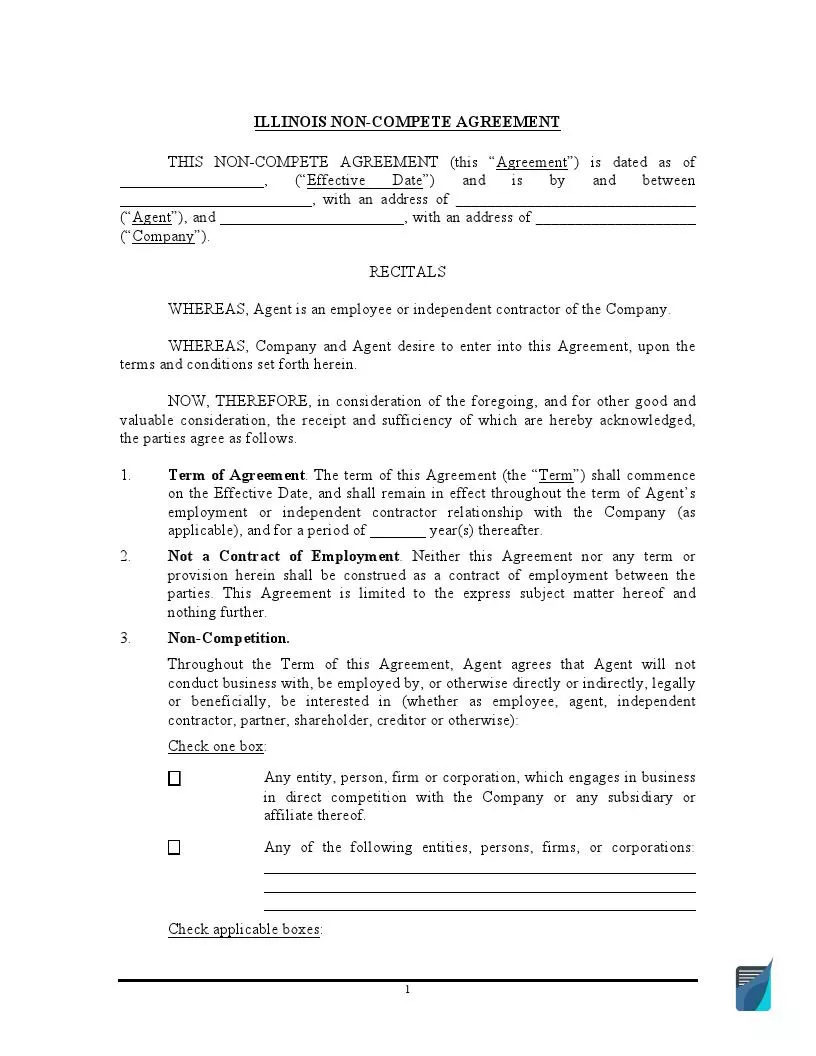
An Illinois non-compete agreement is a written contract that limits what an employee can do after the job ends. The employee promises not to work for a competitor, or not to solicit the employer's clients or workers, for a set time. Illinois sets rules on earnings, advance written notice, and review time before signing. Create a free Illinois non-compete agreement below, then check it against the rules on this page.
Last Updated: October 2026. This guide is reviewed and updated regularly to reflect current Illinois law. If you notice an error or outdated information, please contact us.
Build Your Document
Answer a few simple questions to make your document in minutes
Save and Print
Save progress and finish on any device, download and print anytime
Sign and Use
Your valid, lawyer-approved document is ready
A non-compete clause is a promise in an employment agreement. The employee agrees not to work for a competitor, or run a competing business, for a set time after leaving the job. A related promise, the non-solicitation clause, bars the employee from approaching the employer's clients or workers. Illinois treats the two separately, and the earnings limits later on this page differ for each.
Most clauses spell out three details:
These three details are practice points. Write each one in plain words so both sides read the same thing. When an employee leaves, an exit interview template can help both sides recap what the clause covers. For other hiring paperwork, browse the employment forms library.
Illinois regulates the non-compete clause through the Freedom to Work Act (820 ILCS 90). A covenant not to compete or a covenant not to solicit is illegal and void unless it passes five tests.[1.3] The employer must meet all five, and the list below names each one.
The statute defines adequate consideration in its own words.
"Adequate consideration" means the employee worked for the employer for at least 2 years after the employee signed an agreement containing a covenant not to compete or a covenant not to solicit or the employer otherwise provided consideration adequate to support an agreement to not compete or to not solicit, which consideration can consist of a period of employment plus additional professional or financial benefits or merely professional or financial benefits adequate by themselves.
In plain words, two years of work after signing can be enough. So can other pay or benefits that justify the promise.[1.1]
An employer can enter into a covenant not to compete only with an employee whose actual or expected annualized rate of earnings exceeds $75,000 per year. For a covenant not to solicit, the figure is $45,000 per year. Both amounts rise on a set schedule, shown in the table below.[1.2]
| Period | Covenant not to compete | Covenant not to solicit |
|---|---|---|
| Current amount | Over $75,000 per year | Over $45,000 per year |
| Beginning January 1, 2027 | $80,000 per year | $47,500 per year |
| Beginning January 1, 2032 | $85,000 per year | $50,000 per year |
| Beginning January 1, 2037 | $90,000 per year | $52,500 per year |
Illinois excludes some workers and situations from its non-compete rules. The list below goes through each one. It runs from collective bargaining and construction work to the sale of a business and mental health care. Where the exact wording matters, the Act's own words are quoted.
Any covenant not to compete or covenant not to solicit entered into after January 1, 2025 (the effective date of Public Act 103-915) shall not be enforceable with respect to the provision of mental health services to veterans and first responders by any licensed mental health professional in this State if the enforcement of the covenant not to compete or covenant not to solicit is likely to result in an increase in cost or difficulty for any veteran or first responder seeking mental health services.
Most problems come from skipping a step the Act puts on the employer, or from using the covenant with an employee below the earnings line. Check each point below before anyone signs.
An employee who prevails on a claim to enforce a covenant not to compete or not to solicit recovers from the employer all costs and all reasonable attorney's fees regarding that claim. The court or arbitrator may also award appropriate relief.[1.5]
The Attorney General can add a penalty. The Attorney General may request, and the court may impose, a civil penalty not to exceed $5,000 for each violation or $10,000 for each repeat violation within a 5-year period.[1.6]
Illinois's current non-compete law is 820 ILCS 90. A covenant not to compete needs an employee earning over $75,000 per year, and a covenant not to solicit needs one earning over $45,000 per year.[1.2] The covenant must also have adequate consideration and pass the five tests in the statute.[1.3] The employer must advise the employee in writing to consult an attorney and allow 14 calendar days to review it.[1.4]
General information, not legal or tax advice.
Popular Local NCA Forms
When the relationship between an employee and employer comes to an end, the latter may want the former to sign a non-compete, also called “covenant no to compete (CNC),” to keep their trade secrets from being being exposed to their competitors. Below are the state-level NCA forms our users research the most.

