
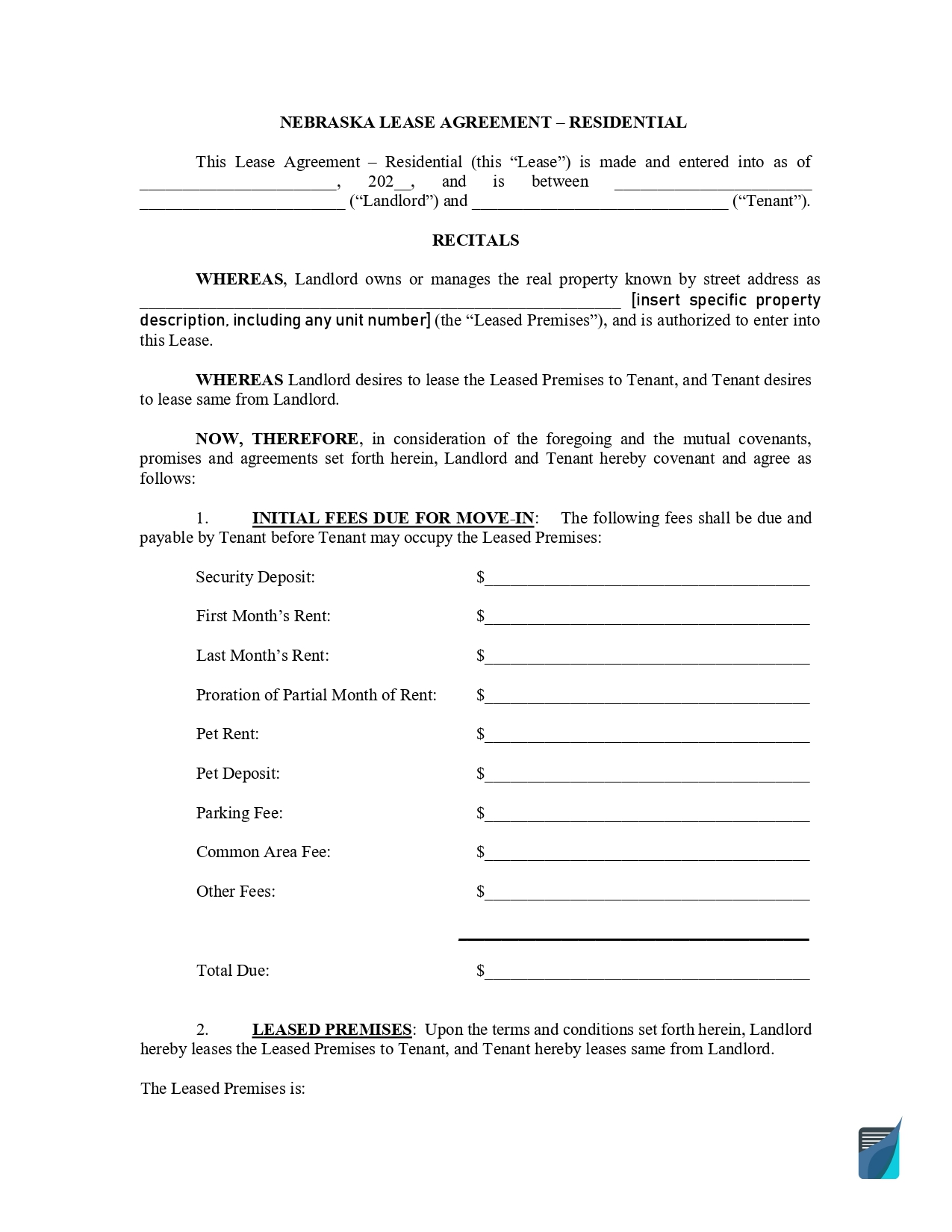
A Nebraska lease agreement is a legal contract that outlines the terms and conditions under which a tenant can rent property from a landlord. This form typically includes details such as the lease’s duration, the rent amount, the payment schedule, and the responsibilities of both the landlord and the tenant. The Nebraska lease agreement may also cover security deposits, maintenance, pet rules, subletting policies, and termination conditions.
Last Updated: September 2026. This guide is reviewed and updated regularly to reflect current Nebraska law. If you notice an error or outdated information, please contact us.
Build Your Document
Answer a few simple questions to make your document in minutes
Save and Print
Save progress and finish on any device, download and print anytime
Sign and Use
Your valid, lawyer-approved document is ready
A well-crafted lease agreement form will help ensure both parties understand their rights and obligations, reducing potential conflicts during the rental period.
In Nebraska, lease agreements must follow state law that covers rental properties. These laws limit security deposits, set notice periods for ending a lease, and define a landlord's and tenant's duties for property upkeep.
Under Nebraska law, a landlord cannot require a security deposit worth more than one month's periodic rent. A separate pet deposit of up to one-quarter of one month's rent is allowed, but this limit does not apply to housing agencies organized under the Nebraska Housing Agency Act.[1]
When the tenancy ends, the landlord must return everything below within fourteen days:[1]
Whoever holds the landlord's interest in the property when the tenancy ends must follow these rules, even after a change of ownership.[1]
If the landlord's failure to follow these rules is willful and not in good faith, the tenant can recover liquidated damages. The amount equals one month's rent or twice the deposit, whichever is less.[1]
“If the landlord's failure to comply ... is willful and not in good faith, the tenant may recover an amount equal to one month's periodic rent or two times the amount of the security deposit, whichever is less, as liquidated damages.”
A tenant is also not liable for damages tied to being removed from the property by a government order because the landlord's negligence made it unfit to live in.[1]
Ending a Nebraska tenancy takes written notice, and how much notice depends on the type of lease. For a month-to-month tenancy, the landlord or the tenant must give written notice at least thirty days before the next periodic rental date. For a week-to-week tenancy, the notice period is at least seven days before the termination date stated in the notice.[2]
These notice periods apply whether the landlord or the tenant is the one ending the tenancy, and they come from Nebraska's Uniform Residential Landlord and Tenant Act.[2]
For example, if a landlord wants to end a month-to-month tenancy on July 1, the landlord should deliver written notice to the tenant no later than June 1, which is thirty days before that date.
Tip: put the notice in writing and date it, and keep a copy for your own records in case the move-out date is ever disputed.
A good lease, consistent with Nebraska landlord tenant law, sets clear expectations for both sides. Beyond rent and the security deposit, most Nebraska leases also address the property's condition, who handles repairs, whether pets are allowed, and who pays for utilities and other services.
These terms vary by landlord and property. Read the lease closely before you sign. Ask the landlord to put anything important in writing. A tenant who does not see a topic covered in the lease can ask the landlord about it directly, since the written lease is what both sides can point back to later.
A Nebraska lease agreement is for any landlord who rents out a house, apartment, or room in the state. It is also for any tenant who wants clear, written terms before moving in.
Landlords use this document to set the rent, the move-in date, and the rules for the property. Tenants use it to know what they are agreeing to before they sign. A written lease can help both sides if a disagreement comes up later, because the terms are on paper instead of only spoken.
This applies to single-family homes, duplexes, apartments, and rented rooms across Nebraska, from Omaha and Lincoln to smaller towns statewide.
| Document Name | Nebraska Rental Lease Agreement Form |
| Other Names | NE Rental Lease, Nebraska Residential Lease Agreement |
| Relevant Laws | Neb. Rev. Stat. §§ 76-1416, 76-1437 |
| Security Deposit Amount | One (1) month’s periodic rent |
| Security Deposit Return | Within fourteen (14) days |
| Avg. Time to Fill Out | 18 minutes |
| # of Fillable Fields | 119 |
| Available Formats | Adobe PDF |

Other Rental Lease Agreement Forms by State
Here are quick answers to the most common questions about Nebraska lease agreements, covering security deposits, termination notice, and how long an eviction can take. Each answer links to the statute or FormsPal tool it comes from.
The landlord must return the balance of the security deposit, along with a written itemization of any amounts kept, within fourteen days after the tenancy ends. The statement and any remaining funds go to the tenant's forwarding address.[1]
Nebraska law does not require a specific termination letter form. It does call for written notice to end a periodic tenancy. A month-to-month tenancy needs at least thirty days written notice, and a week-to-week tenancy needs at least seven days written notice.[2] FormsPal's lease termination letter tool can help you put that notice in writing.
The seven-day notice applies to week-to-week tenancies. A landlord or tenant who wants to end a week-to-week tenancy must give the other party written notice at least seven days before the termination date stated in the notice.[2]
Eviction timelines vary with the type of notice given, whether the tenant responds, and the local court's schedule, so there is no single fixed number of days that applies to every case. FormsPal's Nebraska eviction notice forms cover the notice types landlords use to start the process.
Notice periods depend on the type of tenancy:[2]
A lease termination letter is a written notice that a landlord or tenant sends to end a tenancy on a stated date. Nebraska has no specific form for it, but the letter should include the date, the property address, and the date the tenancy will end.
Nebraska tenants have specific rights around the security deposit and notice. These include a cap on the deposit amount and a fourteen-day deadline for the landlord to return it with a written itemization,[1] plus written notice before a landlord or tenant can end a periodic tenancy.[2] A tenant who believes a deposit was wrongly withheld can use FormsPal's security deposit demand letter to ask for it in writing.
General information, not legal or tax advice.
Every legal claim on this page is backed by a citation to the Nebraska Revised Statutes below. Citation markers like [1] in the text point to the exact section, so you can verify each rule against the official law yourself. Unless noted otherwise, every source on this page comes from the Nebraska Revised Statutes.
