
Electronic Signature Statistics 2026: Adoption, Growth, and Real-World Use
Written by FormsPal Editorial Team
- Time to read
- 9 min
In 2026, e-signatures stopped feeling optional. What was once a small time-saver now affects entire workflows, from hiring forms to high-value agreements. Companies are chasing speed, accuracy, and audit-ready records.
E-sign adoption increased across industries, signing volumes rose, and trust followed as legal frameworks and security controls matured. The numbers tell that story plainly. So, we will break down the most relevant e-signature statistics to show where growth occurred and how people use digital signing tools. Afterward, you'll understand why paper signatures continue to fade into the background.
E-Signature Market Size and Growth
- The global digital signature market reached $9.85 billion in 2025.[1]
- By 2034, that market could be worth $154.52 billion. That works out to an expected annual growth rate of 35.4% from 2026 to 2034.[1]
- In the U.S., the digital signature market is expected to reach $3.58 billion in 2026.[1]
- North America made up 38% of the global market in 2025, with digital signature sales worth $3.74 billion.[1]
- Asia-Pacific is expected to grow faster than any other region for e-signature platforms, at an average of 28.55% a year from 2026 to 2031.[2]
- E-signature platforms were a $7.04 billion market in 2025. That figure is expected to rise to $8.99 billion in 2026.[2]
E-signatures have evolved from an optional feature into a core business tool, as evidenced by their growth rate.
Businesses now incorporate digital signing into contracts, onboarding, procurement, and compliance processes to prevent paperwork delays that can stall deals or hiring cycles. North America generates the largest share of revenue, with the U.S. leading at the country level. Meanwhile, Asia-Pacific is expanding at an even faster pace.
Cloud adoption further clarifies the situation. Companies favor platforms that allow signing from anywhere and sync across devices, integrating into existing systems.
E-Signature Usage in the U.S.
- About 70% to 80% of U.S. organizations already use e-signature tools.[1]
- E-signatures are common in law offices too: 72% of solo firms and 78% of small firms say they use them.[3]
- Among real estate agents surveyed, 79% said they use e-signatures for their work.[4]
- By the first quarter of 2026, eNotes made up 16.8% of Fannie Mae mortgage volume.[5]
E-signatures have become routine for U.S. organizations. Most companies already use them, indicating that digital signing has moved from an early-adopter trend to an everyday practice.
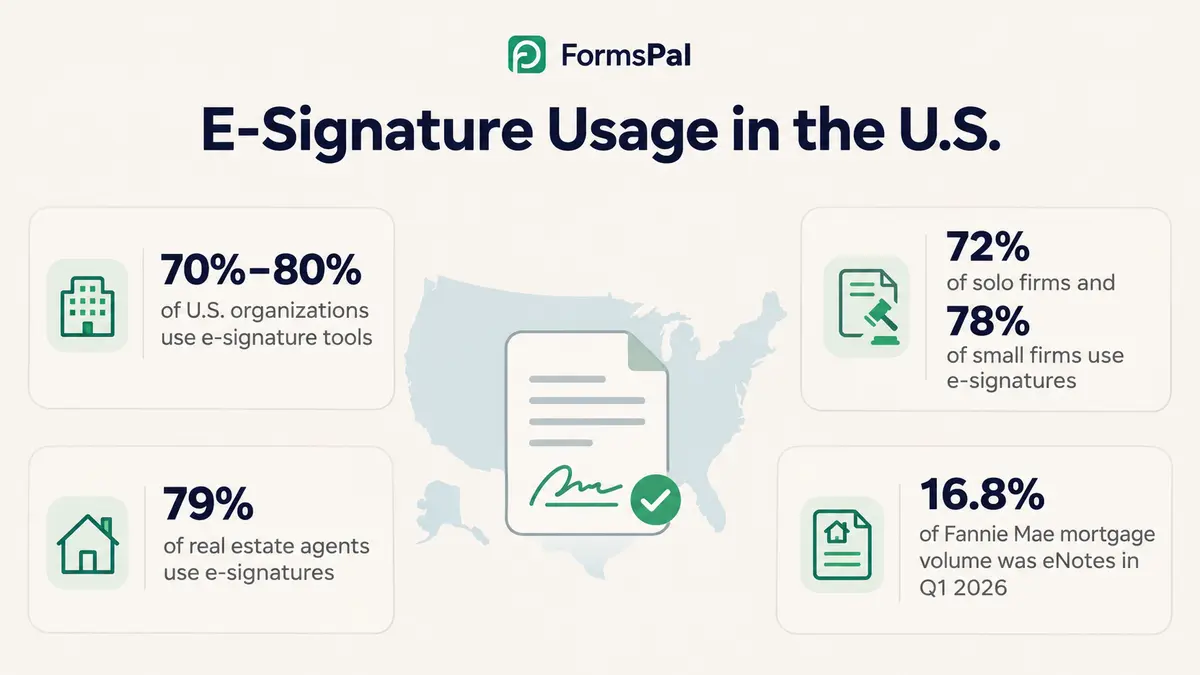
A strong majority of law firms, including solo practitioners and small firms, use e-signature software. Even lean operations see the value of faster approvals and fewer paper files. Real estate professionals are following suit, with most agents now handling offers, disclosures, and closing paperwork digitally instead of waiting for signatures on paper documents.
The mortgage lending industry confirms this trend. A measurable share of loan volume now processes as eNotes, indicating that even tightly regulated financial transactions accept digital execution at scale.
E-Signature Adoption by Industry
- Banking, financial services, and insurance made up 29.76% of digital signature market revenue in 2025.[6]
- Four out of five U.S. cancer centers surveyed (80%) said they could handle patient consent electronically.[7]
- In some countries with advanced online government services, as many as 99% of public transactions are completed digitally.[8]
- Cloud-based services made up 66.22% of digital signature market revenue in 2025.[6]
E-signature adoption is widespread across nearly every major sector. Financial services generate the largest share of revenue, reflecting banks' and insurers' heavy dependence on secure digital execution of contracts and compliance-driven documents. Meanwhile, healthcare providers are increasingly relying on e-consent to speed intake and reduce paper handling.
Public institutions further promote digital use. In leading digital governments, such as Singapore, nearly all citizen transactions occur online.
Business Use of E-Signatures
- Large companies brought in 62.10% of e-signature platform revenue in 2025. Smaller businesses are expected to grow faster through 2031.[2]
- Cloud-based options accounted for 76.05% of the e-signature platform market in 2025.[2]
- Simple electronic signatures made up 48.10% of the e-signature platform market in 2025. They are widely used for everyday approvals and lower-risk documents.[2]
- About two-thirds of large companies (66%) describe themselves as digital-first, compared with 49% of smaller businesses.[9]
Large enterprises generate most e-signature revenue today, but smaller businesses are catching up fast and are expected to grow faster in the coming years. At the same time, cloud deployment dominates the market. So, companies prefer web-based platforms over on-premises setups.
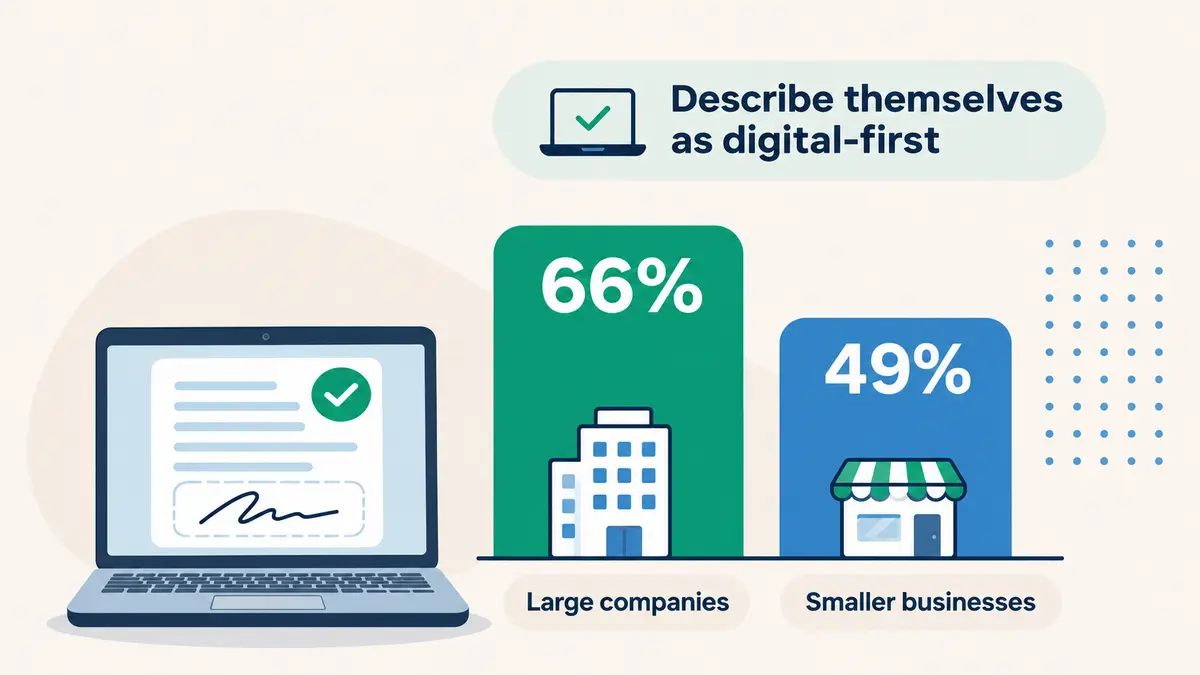
Simple electronic signatures make up the largest share of use, mainly for everyday approvals and low-risk documents. And when it comes to mindset, two-thirds of large companies and about half of smaller ones already describe their operations as digital-first.
E-Signatures in Remote Work and Digital Agreements
Digital signing removes the need to print, scan, or ship contracts when teams work remotely.
Mobile use is a big part of that change. More than 25% of surveyed U.S. employees sign contracts on their phones.
Security and Legal Acceptance of E-Signatures
- By January 2025, 70% of workforce identity users had adopted multi-factor authentication.[12]
- Around 90% of the countries tracked have laws covering electronic transactions.[13]
- Legal recognition reaches 92% in Asia-Pacific and 78% in Africa. The figures are 80% for Least Developed Countries and 78% for Small Island Developing States.[13]
- As of 2025, 49 U.S. states follow UETA, the law covering electronic transactions. New York has its own electronic signature law.[14][15]
- In all 27 EU countries, qualified electronic signatures have the same legal effect as handwritten signatures under eIDAS.[16]
Security standards continue to tighten. A strong majority of users now rely on multi-factor authentication, adding extra verification before documents receive approval. At the same time, most countries formally recognize electronic signatures and records under e-transaction laws.
Cost and Time Savings from E-Signatures
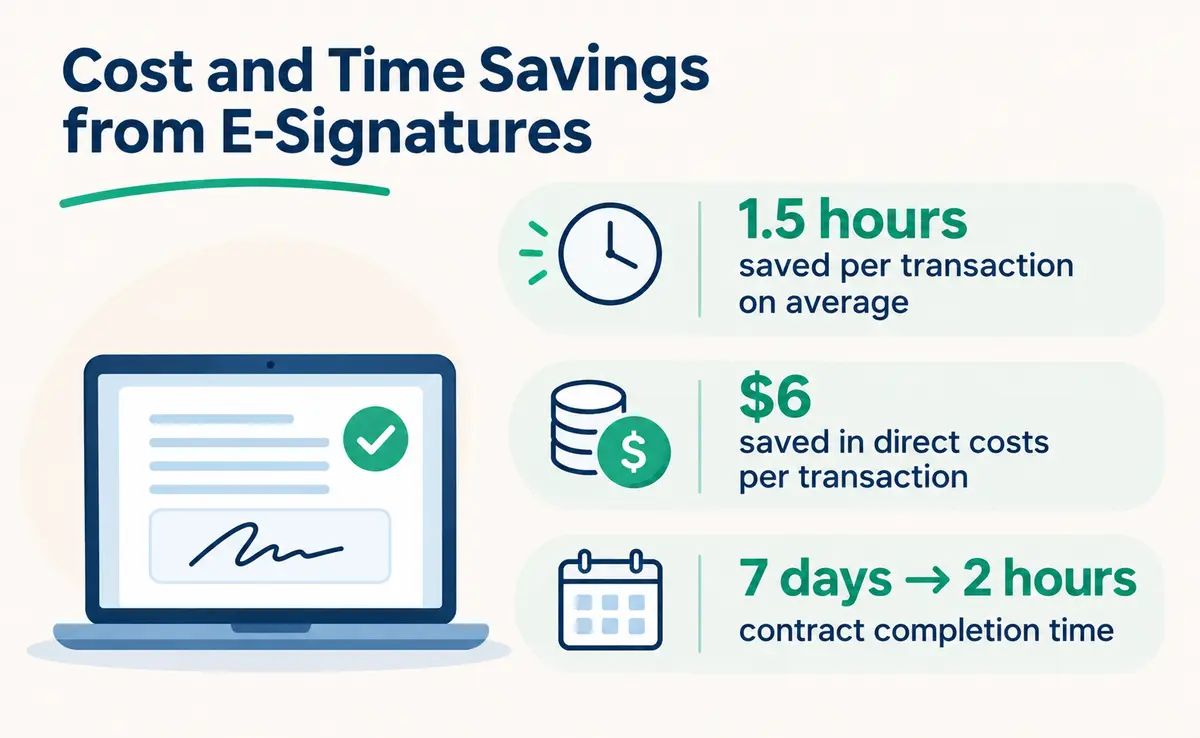
- Switching from manual signing to e-signatures saves organizations an average of 1.5 hours per transaction.[17]
- Businesses save about $6 per transaction on direct costs such as printing and shipping.[17]
- In one modeled business rollout, the time needed to complete a contract fell from 7 days to 2 hours, a 96% reduction.[18]
- Colleges and universities have reported processing enrollment documents up to 41% faster after adopting e-signatures.[19]
Companies save about an hour and a half per transaction once they stop printing, scanning, and mailing documents. Small savings, repeated hundreds or thousands of times, start to feel substantial.
Colleges and universities report similar gains, moving enrollment paperwork through the system faster after switching to digital signing.
E-Signatures vs. Wet Signatures
- Paper has not disappeared: 19 of the 20 surveyed U.S. cancer centers that offered e-consent still used paper alongside it.[7]
- In a 2025 survey, 22% of mortgage lenders who responded said they already used eNotes.[20]
- Skipping printing, scanning, and faxing saves an estimated $13.50 per transaction, including the time employees save.[21]
- Remove mailing and shipping costs too, and estimated savings rise to $21.50 per transaction.[21]
Most organizations don’t commit to a single method. They juggle paper and digital workflows simultaneously, and some documents still call for wet signatures.
Digital workflows save more than $10 per transaction by eliminating print-scan-fax workflows. Savings exceed $20 once mailing and shipping are excluded, making the paper look expensive.
Environmental Impact of E-Signatures
For years, digital signing has quietly reduced paper waste.
Digitally processing large volumes of documents can prevent millions of pounds of carbon emissions. Even mid-sized adoption cuts paper use by millions each year, saving vast amounts of water and wood and turning routine signatures into a subtle climate win.
What the Numbers Suggest for E-Signatures in 2026?
- The global digital signature market could rise from $17.68 billion in 2026 to $66.26 billion by 2031, with average annual growth of 30.2%.[24]
- E-signature platforms are expected to reach $30.46 billion by 2031, growing by an average of 27.65% a year from 2026.[2]
- Europe’s digital signature market is expected to grow from $2.71 billion in 2025 to $26.80 billion by 2032, averaging 38.8% growth per year.[25]
- In healthcare, the market is expected to grow by 24.12% a year through 2031 as digital consent, patient onboarding, and compliance processes become more common.[6]
Forecasts point to strong, double-digit growth in this market through the end of the decade. Platforms and regions are scaling quickly as digital agreements replace manual paperwork in everyday operations.
The U.S. remains a primary revenue engine, and Europe is on track for sharp, multi-year expansion. This growth signals that adoption isn’t limited to early, tech-forward markets. Healthcare stands out among industries for its steady gains, driven by digital consent, patient onboarding, and compliance-heavy documentation.
By 2026, e-signatures will appear less like a convenience feature and more like the default infrastructure for how organizations execute agreements.
FAQ
What is the difference between an electronic signature and a digital signature?
An electronic signature is any electronic indication of intent to sign, such as typing a name or clicking “I agree.” A digital signature is a specific type of electronic signature that uses encryption and digital certificates to verify identity and protect document integrity.
Are e-signatures legally valid?
Yes. In the United States, federal and state laws recognize electronic signatures as legally binding in most business and consumer transactions. In the European Union, qualified electronic signatures carry the same legal effect as handwritten signatures under eIDAS.[14][16][26]
Are e-signatures secure?
Yes, electronic signatures are secure. They are safest when you use FormsPal, which locks the document, creates an audit trail of every step, and verifies the signer's identity rather than just trusting a typed name.
How much money can businesses save by switching to e-signatures?
On average, companies save between $6 and $21.50 per transaction by eliminating printing, scanning, faxing, mailing, and physical storage costs.[17][21]
Can all documents be signed electronically?
Not always. Some documents, such as certain wills, court filings, or real estate records, may still require wet signatures depending on state or country law.[14][26]
Sources & References
- Fortune Business Insights Digital Signature Market Size, Share & Industry Analysis (updated November 2, 2026).
- Mordor Intelligence E-Signature Platform Market, 2026-2031.
- Clio 2025 Legal Trends for Solo and Small Law Firms.
- National Association of REALTORS REALTORS Embrace AI, Digital Tools to Enhance Client Service (September 18, 2025).
- MISMO Digital Mortgage Resource Center: eNote Adoption Statistics (2026).
- Mordor Intelligence Digital Signatures Market Size & Global Research Report, 2026-2031.
- Chimonas, S., et al. Electronic Consent at US Cancer Centers: A Survey of Practices, Challenges, and Opportunities (2023).
- GovTech Singapore Digital Services: Government Transactions Online.
- Exploding Topics 20+ E-Signature and Digital Document Statistics (Digital Business Study findings).
- Adobe Mobile Devices Are Reshaping the Modern Workday.
- DocuSign Electronic Signature: Fast & Easy e-Signature.
- Okta The Secure Sign-in Trends Report 2025.
- UN Trade and Development (UNCTAD) Global Cyberlaw Tracker (updated September 9, 2026).
- Adobe U.S. E-Signature Laws and Regulations.
- New York State Office of Information Technology Services Electronic Signatures and Records Act (ESRA).
- European Union Regulation (EU) No 910/2014, eIDAS, as amended.
- Adobe / Forrester Consulting The Total Economic Impact of Adobe Sign: Time and Cost Savings.
- Forrester Consulting for Adobe The Total Economic Impact of Adobe Sign: 7-Day to 2-Hour Cycle Time (2019).
- EDUCAUSE (sponsored article) eSignature Across Campus: Empowering Agreement Transformation (2022).
- Fannie Mae Mortgage Lender Sentiment Survey: eMortgage Technology (2025).
- Forrester Consulting for Adobe The Total Economic Impact of Adobe Acrobat Sign: Cost Savings (2022).
- Adobe Sustainability at Scale: Adobe Acrobat Sign Estimated Resource Savings.
- Adobe Digital Mortgages and the Future of Lending Are Powered by E-Signature: NatWest Case.
- MarketsandMarkets Digital Signature Market: Global Forecast to 2031 (September 2026).
- Fortune Business Insights Europe Digital Signature Market Size and Forecast to 2032.
- United States Congress Electronic Signatures in Global and National Commerce Act (E-SIGN Act).