
An Alabama quitclaim deed is a written deed in which the owner, called the grantor, passes whatever interest they hold in real property to a grantee. The grantor must sign it and have a witness attest the signature.[1] Recording the deed protects it against later purchasers and creditors who had no notice.[2] Download the Alabama form below, use our free quitclaim deed form builder, or browse other fillable deed forms.
Last Updated: October 2026. This guide is reviewed and updated regularly to reflect current Alabama law. If you notice an error or outdated information, please contact us.
Build Your Document
Answer a few simple questions to make your document in minutes
Save and Print
Save progress and finish on any device, download and print anytime
Sign and Use
Your valid, lawyer-approved document is ready
Alabama sets three main rules for a deed that transfers land. A written deed must be signed by the grantor and attested by a witness.[1] A deed that is not recorded can be void against later purchasers and creditors who had no notice.[2] Certain words in the deed also carry a promise from the grantor.[3]
Under Section 35-4-20 of the Ala. Code, a deed that conveys land must be written or printed on parchment or paper. The grantor, or an agent who has written authority to act for the grantor, must sign it at the foot. If the grantor cannot sign, another person writes their name and adds the words "his mark" against it or over it.[1]
The signature must also be attested by a witness. An attestation is a written statement by a person who watched the grantor sign. An acknowledgment before an officer authorized to take acknowledgments stands in place of the attestation. An acknowledgment before a notary public satisfies Alabama's witness requirement (Sections 35-4-23 and 35-4-24 of the Ala. Code).[4]
The number of witnesses depends on how the grantor signs:[1]
Section 35-4-90 of the Ala. Code deals with deeds that are not recorded. The statute says:
All conveyances of real property, deeds, mortgages, deeds of trust, or instruments in the nature of mortgages to secure any debts are inoperative and void as to purchasers for a valuable consideration, mortgagees, and judgment creditors without notice, unless the same have been recorded before the accrual of the right of such purchasers, mortgagees, or judgment creditors.
In plain words, a deed that is not recorded can be void against buyers who paid value, against mortgagees, and against judgment creditors who had no notice of it. Recording the deed before their right arises protects it.[2]
In Alabama, deeds are recorded in the office of the county judge of probate (Section 35-4-50 of the Ala. Code).[5]
When a deed is recorded, Alabama requires proof of the purchase price or, if the property was not sold, its actual value (Section 40-22-1 of the Ala. Code). The Department of Revenue's Real Estate Sales Validation Form (RT-1) is used for this, unless the deed itself states the required information.[6]
Section 35-4-271 of the Ala. Code gives special meaning to certain words. In a conveyance of an estate in fee, the words "grant," "bargain" or "sell" are read as an express covenant to the grantee, unless the deed clearly says otherwise.
That covenant says the grantor owned an indefeasible estate in fee simple, free from incumbrances done or suffered by the grantor. In plain words, that is a complete ownership interest that cannot be taken away.
The covenant also promises quiet enjoyment against the grantor and the grantor's heirs and assigns, unless the deed limits it in express words. The grantee can sue for a breach as if the covenants were written into the deed.[3]
A deed that uses those words can therefore carry a promise from the grantor, even if it is called a quitclaim deed. The FormsPal form uses the words "remises, releases, and quit claims" instead.
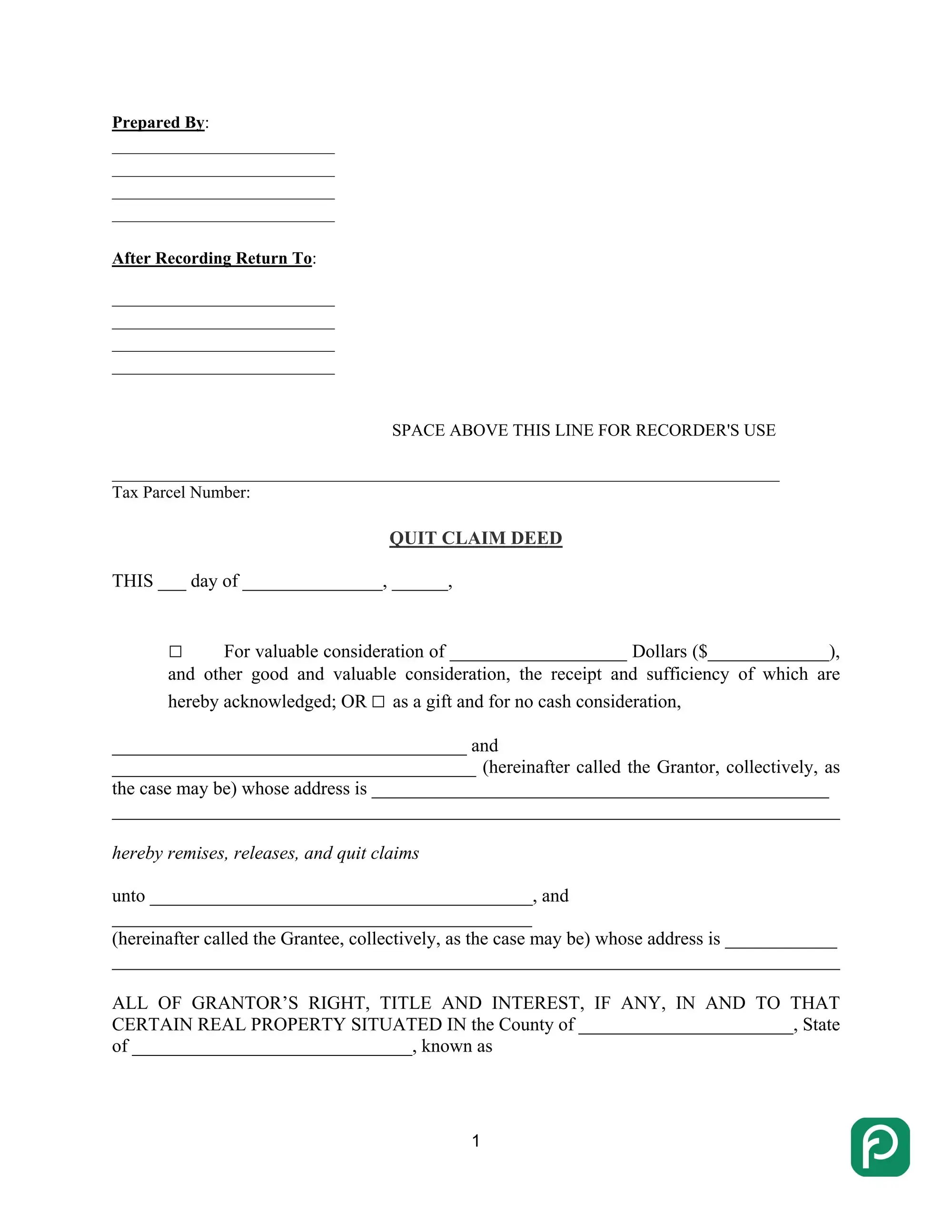
The FormsPal form for Alabama has blanks for the parties, the property and the signatures. Work through the 10 numbered parts below in the order they appear on the form. After you download the PDF, you can fill it in on screen with our PDF editor, or print it and write by hand.
Gather the following details before you open the form, so that each blank can be completed in one sitting:
With those details at hand, work through the numbered parts in order.
Once the deed form is signed, read the recording rules above. Every deed form on FormsPal is a starting point for the property you are transferring, so check each blank against your own records. Keep a copy of the signed deed with your property records, and make sure that every name on it matches the identification used at the signing.
The FormsPal form has fixed wording as well as blanks. Page 1 states the transfer, and page 2 holds paragraphs with nothing to fill in. Reading them before you sign shows what the deed says and what it leaves out.
Taken together, these paragraphs show how the form is built. It passes the grantor's right, title and interest, if any, rather than promising that the grantor owns anything. The form therefore describes a transfer of whatever the grantor holds, with no warranty language, so check the wording closely before you add or remove any text.
A few legal terms appear on the form and in the Alabama statutes cited on this page. Knowing them makes the form easier to complete. Each term below is explained in plain words.
These questions cover the Alabama rules that people ask about most often when they fill in a quitclaim deed form. Each answer comes from the Code of Alabama sections listed under Sources (Sections 35-4-20, 35-4-90 and 35-4-271), and the answers apply to the deed form on this page.
Recording is what protects the deed against later purchasers and creditors. Under Section 35-4-90 of the Ala. Code, a deed that is not recorded is void as to purchasers for a valuable consideration, mortgagees and judgment creditors without notice, unless it was recorded before their right arose.[2]
At least one witness must attest the signature. Where the grantor cannot write, two witnesses who can write must attest it, and they must write their names as witnesses.[1]
Yes, an agent who has written authority may sign at the foot of the deed in place of the grantor.[1]
In a conveyance of an estate in fee, those words are read as an express covenant to the grantee unless the deed clearly says otherwise.[3]
The covenant covers three things:
Page 2 of the FormsPal form says the legal description is set forth on Exhibit A. Enter the parcel ID on that page, then attach an exhibit that holds the full legal description of the property.

General information, not legal or tax advice.
Every statement about Alabama law on this page comes from one of the Code of Alabama sections below. The bracketed numbers in the text match the numbered entries in this list.
