
A Wisconsin quitclaim deed is a written deed that passes all of the interest in the land that the grantor could lawfully convey to the grantee. It does not warrant or imply the existence, quantity or quality of that interest.[1.1] The grantor is the person giving up the interest, and the grantee is the person receiving it. The free FormsPal form is ready to fill out online or to download as a PDF or Word file.
Last Updated: October 2026. This guide is reviewed and updated regularly to reflect current Wisconsin law. If you notice an error or outdated information, please contact us.
Build Your Document
Answer a few simple questions to make your document in minutes
Save and Print
Save progress and finish on any device, download and print anytime
Sign and Use
Your valid, lawyer-approved document is ready
People often use a quitclaim deed to move real estate within a family. The most common reasons are:
Three sections of Chapter 706 of the Wisconsin Statutes matter most for a quitclaim deed, and each one is listed below with a short note on what it covers for you as a grantor or grantee:
Wis. Stat. § 706.10 covers the effect of a quitclaim deed. The statute reads:
A quitclaim deed shall pass all of the interest in or appurtenant to the land described which the grantor could lawfully convey, but shall not warrant or imply the existence, quantity or quality of any such interest.
In plain words, a quitclaim deed passes whatever interest the grantor could lawfully convey, and it makes no promise about that interest.[1.1] The grantee receives the grantor's interest as it stands, with no statement about its existence, size or quality.
Section 706.10(1) covers the forms of conveyance. Terms and forms authorized by law or in common use in this state on July 1, 1971, keep the same operation and effect under Chapter 706 as formerly. The chapter can expressly provide otherwise. The section also does not block other, different or more concise forms that meet the chapter's requirements.[1.2]
Under Wis. Stat. § 706.05, an instrument offered for record must contain a form of authentication authorized by s. 706.06 or ch. 140.[2] In plain words, a deed offered for record needs an authorized form of authentication.
Our form has two Witness lines under each grantor block on page 4 and an acknowledgment block for each grantor on page 5, which a notary public completes.
The conveyance must be signed by or on behalf of each grantor (Wis. Stat. § 706.02).[4.1]
A notary is not the only option. Any public officer entitled to administer oaths, or any member in good standing of the State Bar of Wisconsin, may authenticate the signatures by endorsing the deed (Wis. Stat. § 706.06(2)).[5.1]
Under Wis. Stat. § 706.08, an unrecorded conveyance can lose out to a later buyer. The statute reads:
Except for patents issued by the United States or this state, or by the proper officers of either, every conveyance that is not recorded as provided by law shall be void as against any subsequent purchaser, in good faith and for a valuable consideration, of the same real estate or any portion of the same real estate whose conveyance is recorded first.
In plain words, recording protects a deed. An unrecorded deed can be treated as void against a later buyer who acts in good faith, pays value and records first.[3]
Record the deed with the register of deeds of the county where the land lies (Wis. Stat. § 706.05(1)).[2.1]
The register of deeds charges a recording fee set by statute, payable in advance (Wis. Stat. § 59.43(2)).[6.1]
To be accepted for recording, the deed needs a blank 3-inch by 3-inch space in the upper right corner of the first page, a 0.5-inch top margin and bottom and side margins of at least 0.25 inch, and the ink must be black, blue or red (Wis. Stat. § 59.43(2m)).[6.2]
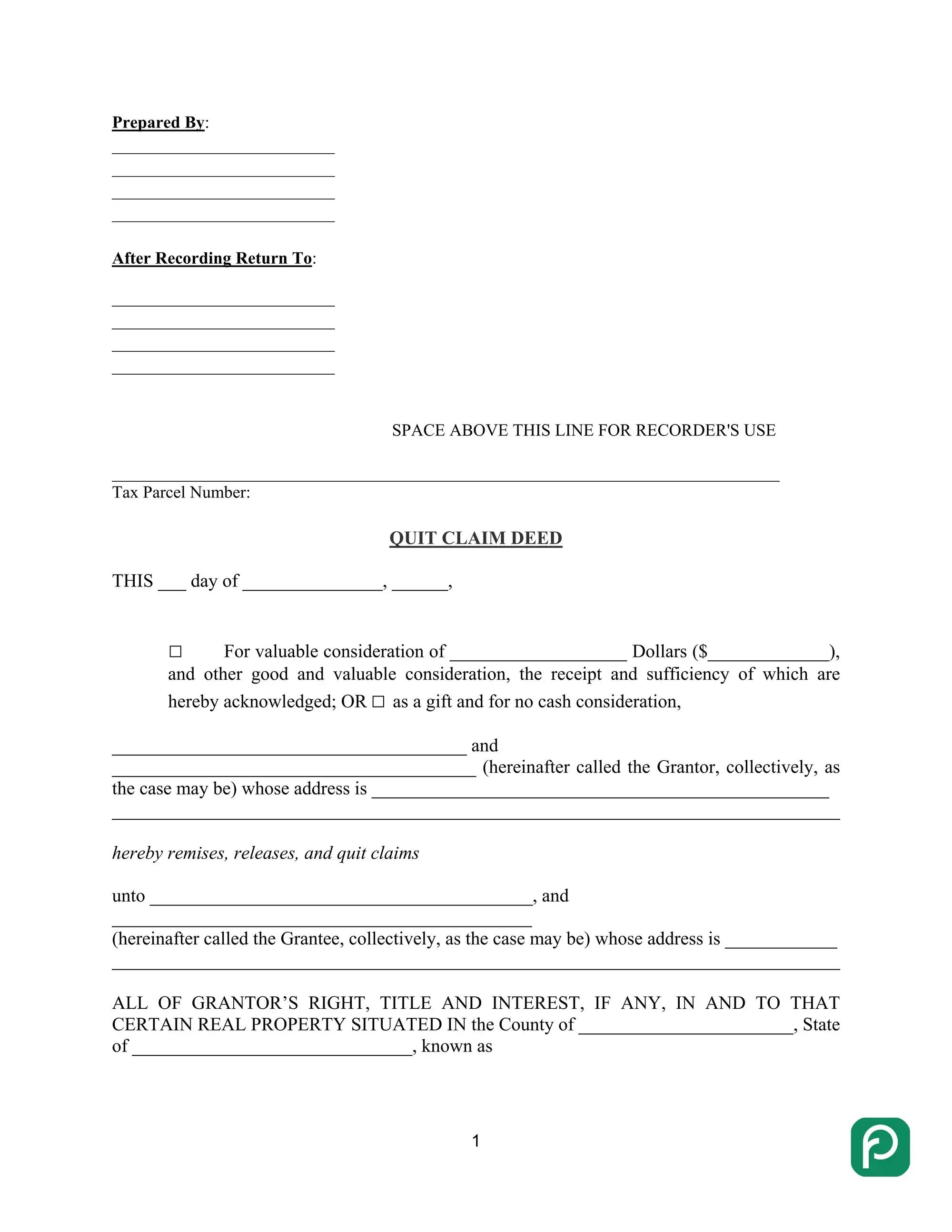
To prepare a Wisconsin quitclaim deed, fill in each part of the form, have it signed, and record it so the deed is protected against later buyers.[3] The steps below follow the order of our PDF, from the Prepared By line on page 1 to the acknowledgment block on page 5.
Fill in the form with the FormsPal online builder above, or complete the downloaded PDF with our online PDF editor.
The FormsPal Wisconsin form runs five pages, and each page has a clear job. Page 1 holds the recording details, the date, the consideration, and the names and addresses of grantor and grantee. Page 2 holds the parcel number, the legal description line, and the no-warranty and subject-to paragraphs.
Page 3 is left blank on purpose. Page 4 holds the signature block with two Witness lines for each grantor. Page 5 holds one acknowledgment block per grantor for a notary public.
Before you sign, check each name, the county and the parcel number against your records.
These short answers about the Wisconsin quitclaim deed come from the Wisconsin Statutes listed in the Sources section below. Each answer explains one rule in plain words and points to the section it comes from.
A quitclaim deed in Wisconsin does two things under the statutes:
No. The statute says a quitclaim deed shall not warrant or imply the existence, quantity or quality of the interest it passes.[1.1] Page 2 of our form repeats this by stating that the property is quit claimed without warranty of any kind.
An unrecorded conveyance can be void as against a later purchaser who bought in good faith for a valuable consideration and whose conveyance is recorded first.[3] Recording is what protects the deed against these buyers.
General information, not legal or tax advice.

Other Quitclaim Deed Forms by State
