
A Kansas quitclaim deed is a written document in which the grantor conveys to the grantee whatever interest the grantor holds in the land described. Under Kan. Stat. Ann. § 58-2204, such a deed is a good and sufficient conveyance in quitclaim when the grantor duly signs and acknowledges it.[1] The deed is common for moving real estate between family members, or into a trust or a company. You can download the free Kansas quit claim deed PDF below or build it online.
Last Updated: October 2026. This guide is reviewed and updated regularly to reflect current Kansas law. If you notice an error or outdated information, please contact us.
Build Your Document
Answer a few simple questions to make your document in minutes
Save and Print
Save progress and finish on any device, download and print anytime
Sign and Use
Your valid, lawyer-approved document is ready
Kansas sets out the wording of a quitclaim deed in Kan. Stat. Ann. § 58-2204. A deed in that wording, duly signed and acknowledged by the grantor, is a good and sufficient conveyance in quitclaim.[1] The recording of deeds is covered by § 58-2222.[2] For the general idea, see our guide to the right quitclaim deed form and our other free printable deed form options.
In plain words, a deed that follows the statutory wording is enough to convey the grantor's interest, once the grantor duly signs and acknowledges it.[1] The statute reads:
Any conveyance of lands, worded in substance as follows: a.b. quitclaims to c.d. (here describe the premises), for the sum of (here insert the consideration), the said conveyance being duly signed and acknowledged by the grantor, shall be deemed to be a good and sufficient conveyance in quitclaim to the grantee, his or her heirs and assigns.
The deed must be signed by the grantor, the party from whom the interest passes. The grantor must also acknowledge it, so the deed is notarized.[1] The signing works like this:
Kansas requires every deed to be subscribed by the party granting the land, or by that party's lawful agent or attorney (Kan. Stat. Ann. § 58-2209). The grantee does not sign.[3]
Once a deed is certified and recorded as the statute prescribes, filing it with the register of deeds gives notice to all persons of what it says. Later purchasers and mortgagees are treated as buying with notice.[2] The statute reads:
Every such instrument in writing, certified and recorded in the manner hereinbefore prescribed, shall, from the time of filing the same with the register of deeds for record, impart notice to all persons of the contents thereof; and all subsequent purchasers and mortgagees shall be deemed to purchase with notice.
Under Kan. Stat. Ann. § 58-2221, the acknowledged and certified deed may be recorded in the office of the register of deeds of the county where the land is situated. Ask that office what it needs before you go.[4]
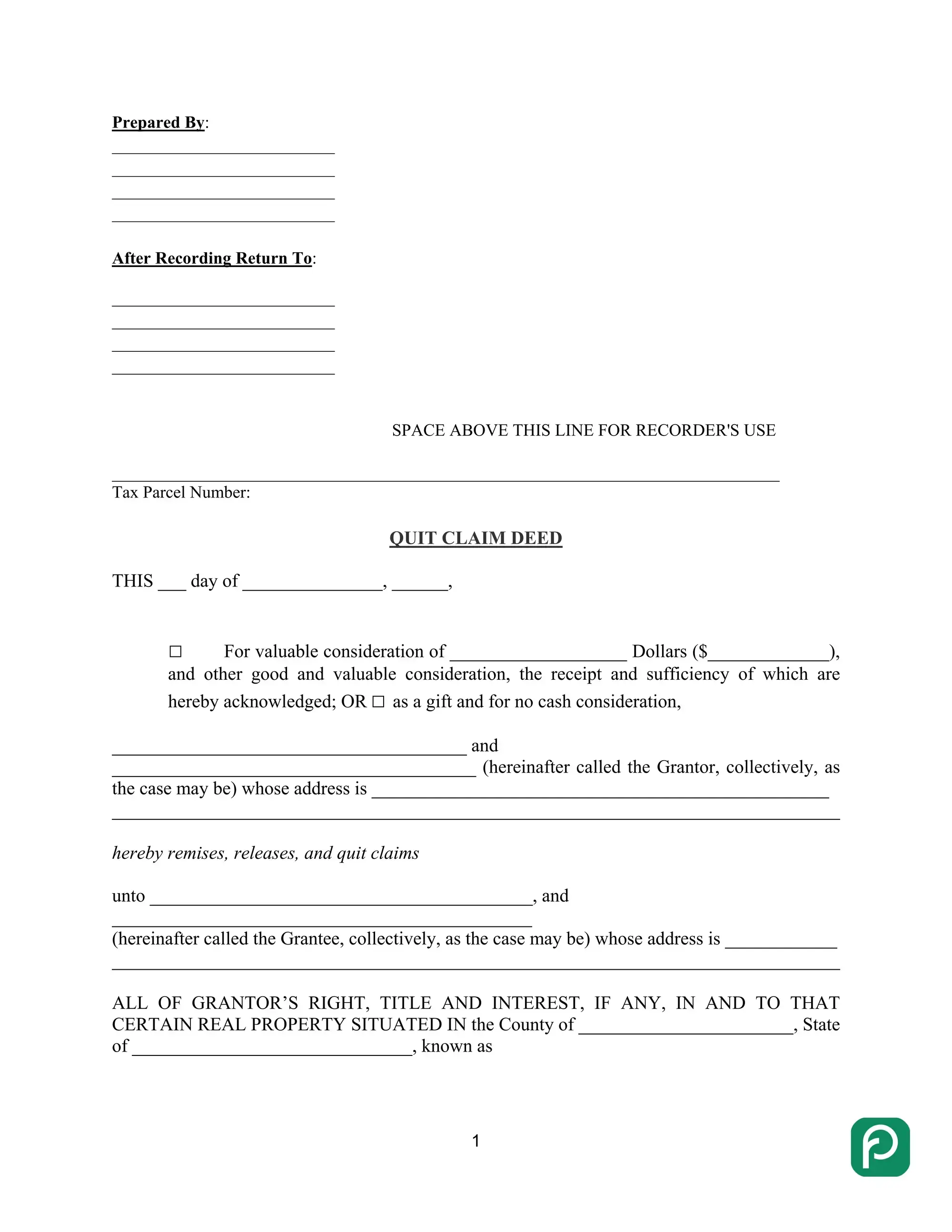
The Kansas quit claim deed form follows a fixed order. You fill in the recording and tax parcel blocks, the date and consideration, the grantor, the grantee and the property on pages 1 and 2. Then the grantor signs on page 4, and the notary completes the acknowledgment on page 5. The steps below take each part in that order.
After the deed is signed and acknowledged, file it with the register of deeds.[2] The After Recording Return To block on page 1 shows where the recorded deed should be sent back. You can also fill in the downloaded PDF online with our PDF editor. If you have doubts about your situation, ask a Kansas attorney.
These answers come straight from the Kansas statutes cited at the end of this page. They cover what the statutory wording does for a Kansas quit claim deed and whether the deed must be notarized.
A deed worded in substance like the statute's model is deemed a good and sufficient conveyance in quitclaim to the grantee, his or her heirs and assigns. The grantor must duly sign and acknowledge it.[1]
The statute describes the deed as duly signed and acknowledged by the grantor, which means it must be notarized.[1]

General information, not legal or tax advice.
Unless noted otherwise, the sources below are from the Kan. Stat. Ann.
