
An Idaho quitclaim deed is a written document in which the grantor releases all of their right, title and interest in a property to the grantee, the person receiving it. In Idaho, this type of deed is often used to move a property between family members or to clear up a title issue. Because a quitclaim deed form makes no promises about the title, the grantee takes on any title problem that comes up later.
Last Updated: October 2026. This guide is reviewed and updated regularly to reflect current Idaho law. If you notice an error or outdated information, please contact us.
Build Your Document
Answer a few simple questions to make your document in minutes
Save and Print
Save progress and finish on any device, download and print anytime
Sign and Use
Your valid, lawyer-approved document is ready
Idaho law sets five rules that matter when you use a quitclaim deed. They cover what the word "grant" implies, who signs the deed, how the signature is acknowledged, what the deed shows about the grantee, and what recording does for the deed.
Idaho Code 55-612 gives the word "grant" a legal effect. When a conveyance of an estate of inheritance, possessory right, or fee simple uses the word "grant," certain covenants (promises) are implied on the part of the grantor. They run to the grantee and the grantee's heirs and assigns, unless the express terms of the conveyance restrain them.
Together they work as a special warranty against the grantor, the grantor's heirs, and all persons claiming under them.[1]
Practice tip: the form says the property is quit claimed without covenant, representation or warranty of any kind. Because the word "grant" implies covenants of title in Idaho (Idaho Code 55-612), a quitclaim deed avoids it.[1]
Idaho Code § 9-503 says that, apart from transfers by operation of law, an interest in real property can be created, granted or assigned only by a written instrument. Leases of one year or less are the exception.[4]
The instrument must be signed in one of two ways:
Idaho Code 55-805 ties recording to acknowledgment. It reads:
Before an instrument may be recorded, unless it is otherwise expressly provided, its execution must be acknowledged by the person executing it.
In plain words, the person who signs the deed must acknowledge that they signed it before the deed can be recorded.[2] The last sheet of the form has a notary acknowledgment block for this purpose.
Idaho Code § 55-601 says the name of the grantee and the grantee's complete mailing address must appear on the instrument.[5] The form has a blank for each of them.
Idaho Code 55-812 covers every conveyance of real property except a lease for a term of one year or less. Such a conveyance is void as against any subsequent purchaser or mortgagee of the same property, or any part of it, who acts in good faith and for a valuable consideration. That applies when the subsequent purchaser or mortgagee records first.[3]
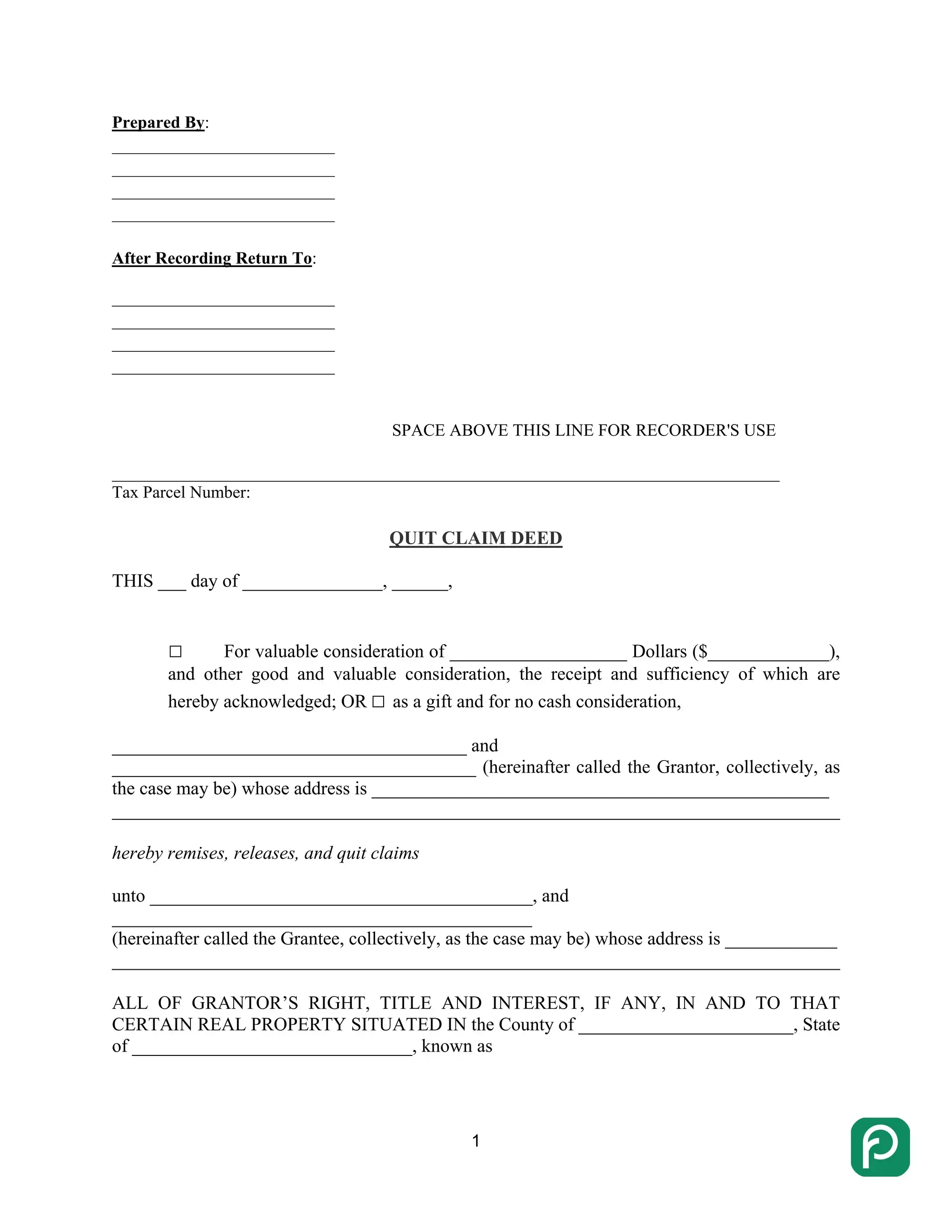
The form has five sheets. It says that the grantor remises, releases and quit claims all of the grantor's right, title and interest, if any, in the property to the person receiving it. The list below shows what each page holds.
The first of those two paragraphs says the property is quit claimed without covenant, representation or warranty of any kind. The second says it is quit claimed subject to easements, building and use restrictions, mineral rights, encumbrances, liens and covenants, whether recorded or unrecorded. It also says the receiving party assumes the assessments and taxes due before the date of the deed, so read both paragraphs before you sign.
Before you open the form, collect the details that its blanks ask for, so that you can complete the deed in one sitting without stopping to look up a parcel number or a mailing address.
To complete the Idaho quitclaim deed form, fill in the header, the date and consideration, the grantor, the grantee and the property, then sign. Download the PDF and fill it in with the PDF editor, or print it and fill it in by hand.
After the form is signed and acknowledged, the next step is recording. Record the deed with the county recorder of the county where the property is located (Idaho Code 55-808).[6]
These questions cover how to do the deed, what it must show about the person receiving the property, whether it must be acknowledged, and how it treats warranties. Each answer names the Idaho Code section behind it.
To do a quitclaim deed in Idaho, put the name of the grantee and the grantee's complete mailing address on the deed.[5] The owner signs it, or an agent signs for the owner if the agent's authority is in writing.[4] The numbered steps above walk through each part of the form in order.
Idaho Code § 55-601 says that the instrument must carry two details about the person who receives the property:
The form has a blank for each of them.
Yes, in the ordinary case, because Idaho Code 55-805 says that, unless the law expressly provides otherwise, the person who executes an instrument must acknowledge its execution before the instrument may be recorded.[2] The form has a notary acknowledgment block for each grantor.
Idaho Code 55-612 attaches implied covenants to a conveyance that uses the word grant,[1] but the form instead says the property is quit claimed without covenant, representation or warranty of any kind.

General information, not legal or tax advice.
