
A Louisiana quitclaim deed is a written document that transfers to the grantee whatever rights the grantor has in a property, without warranting that those rights exist.[2] It passes only the interest the grantor holds, so people commonly use it between family members or to settle a title question. You can download the free Louisiana quitclaim deed template below as a PDF, Word or OpenDocument file, or build it online.
Last Updated: October 2026. This guide is reviewed and updated regularly to reflect current Louisiana law. If you notice an error or outdated information, please contact us.
Build Your Document
Answer a few simple questions to make your document in minutes
Save and Print
Save progress and finish on any device, download and print anytime
Sign and Use
Your valid, lawyer-approved document is ready
The Louisiana Civil Code covers a quitclaim deed in four places. Article 2502 says what a transfer without warranty does. Article 1839 sets how a transfer of immovable property is made. Article 3338 covers recording, and article 3352 lists what the deed must show about the parties. For the general idea of the document, see our page on quitclaim deeds or browse the other deed form types.
Article 2502 of the Louisiana Civil Code is the rule behind the deed. In plain words, the deed passes all of the grantor's right, title and interest in the property it describes, unless the deed limits the grant. It conveys nothing more than the interest the grantor then holds. The statute reads:[2]
A person may transfer to another whatever rights to a thing he may then have, without warranting the existence of any such rights.
The same article sets out what follows from a transfer made this way:
Under article 1839, a transfer of immovable property (real estate) must be made by authentic act or by act under private signature. An authentic act is executed before a notary public and two witnesses.[1]
The Civil Code says the rights and obligations created by the written instruments it lists are without effect as to a third person unless the instrument is registered by recording it in the appropriate mortgage or conveyance records.[3] In plain words, recording is what protects the deed against third parties.
Article 3352 says an instrument must contain the full name, domicile (legal home) and permanent mailing address of the parties, when appropriate for its type and nature.[4]
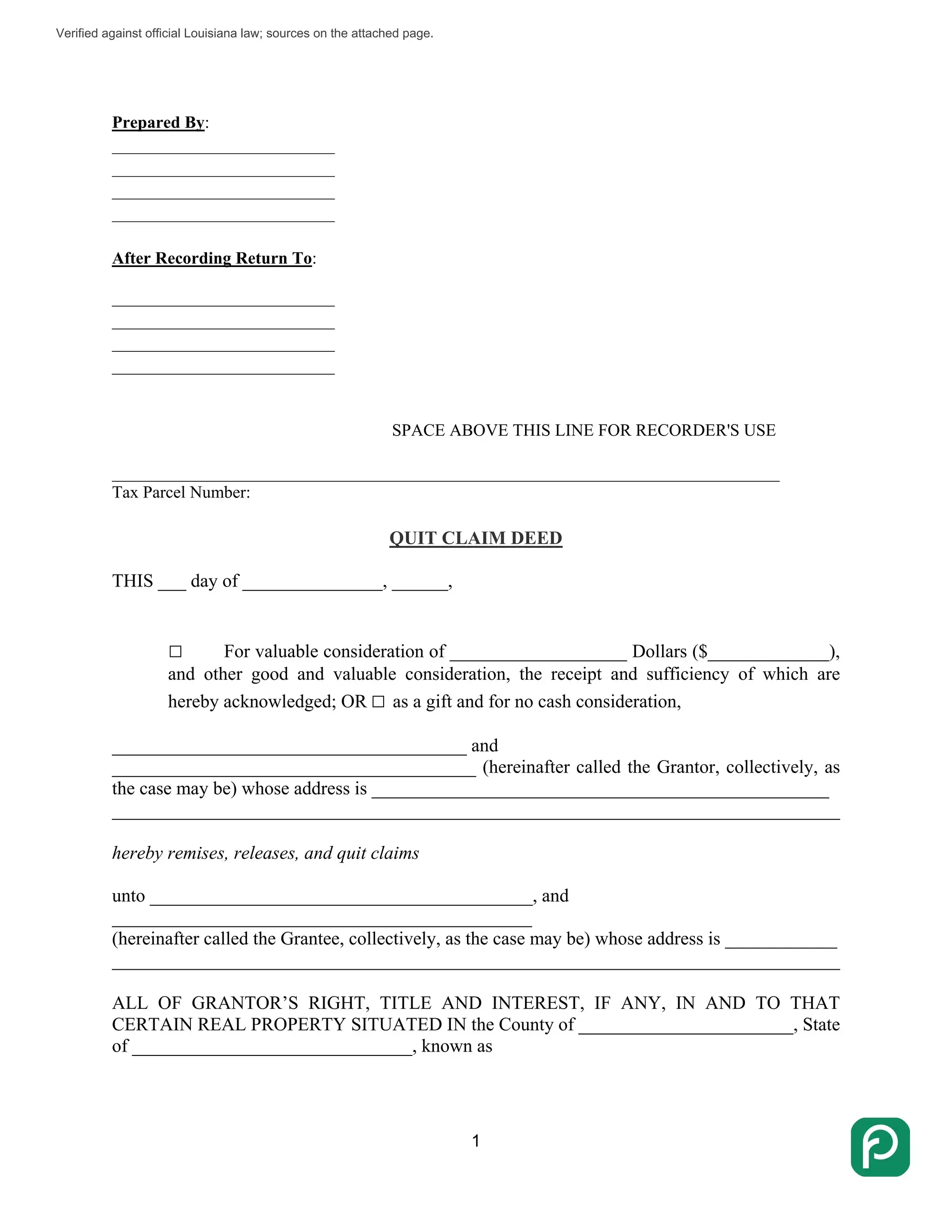
The Louisiana quitclaim deed form follows a fixed order. Page 1 holds the preparer, return address, tax parcel number, date, consideration, grantor, grantee and property. Page 2 holds the Parcel Id and the printed terms. The grantor signs on page 4, and the notary completes the acknowledgment on page 5.
After the deed is signed and acknowledged, record it in the appropriate mortgage or conveyance records.[3] You can also fill in the downloaded PDF online with our PDF editor.
This answer comes straight from the Louisiana Civil Code cited at the end of this page. It explains what a Louisiana quit claim deed is and what the transfer does and does not carry with it.
A quitclaim deed transfers whatever rights the grantor has in a property, without warranting that those rights exist. The transferor does not owe the price back if the transferee is evicted, and the transfer cannot be rescinded for lesion.[2]

General information, not legal or tax advice.
