
An Oregon quitclaim deed is a written document that transfers the grantor's interest in real estate to the grantee. The grantor is the person giving up the property, and the grantee is the person receiving it. The deed passes only the interest the grantor has on the date of the deed.[1.7] It implies no warranty or covenant, so the grantee gets no promise that the title is clear.[1.5]
Last Updated: October 2026. This guide is reviewed and updated regularly to reflect current Oregon law. If you notice an error or outdated information, please contact us.
Build Your Document
Answer a few simple questions to make your document in minutes
Save and Print
Save progress and finish on any device, download and print anytime
Sign and Use
Your valid, lawyer-approved document is ready
In Oregon, quitclaim deeds are often used when property is given to someone without a sale, such as within a family, or when a recorded title needs a correction. For example, a parent might use this form of deed to give a house to a child.
A quitclaim deed in Oregon passes the interest the grantor holds and nothing more.[1.3] The rules come from Chapter 93 of the Oregon Revised Statutes (Or. Rev. Stat.), which covers conveyancing. The sections below explain what the deed passes, how it is signed and acknowledged, and what a county clerk needs to see before recording it.
Under ORS 93.040, every instrument that transfers or contracts to transfer fee title to real property must include a prescribed land-use statement in its body, with owner's sale agreements and earnest money receipts carrying a different prescribed statement instead. The statutory quitclaim form places that statement right after the property description.[1.8]
A deed of quitclaim and release is enough to pass all the estate the grantor could lawfully convey by a deed of bargain and sale. In plain words, the grantor hands over every right, title, and interest they hold in the property described.[1.3]
A conveyance of real estate passes all of the grantor's estate, unless the deed shows that the grantor means to pass a lesser estate. That intent can appear in the express terms of the deed, or it can be necessarily implied in the terms of the grant.[1.4]
The deed conveys only the title or interest the grantor has at the date of the deed, and it does not operate as an estoppel:
A deed in the form of subsection (1) of this section shall have the effect of conveying whatever title or interest, legal or equitable, the grantor may have in the described property at the date of the deed but shall not transfer any title or interest which the grantor may thereafter obtain nor shall it operate as an estoppel.
If the grantor gets title to the property after signing, this deed does not pass that later title to the grantee.
Under Section 93.410 of the Or. Rev. Stat., a deed executed in Oregon for land or an interest in land must be signed by the grantors and acknowledged. An acknowledgment is the signer's formal statement, made before an authorized official, that the signature is their own. The deed must be acknowledged before any of these officials within the state:
No seal is needed on the deed. The statute says no seal of the grantor, corporate or otherwise, is required.[1.1] In practice, many people have a notary public complete the acknowledgment. The FormsPal form has the acknowledgment on page 5.
A county clerk or recording officer in Oregon may not accept for recording an instrument that conveys fee title to real estate. The exception is an instrument that carries the statement of consideration the statute requires on its face.[1.2] A deed that leaves that statement out can be turned away.
In practice, people take the signed and acknowledged deed to the county clerk in the county where the property is located. Recording puts the deed in the public record, which helps show who now holds the grantor's interest.
That statement gives the true and actual consideration paid for the transfer, in dollars, or notes that other property or value was given. Leaving it out does not invalidate the conveyance, but it keeps the deed from being recorded (ORS 93.030).[1.9]
Under ORS 205.130, the county clerk records, in a legible and permanent manner, all deeds of real property authorized by law to be recorded, once they are properly acknowledged or proved.[2.1]
The county clerk charges a per-page recording fee under ORS 205.320 plus the fixed recording fees under ORS 205.323, and collects them in advance.[2.2]
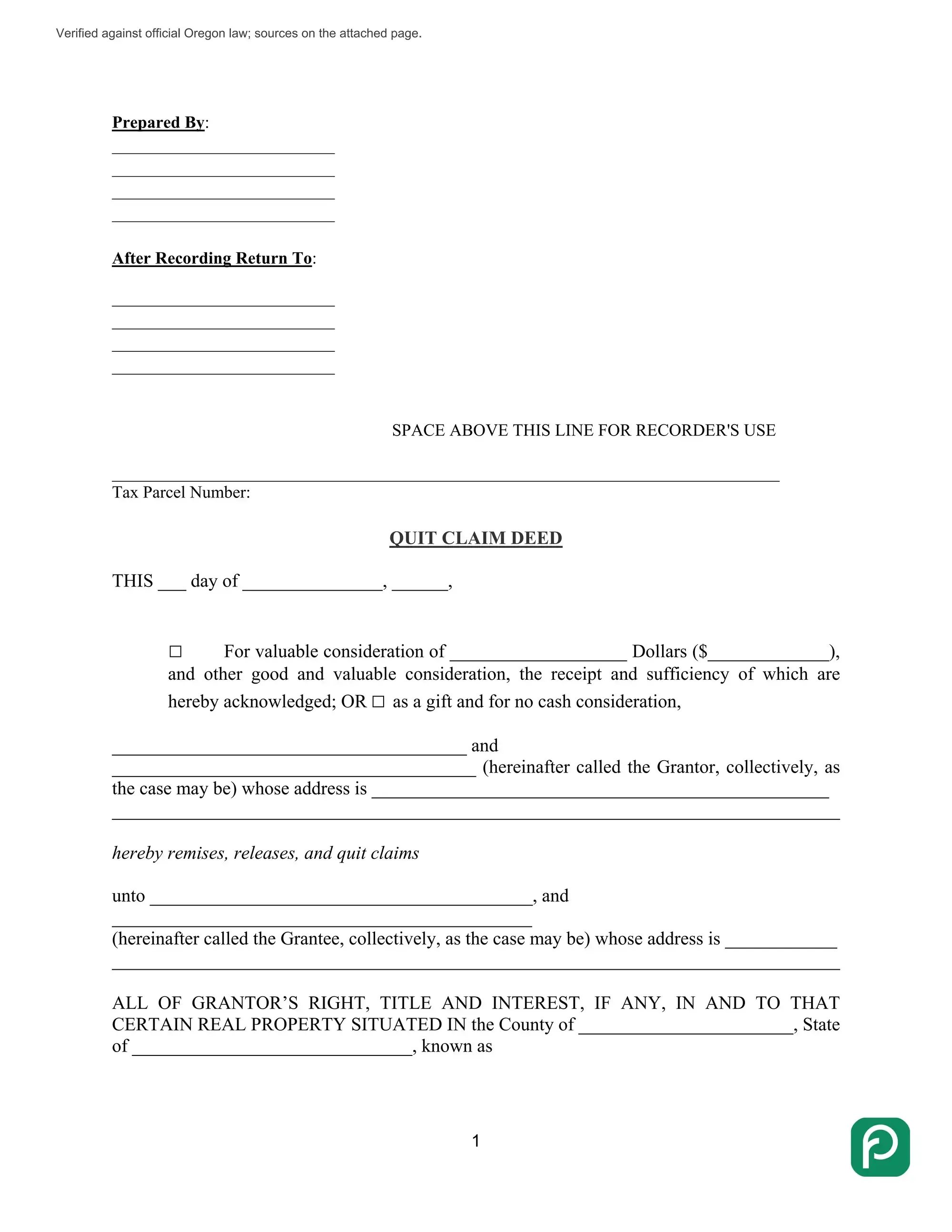
The FormsPal Oregon quitclaim deed form runs five pages. The fields are on pages 1, 2, 4, and 5, and page 3 is blank. Work through the parts below in the order they appear on the form. After you download the PDF, you can fill it in on screen with our PDF editor, or print it and write by hand.
The form asks for the details below. Gather them first, so you can complete the deed in one sitting and avoid blanks you have to fix later.
These answers come from the Oregon statutes on conveyancing, found in Chapter 93 of the Or. Rev. Stat. Each one states what the law provides for a quitclaim deed, and the full list of sections appears under Sources at the end of this page.
No. Oregon law says no covenant is implied in any conveyance of real estate, whether it contains special covenants or not, except as provided by ORS 93.850 to 93.870. In plain words, the deed implies no promise about the title beyond what those sections provide.[1.5]
Yes. A grantee who takes title by quitclaim deed is not denied the status of a good faith purchaser for value merely because the title came by that deed.[1.7]

General information, not legal or tax advice.
