
A Pennsylvania eviction notice is a written notice a landlord serves on a tenant to end the tenancy for nonpayment of rent, a lease violation, or without cause, before filing an eviction case in court. Pennsylvania law sets the notice period, the way the notice must be delivered, and what happens if the tenant does not act.
The Landlord and Tenant Act of 1951 governs these notices in Pennsylvania. The required notice period depends on the reason for eviction and the length of the lease, and using the wrong notice period can force the landlord to start the process over.
Build Your Document
Answer a few simple questions to make your document in minutes
Save and Print
Save progress and finish on any device, download and print anytime
Sign and Use
Your valid, lawyer-approved document is ready
Last Updated: September 2026. This guide is reviewed and updated regularly to reflect current Pennsylvania law. If you notice an error or outdated information, please contact us.
Pennsylvania eviction law comes from the Landlord and Tenant Act of 1951. A landlord may end a tenancy for nonpayment of rent, a lease violation, or without cause, and the required notice period depends on which of these applies and how long the lease runs. The notice may be served personally on the tenant, left at the main building on the property, or posted where the tenant will see it.[1.4]
| Rent Grace Period | Not specified |
| Notice of Non-Payment | 10 days[1.4] |
| Notice of Non-Compliance | 15 days[1.4] |
| No-Cause Notice (lease over 1 year) | 30 days[1.4] |
| State Law | Landlord and Tenant Act of 1951, 68 P.S. § 250.101 et seq.[1] |
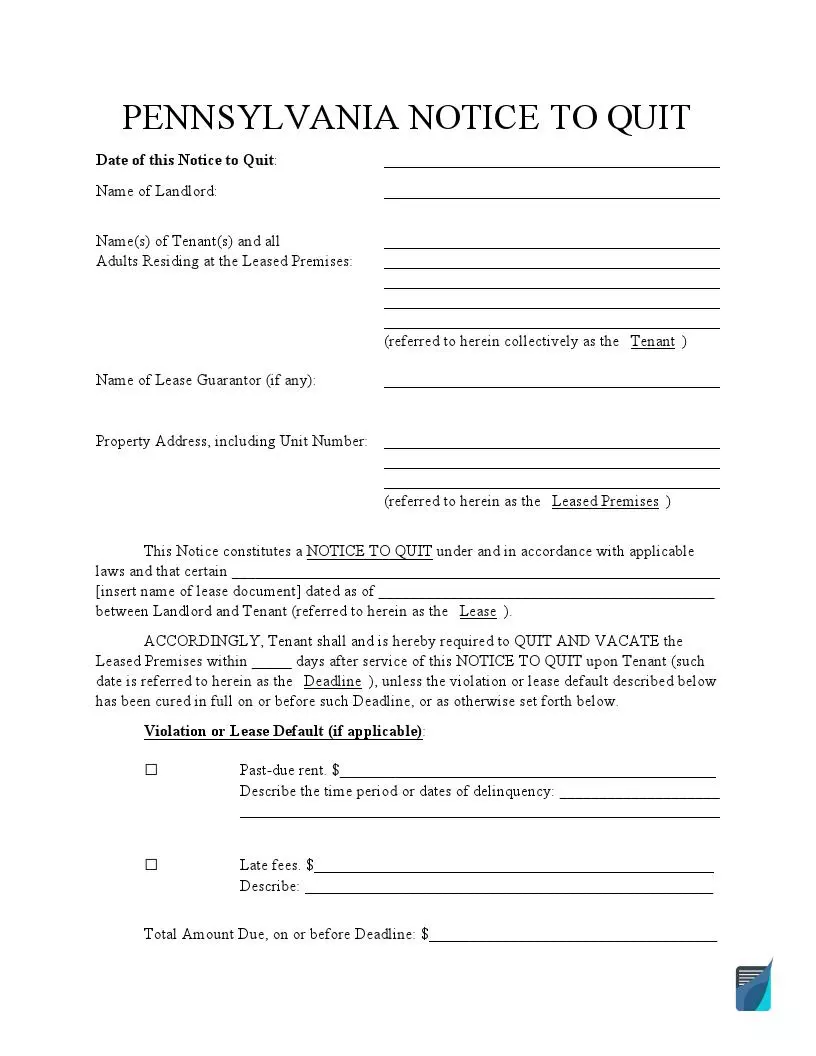
A Pennsylvania eviction notice is also called a notice to quit or a notice to vacate. All three names refer to the same document.
Pennsylvania treats mobile home space leases differently from apartment or house leases.[1.4]
A landlord or owner may not charge the tenant any fee, service charge, or additional rent for the tenant exercising the tenant's rights under this law, including serving a required notice.[1.7]
Pennsylvania recognizes several notice types for ending a tenancy, and the correct one depends on why the landlord is acting. A notice to quit ends the tenancy for nonpayment of rent or a lease violation. A notice of lease termination ends a month-to-month lease without cause. Other notices cover a tenant's death during the lease and a sublease.
Pennsylvania law also protects tenants from retaliation. A landlord may not end or refuse to renew a lease because a tenant, or a member of the tenant's family, took part in a tenants' organization.[1.2]
Pennsylvania eviction cases follow a set path: the landlord serves written notice, files a complaint if the tenant does not comply, gets a judgment from the court, and requests a writ of possession to remove the tenant. Each step has its own timeline set by state law.
A landlord may not dispose of, or take control of, a tenant's belongings left on the property without the tenant's express permission, and only a sheriff, constable, or writ server acting on a writ of possession may remove a tenant.[1.8] A landlord who violates this rule is liable for treble damages, attorney fees, and court costs.[1.8]
If the landlord is holding a tenant's abandoned property, the tenant has ten days from the postmark date of the notice to retrieve it, or to ask that it be stored for up to an additional thirty days.[1.8] When the landlord knows of a protection from abuse order for the tenant or a family member, the property must be held for thirty days from the notice before the landlord may dispose of it.[1.8]
Pennsylvania law also lets a landlord distrain, or seize, a tenant's property for unpaid rent in limited circumstances. A distress may happen on any day except Sunday, between seven in the morning and seven in the evening.[1.3] The landlord must give the tenant written notice of the distress, including the cause, the date, and the property taken, within five days of taking it.[1.3]
Pennsylvania law limits how much a landlord can require for a security deposit, sets rules for holding the money in escrow, and controls how and when it must be returned to the tenant. These rules apply only to residential rental property, not commercial leases.[1.9]
Within thirty days after the lease ends, the landlord must give the tenant a written list of any damages the landlord claims against the deposit.[1.11] A landlord who misses this deadline forfeits the right to keep any part of the deposit or to sue the tenant for damages to the unit.[1.11] If the landlord still owes the tenant money and does not pay the difference within thirty days of that deadline, the landlord owes the tenant double the amount owed.[1.11]
An eviction case in Pennsylvania moves through three main court documents once a landlord files a complaint. These are the summons that brings the tenant to a hearing, the judgment issued after the hearing, and the writ of possession that authorizes the tenant's removal.

No. Pennsylvania law requires at least ten days written notice before an eviction for nonpayment of rent, not five.[1.4] The notice period is shorter for some other situations, such as fifteen days for a lease violation on a short-term lease, but no Pennsylvania eviction notice is as short as five days.
This page is general information about Pennsylvania eviction notices, not legal advice. For advice on your situation, talk to a Pennsylvania landlord-tenant attorney.