
A Wyoming living will is a written document that lets you record your wishes for medical treatment if you become unable to communicate them yourself. It is part of the state’s Advance Health Care Directive. That directive also lets you name a health care agent, sometimes called a medical power of attorney, to make decisions for you.
Last Updated: September 2026. This guide is reviewed and updated regularly to reflect current Wyoming law. If you notice an error or outdated information, please contact us.
The living will takes effect once it is given to your attending physician. At that point, you must be determined, in writing, to be in a terminal condition or a state of permanent unconsciousness with no reasonable expectation of recovery.
Having both a living will and a named health care agent is recommended. Together they cover your treatment preferences even if you cannot state them yourself.
For example, Anna Baker could use a Wyoming living will to state that she does not want to be kept on life support if she is ever in a permanent coma with no reasonable expectation of recovery. She could also name her sister as the health care agent who can make other decisions doctors need answered quickly.
Any adult Wyoming resident can benefit from having one. This is especially true if you want a say in your own end-of-life care, or want to spare your family from having to guess what you would have wanted.
In Wyoming, a living will and health care power of attorney are governed by Title 35 of the Wyoming Statutes, the state’s public health and safety code. It sets out the signing, witnessing, and revocation rules you must follow for the document to be legally valid.
To create a legally valid living will in Wyoming, you must meet these signing requirements:
Wyoming law also restricts who can serve as a witness. None of the following may act as a witness for a power of attorney for health care:[1.3]
It’s a good idea to complete your living will while you are clearly of sound mind. Give copies to your physician and your health care agent so your wishes are on hand if they are ever needed.
Under Wyoming law, you may revoke your living will at any time, regardless of your mental or physical condition. If you revoke it orally, the revocation must be put in writing and signed and dated by you or by a witness to the revocation, as soon as possible afterward.[2]
| Document Name | Wyoming Advance Healthcare Directive |
| State Form Name | Wyoming Advance Healthcare Directive |
| Signing Requirements | Two Witnesses or Notary Public |
| Validity Requirements | W.S. 35-22-403 |
| State Laws: Wyo. Stat. Ann. §§ 35-22-403 to 35-22-404 | |
Popular Local Living Will Forms
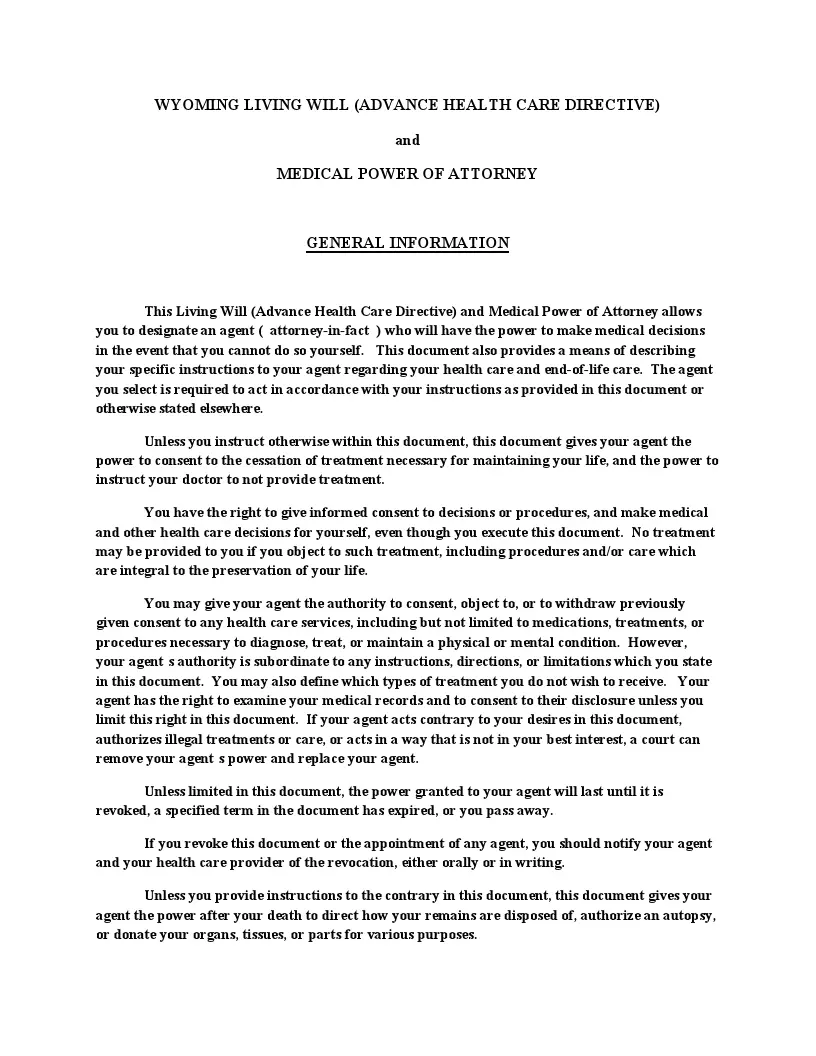
These steps walk you through the Wyoming living will and health care power of attorney form, in the order the form itself presents them. You can fill in the downloaded PDF using our online PDF editor as you follow along, from the declaration on page 2 through the witness acknowledgment on page 8.
Most problems with a Wyoming living will come from avoidable mistakes made during signing, not from how the document is worded. Here are the mistakes people run into most often when completing and signing this form.

A Wyoming living will is a legal document that records the medical treatments you want, or do not want, if you become unable to communicate your wishes. It is combined with a health care power of attorney in the state’s Advance Health Care Directive. The same form also lets you name someone to make decisions on your behalf.
Yes, under Wyoming law an oral revocation of a living will must be put in writing as soon as possible after the revocation. It must be signed and dated by either you or a witness to the revocation.[2] Putting it in writing protects you if your wishes are ever questioned. It also gives your physician and health care agent clear, dated evidence that your earlier instructions no longer apply.
General information, not legal or tax advice.
Unless noted otherwise, the sources below are from the Wyo. Stat. Ann..
