
Updated:
A Colorado last will and testament is a written document that lets a testator name an executor and direct how their property is distributed after death. Colorado recognizes it as valid once it meets the state’s writing, signing, and witness or notarization rules.
A printable and fillable Colorado last will and testament template is available in PDF and DOC format on this page, together with instructions for writing it correctly. You can also use our online document builder for a more personalized approach.
Build Your Document
Answer a few simple questions to make your document in minutes
Save and Print
Save progress and finish on any device, download and print anytime
Sign and Use
Your valid, lawyer-approved document is ready
Colorado law sets specific rules for a valid last will in Colo. Rev. Stat. § 15-11-502.[1] Under Colo. Rev. Stat. § 15-11-502, the document must be in writing and signed by the testator, or in the testator's name by another individual in the testator's conscious presence and by the testator's direction.[1] If the will is not wholly in the testator's handwriting, Colo. Rev. Stat. § 15-11-502 requires it to be signed by at least two witnesses or acknowledged by the testator before a notary public or other individual authorized by law to take acknowledgments. The table below summarizes these requirements alongside the state's other formalities.
| Requirements | State laws | |
| Statutes | Title 15: Probate, Trusts and Fiduciaries, Article 11: Intestate Succession and Wills | |
| Definitions | 15-10-201. General definitions | |
| Signing requirement | Two witnesses OR a notary public | 15-11-502. Execution: witnessed or notarized wills, holographic wills |
| Age of testator | 18 and older | 15-11-501. Who may make a will |
| Age of witnesses | 15-11-505. Who may witness | |
| Self-proving wills | Allowed | 15-11-504. Self-proved will |
| Handwritten wills | Recognized if meeting certain conditions | 15-11-502. Execution: witnessed or notarized wills, holographic wills |
| Oral wills | Not recognized | |
| Holographic wills | Recognized if meeting certain conditions | |
| Depositing a will | Some courts accept a will for safekeeping during the testator's lifetime | 15-11-515. Deposit of will with court in testator’s lifetime |
Colorado also recognizes a handwritten (holographic) will as valid without any witnesses, as long as the signature and the material portions of the document are in the testator's own handwriting.[1] A typed template like this one still needs the standard witness or notary steps above.[1]
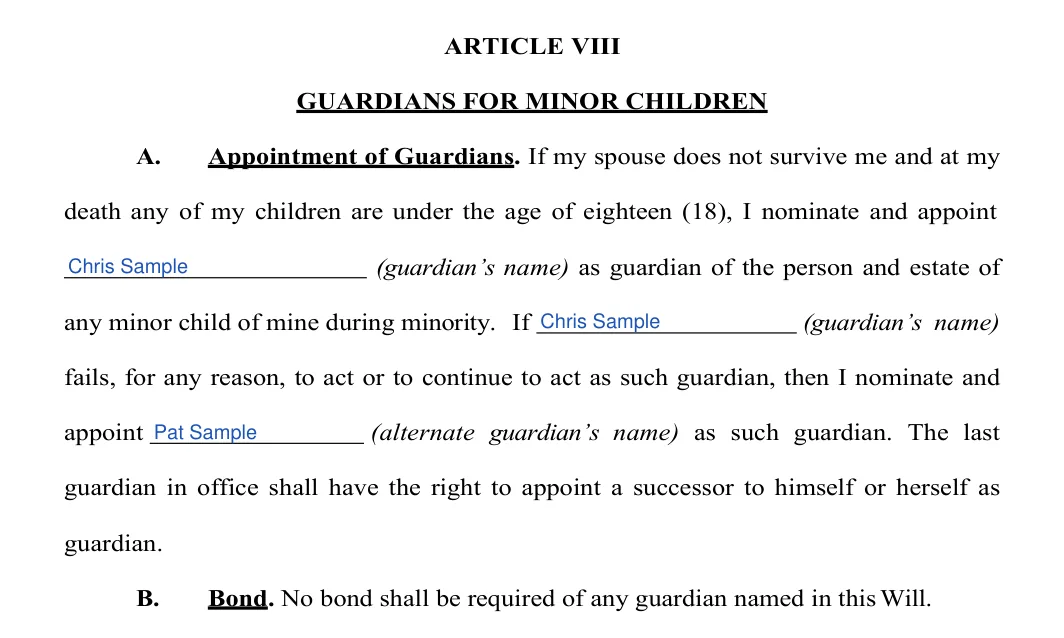
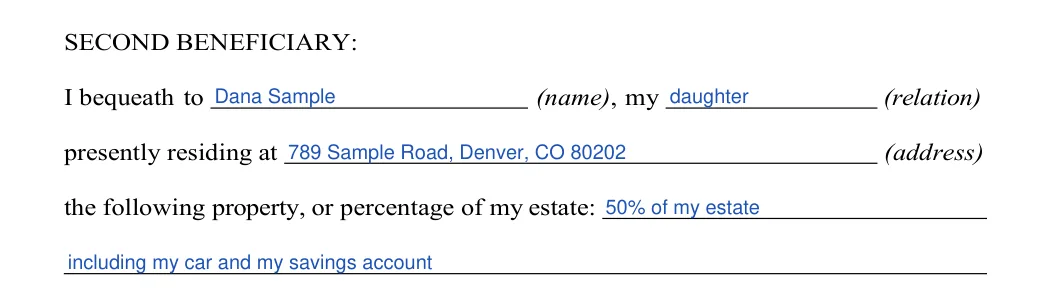
The screenshots under each step show the FormsPal Colorado last will and testament template filled with sample entries in blue, so you can see where each answer goes. The names, addresses, dates and amounts are examples only.
Follow the steps below to fill out a Colorado last will and testament, from choosing between an attorney and a DIY template to signing the finished document in front of witnesses or a notary. Each step maps to a section of the template you will find further down this page.
Consider your possible choices. Decide whether or not you prefer to seek the services of attorneys or write your will by yourself (either by handwriting it or using a free last will and testament form).
Specify your information. Establish the testator and their details: full name and residence (city, county, and state). Go over the remaining part of the passage, including the information you have written along with the “Expenses and Taxes” subsection.
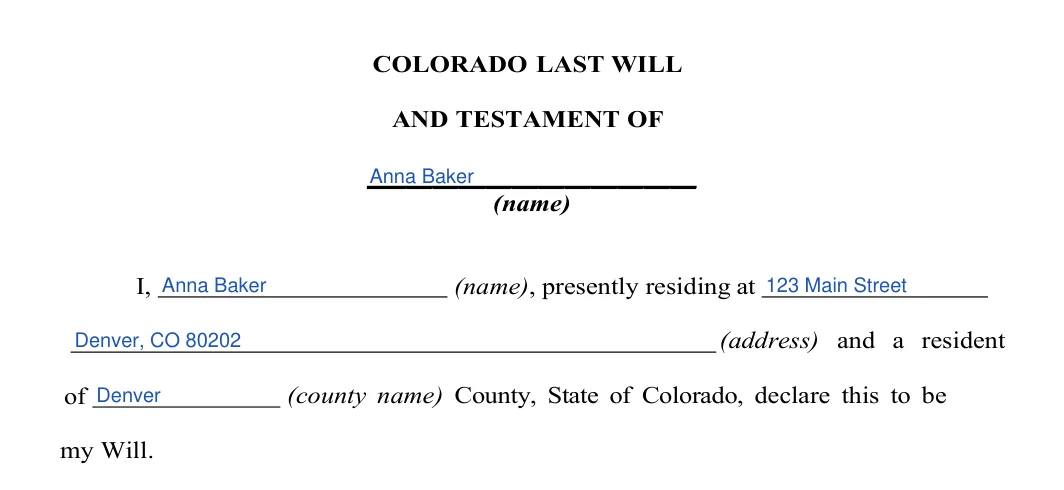
Establish the executor. Decide on the executor of your last will, the person responsible for carrying out the instructions in this document. Enter the executor’s full legal name and their city, county, and state of residence.
Colorado disqualifies as personal representative only a person under the age of twenty-one or a person the court finds unsuitable in formal proceedings (Colo. Rev. Stat. § 15-12-203(6)), so an executor who lives in another state may serve. It is not required, but naming a backup executor is a good idea in case the first one is unwilling or incapable of executing your will.
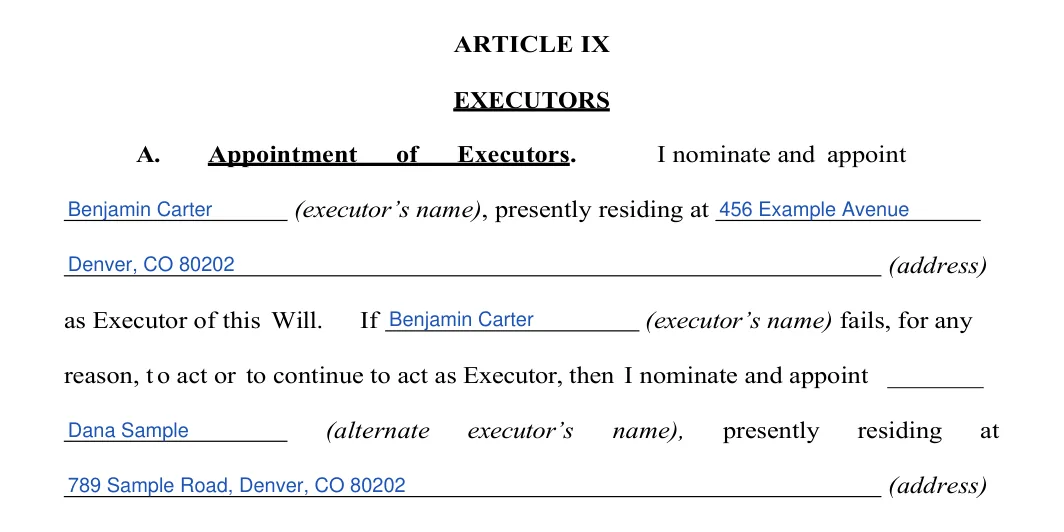
Determine the guardian (optional). You can choose a trusted person as a guardian in the event that you’ve got minor or dependent children that need to be taken care of. In practice, a court chooses the guardian when the will names none.
Specify your beneficiaries. This is where you indicate people who are going to receive your property. For every named beneficiary, enter the next particulars: full name, address, and how they are related to you.
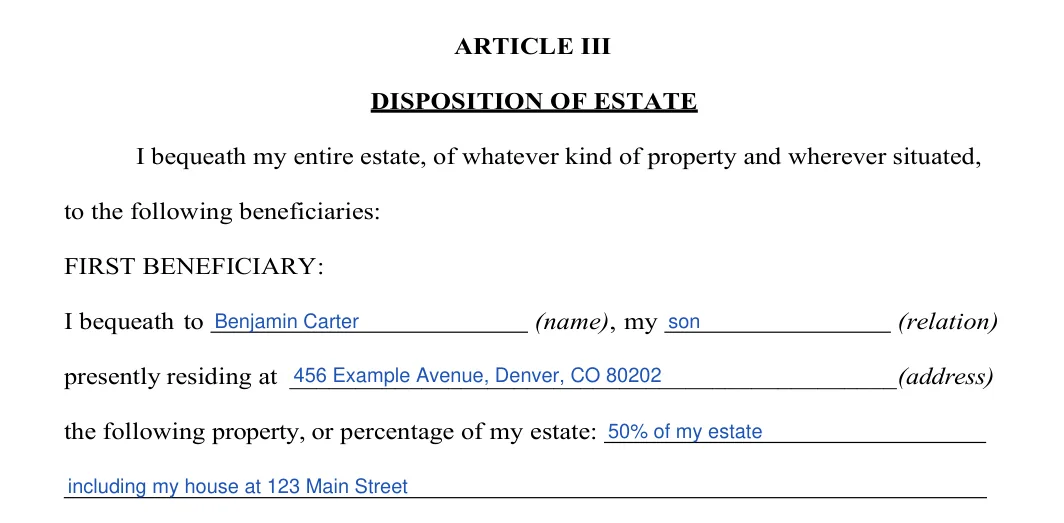
Allocate property. In the event that you have an asset distribution on your mind that is not proportional, you’ll be able to explain it within this part. Assets could include money for unresolved arrears, realty, stocks, company control, cash, and any physical items of commercial worth that count among your possessions. Life insurance, accounts with a named beneficiary and assets held in a trust pass by their own terms outside the will: Colo. Rev. Stat. § 15-15-101(1) makes a transfer on death provision in an insurance policy, account agreement or trust nontestamentary. A living will is a health care document and holds no property.
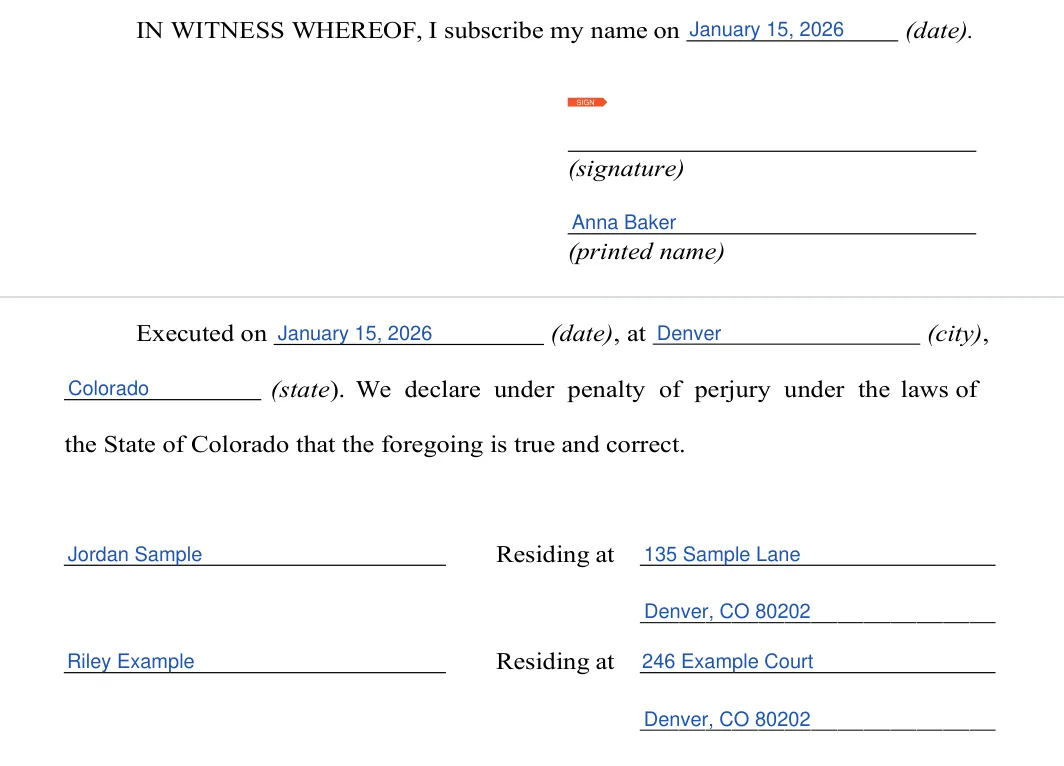
Ask witnesses to sign the document, or use a notary. Colorado Revised Statutes require at least two witnesses to sign a last will and testament for it to be legally binding, or the testator can acknowledge the will before a notary public instead.[1] In practice, choose adult witnesses who take nothing under the will.
It also helps to choose a witness younger than you, so they are more likely to still be around if your will is ever contested. After you review every section of your last will and testament, all parties involved, you and the two witnesses, or you and the notary, must print their full names and addresses and sign the document.

Colorado law does not require every will to be notarized, but it accepts notarization as an alternative to witnesses. A will becomes valid once it is signed by at least two witnesses, or once it is acknowledged by the testator before a notary public or other individual authorized by law to take acknowledgments instead.[1]
No, if the will is not wholly in the testator's handwriting, Colo. Rev. Stat. § 15-11-502 accepts either the signatures of at least two witnesses or acknowledgment before a notary public.[1] Beyond that execution choice, many testators also add a notarized self-proving affidavit to a witnessed will. A self-proving last will can make probate quicker since the court can recognize it without getting in touch with the witnesses who signed it.
No, only you (as the testator) can change your last will and testament. Colo. Rev. Stat. § 15-11-502(1)(b) lets another individual sign the will in your name, but only in your conscious presence and by your direction, and that signature is not a power to change the will.
Yes, you can modify your last will at any time.
Colo. Rev. Stat. § 15-11-507(1)(b) counts burning, tearing, canceling, obliterating, or destroying the will or any part of it as a revocatory act; a codicil or a new will changes it.
You should also consider amending it after a major life event.
A lost original will can be hard to prove in probate. Keep the signed original in a safe place, and tell your executor where it is.
| Related documents | When to make it |
| Codicil | Your will needs one or a number of small adjustments. |
| Self-proving affidavit | You would like to save time and legal fees for your witnesses. |
| Living will | You would like to establish precisely what health care you want if you’re unable to communicate that yourself. |
| Living trust | You would like to avoid probate by putting your assets in a trust. |
Need a last will and testament template for a different state? Browse the state-specific forms below. Each one is built to match that state's own witness, notarization, and signing rules, so you are not stuck reusing Colorado's requirements somewhere else.
This page is general information about Colorado last wills, not legal advice. For advice on your situation, talk to a Colorado attorney.
