
A Kansas durable power of attorney is a written document that lets a principal appoint an agent, called an attorney in fact, to handle financial and property matters. Under Kansas law, the authority granted in the power of attorney is not terminated if the principal becomes disabled, as long as the document meets the statute's conditions for durability.[1]
This form only covers financial and property decisions. It has nothing to do with health care. For medical decisions, you need a separate power of attorney form.
Kansas power of attorney forms – click to get more Kansas-related power of attorney documents that you might use.
Build Your Document
Answer a few simple questions to make your document in minutes
Save and Print
Save progress and finish on any device, download and print anytime
Sign and Use
Your valid, lawyer-approved document is ready
When creating a DPA, you may choose the trusted person who will be responsible for your financial affairs from either professional agents or your family members. It can be your husband or wife, brother or sister, a child, or another relative.
The form is described as “durable” because, if it meets the statute’s conditions, the authority it grants is not terminated even if you later become disabled.[1] You may also call the form off if needed and create a new one.
The rules used to complete a DPA and the template vary from state to state in the US. Most states require notarization of the DPA form, and some also require witnesses. One of the key conditions in every state is that all the signatories should be of sound mind.
Last Updated: September 2026. This guide is reviewed and updated regularly to reflect current Kansas law. If you notice an error or outdated information, please contact us.
A Kansas durable power of attorney must be signed by the principal, dated, and notarized in the manner the state’s notarial acts law prescribes.[1] To survive the principal’s incapacity, it must also be denominated a durable power of attorney and include the statute’s required durability language.
Kansas law sets specific conditions for a power of attorney to remain in effect after the principal becomes disabled. It must be denominated a durable power of attorney and include a provision that states, in substance, one of two model clauses the statute sets out.[1]
"This is a durable power of attorney and the authority of my attorney in fact shall not terminate if i become disabled or in the event of later uncertainty as to whether i am dead or alive."
The principal must sign the power of attorney and have it notarized in the manner the state’s notarial acts law requires.[1] If the principal is physically unable to sign but is otherwise competent and conscious, an adult the principal designates may sign instead. This must happen in the principal’s presence, at the principal’s specific direction, in front of a notary public.[1] A notary public completes the acknowledgment that makes the notarization valid.
Kansas does not require you to use a state-issued form. Under Kan. Stat. Ann. § 58-652, a power of attorney executed on or after July 1, 2021 shall be deemed sufficient if it is in substantial compliance with the form set forth by the judicial council.[1]
Kansas law does not require a power of attorney to be recorded for it to be valid and binding. This is true both between the principal and the attorney in fact, and between the principal and third persons.[1] Recording matters most for real estate transactions, where a county register of deeds may keep a copy on file with the property records.
If the document expressly says so, it can take effect later instead of immediately. For example, it may start on a specific future date, when a specified event happens, or when a specified condition arises.[1] Without actual knowledge to the contrary, a person given the power of attorney may rely on the attorney in fact’s affidavit that the triggering event or condition has occurred.[1]
A person appointed attorney in fact under a durable power of attorney has no duty to exercise that authority. The exception is when the attorney in fact has agreed expressly in writing to act for the principal in those circumstances.[1]
Similar to other states in the US, the DPA form in Kansas allows your agent or attorney to act on your behalf in many different cases, such as:
And other actions.
If you want to, all points of the list can be chosen. Those who are going to create and sign such a form should realize the importance of it and read all the responsibilities carefully. Take some time to understand every sentence and clarify if something is vague and unclear.
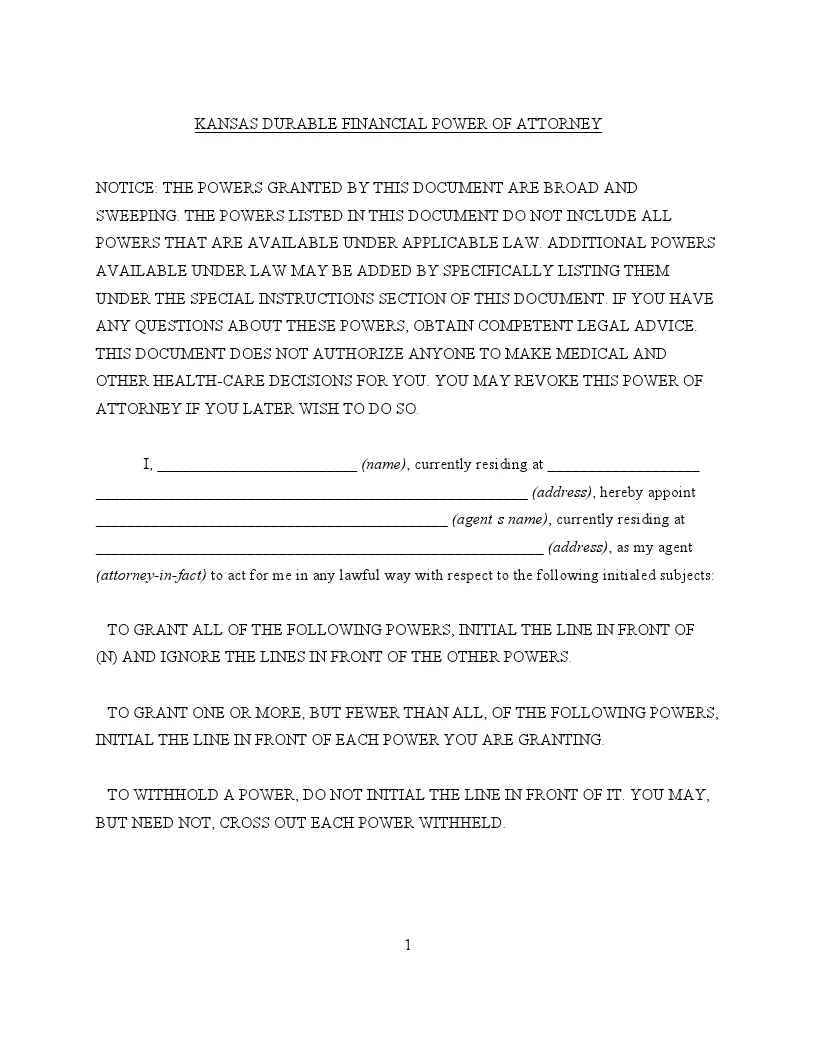
You may want to prepare a few copies of the signed form for your agent and any institutions that will rely on it. Also, remember that Kansas law requires notarization for the DPA to be valid.[1] The form template in Kansas is eight pages long, with 37 fillable fields across its first 5 pages.
| Document Name | Kansas Durable Power of Attorney Form |
| Other Names | Kansas Financial Durable Power of Attorney, KS DPOA |
| Relevant Laws | Kan. Stat. Ann. § 58-652 |
| Signing Requirements | Notary Public (Notarization) |
| # of Fillable Fields | 37 |
| Available Formats | Adobe PDF |
Popular Local Durable POA Forms
DPOA forms enable you to appoint an agent who can take care of your financial matters even in case you end up incapacitated. These are the states DPOA forms are used in most regularly.
Yes. Kansas law requires a durable power of attorney to be signed by the principal, dated, and acknowledged in the manner the state’s notarial acts law prescribes, which means it must be notarized.[1]
How you revoke a Kansas power of attorney depends on whether it was recorded. If the power of attorney was not recorded, you may revoke it with a recorded revocation or in any other appropriate manner.[1] If it was recorded, the revocation must be recorded in the same manner for the revocation to be effective.[1]
Termination of the agent’s authority is not effective against someone who acts in good faith under the power of attorney. This protection applies as long as that person has no actual knowledge or notice of the revocation.[1] If a power of attorney requires notice of revocation to named persons, those persons may keep relying on it until they receive that notice.[1]
To make it easier for you, we built a step by step guide that walks through each part of the Kansas durable power of attorney form, in the order the form presents them. Follow the numbered steps below to complete every section correctly.


Download the free, printable Kansas durable power of attorney form below as a fillable PDF. You can also build a customized version online, save it, and print it once you have signed and notarized it.
This page is general information about Kansas durable power of attorneys, not legal advice. For advice on your situation, talk to a Kansas attorney.